A data‑driven look at hiring trends for software and AI engineers in 2026, with regional breakdowns, company‑level insights, and practical advice for candidates and recruiters.
State of the Software Engineering Job Market in 2026
By Gergely Orosz & Jessica Salmon
May 26 2026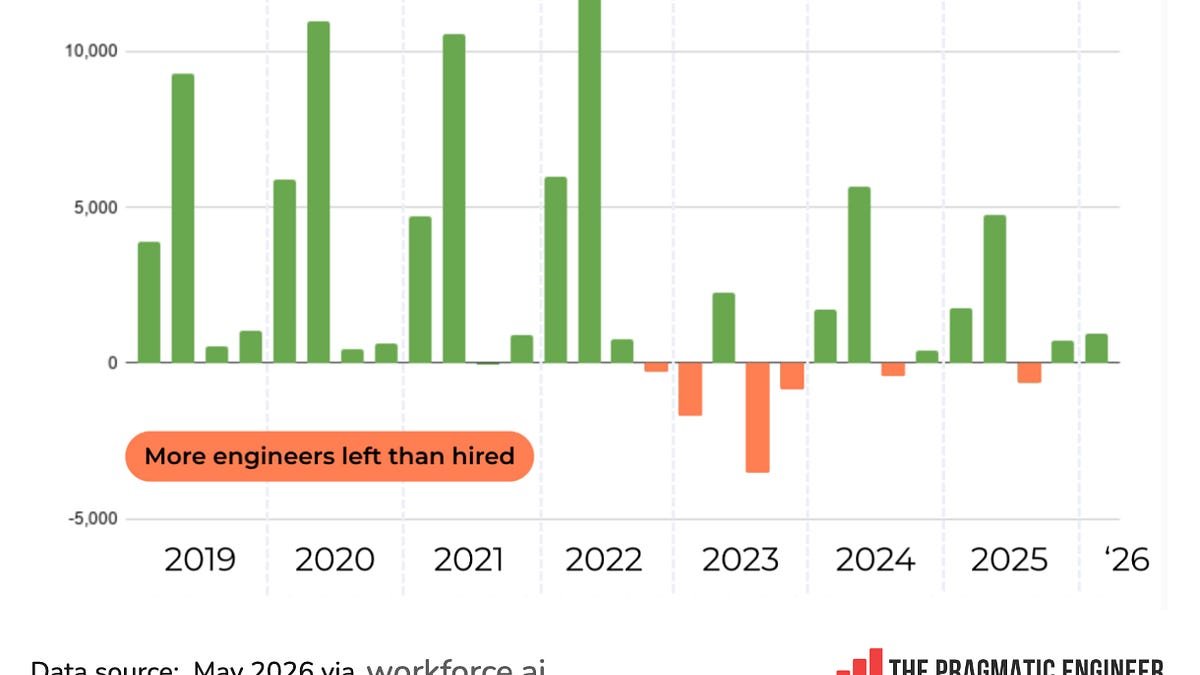
What’s new?
- Software‑engineer postings are up in the US and UK but down in Germany and France.
- Apple, Amazon and IBM now lead the list of companies with the most open software‑engineer roles.
- AI‑engineering jobs have exploded – Apple, Google and TikTok each list 50‑100 % more AI positions than a year ago.
- Fintech, observability and security firms are the fastest‑growing hiring hubs.
These headlines come from two fresh data sources that we combined for the first time:
- TrueUp – a scraper that indexes every open role at the highest‑paying “top‑tier” tech firms (Big Tech, top‑scale‑ups, fintech unicorns).
- Workforce.ai – a live‑data platform that watches >1 M job‑change signals and validates >300 M employment records each month.
Both services give us a near‑real‑time view of where talent is flowing, which is why the numbers below feel more reliable than the usual quarterly reports.
Why it matters
1. The paradox of “hard‑to‑hire, hard‑to‑get‑responses” is easing
Last year many engineers complained that their applications vanished into a black‑hole, while hiring managers said they couldn’t fill roles. The new data shows a modest reversal: the net growth of software‑engineer profiles (Workforce.ai) turned positive in Q2 2026 after three years of decline, and the number of active postings on major aggregators (Indeed) is up 7 % year‑over‑year in the US.
2. AI skills are becoming a baseline requirement
AI‑engineering listings have risen dramatically, but they are not displacing traditional software roles. Instead, many job ads now list “experience with ML pipelines, LLM prompting or vector databases” as required for a generic software‑engineer position. Candidates who can demonstrate a working knowledge of TensorFlow 2.14, LangChain 0.2, or the new OpenAI Assistants API will have a clear edge.
3. Regional hiring asymmetry
The US and UK are the only two countries where software‑engineer vacancies are still climbing. Canada is flat, while Germany and France have slipped 4‑6 % over the past 12 months. This suggests that U.S.–headquartered firms are continuing to offshore talent to the US/UK, while European‑based firms are tightening budgets amid slower consumer‑tech spend.
How to use it – practical takeaways
For recruiters
| Action | Detail |
|---|---|
| Refresh job titles | Add “AI‑enabled” or “ML‑focused” to existing software‑engineer listings. Tools like Greenhouse 3.12 let you bulk‑edit titles via CSV import. |
| Target fast‑growing sectors | Fintech (Ramp, Stripe), observability (Datadog, New Relic) and security (Wiz, CrowdStrike) posted >50 % more openings YoY. Use their public career pages as a source for candidate pipelines. |
| Adjust sourcing windows | Workforce.ai shows the bulk of hires happen March‑June. Schedule campus and hackathon outreach in February‑March to hit the budget‑allocation window. |
| Leverage AI‑assisted screening | Deploy HireVue AI‑Screen to score candidates on both coding fundamentals and ML concepts, reducing manual triage time by ~30 %. |
For job‑seekers
- Polish your AI toolbox – Even if you’re a backend engineer, add a section for “ML Ops” with tools like MLflow 2.8, Kubeflow Pipelines, and LangChain. Mention any production LLM deployments you’ve touched.
- Geography matters – If you’re based in Europe, consider remote roles at US firms; they often list “US‑based remote” as a location option. TrueUp’s API (see docs here) can be queried for “remote‑US” postings.
- Timing your applications – Aim for the first two weeks of March or early April. The hiring‑budget data shows that most firms have allocated headcount by then and start posting aggressively.
- Show impact with numbers – Instead of “worked on an AI feature”, write “built an LLM‑powered search service that reduced query latency by 42 % and increased conversion by 3.5 %”. Recruiters love quantifiable outcomes.
Deep dive into the numbers
Software‑engineer recruitment trends
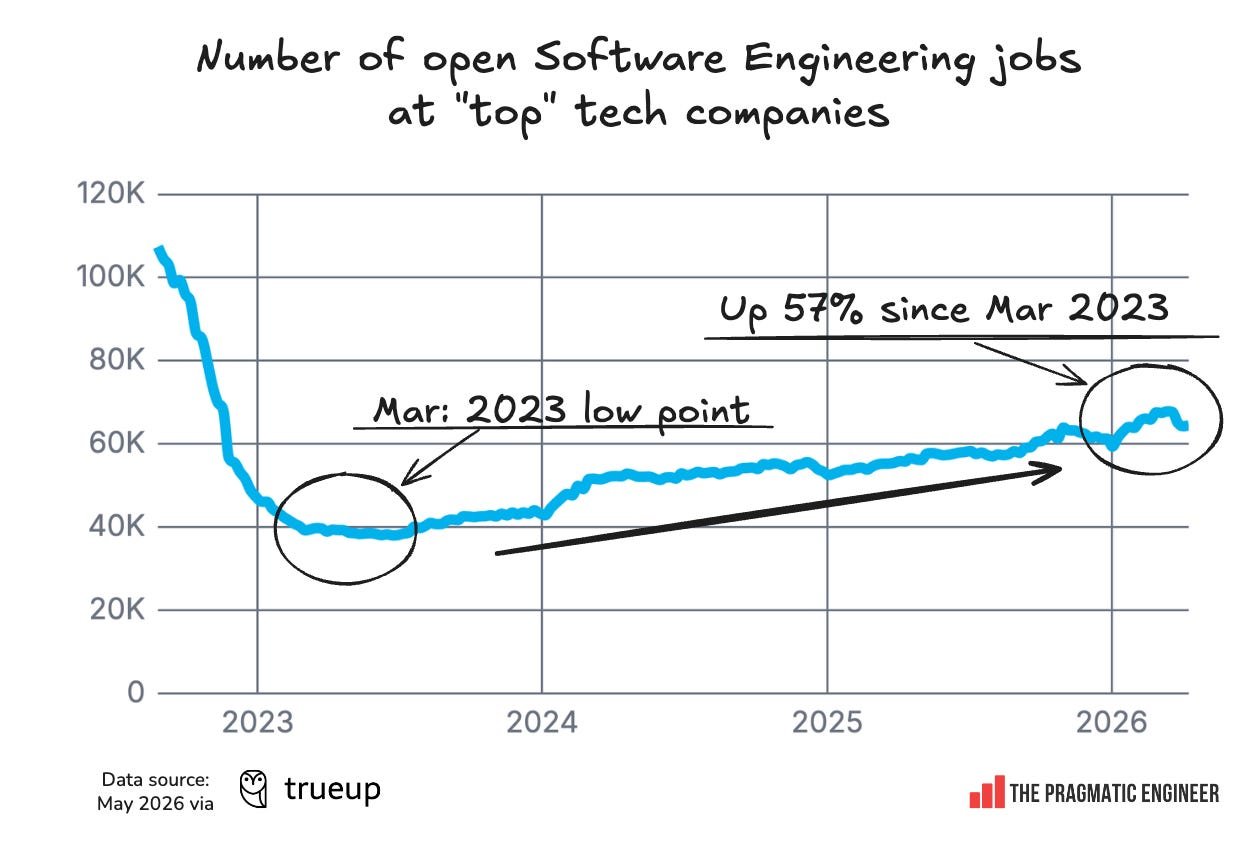
- US vs. Europe – TrueUp reports a 12 % YoY increase in US postings, while German listings fell 5 % and French listings fell 4 %.
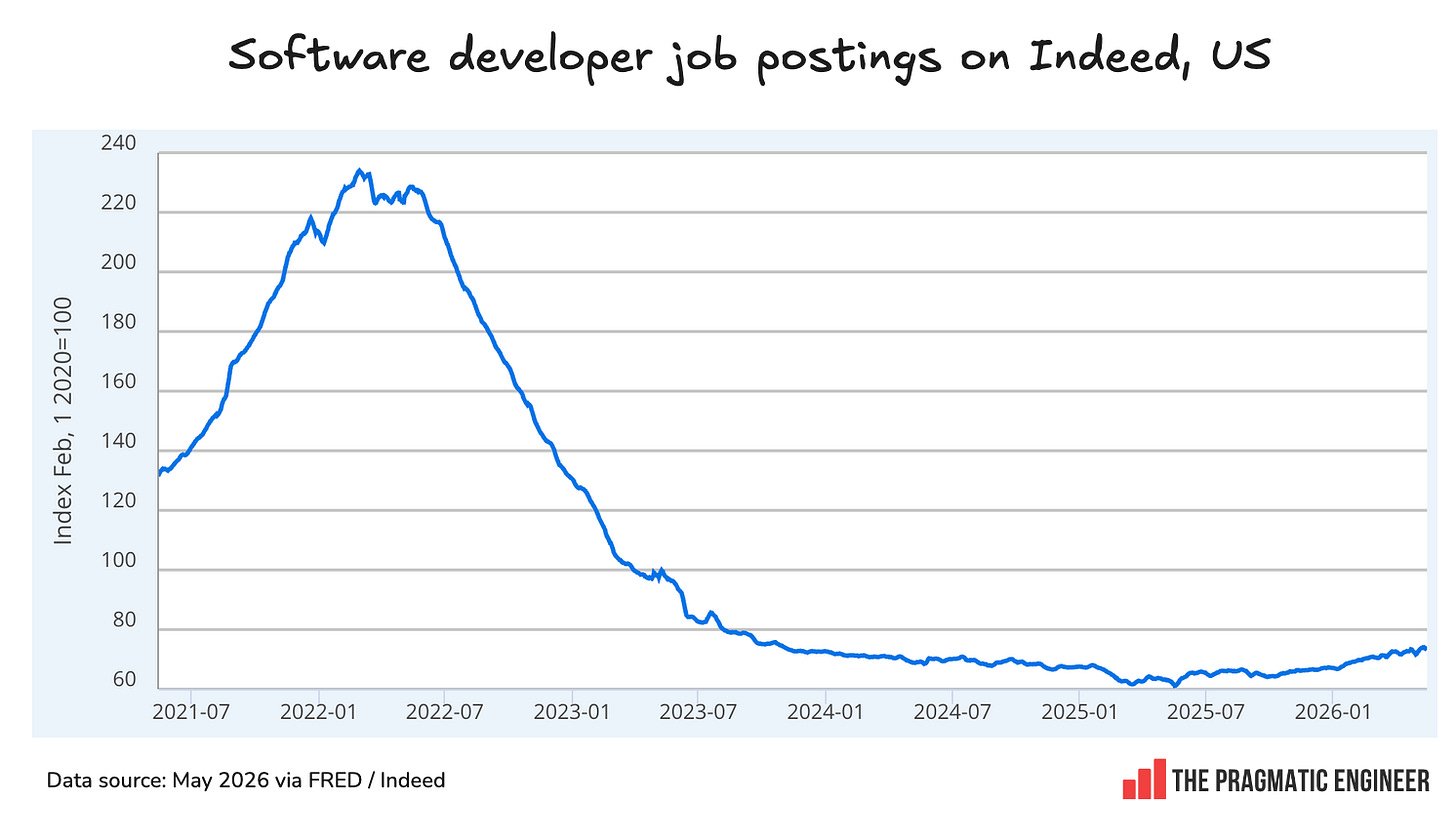
- Overall market volume – Indeed’s aggregated data shows 1.84 M software‑engineer listings in the US as of May 2026, compared with 1.71 M a year earlier.
- Seasonality – Workforce.ai’s heat map shows a sharp hiring peak from March to June, a trough in September‑October, and a small rebound in December (often for contract/seasonal work).
Big‑Tech headcount shifts (software engineers only)
| Company | 2024‑2025 Δ% | 2025‑2026 Δ% |
|---|---|---|
| Apple | +8 % | +10 % |
| +4 % | +5 % | |
| Microsoft | -0.9 % | -1.1 % |
| Amazon | -1.0 % | -1.3 % |
| Meta | +19 % (2024‑25) | -10 % (2025‑26 layoffs) |
Apple and Google remain the most stable hiring grounds; Meta’s volatility is now evident in the swing from a 20 % headcount surge to a 10 % cut within 12 months.
Publicly‑traded “non‑Big‑Tech” growth
- Stripe: +15 % software‑engineer hires in the last 12 months (still above the industry average).
- Shopify: +6 %.
- Atlassian: +11 % (but announced a 10 % workforce reduction in July 2026).
- Snap: +2 % (followed by a 16 % layoff wave in April 2026).
Companies with the most open software‑engineer roles (TrueUp data, May 2026)
- Apple – 2,342 listings
- IBM – 1,987 listings
- Amazon – 1,845 listings
- Google – 1,632 listings
- Stripe – 1,210 listings
New entrants to the top‑20 include Tesla, SpaceX, Cadence, and HPE, reflecting a broader push for embedded‑software talent.
Fastest‑growing hiring segments (2025‑2026)
| Segment | YoY growth | Notable hires |
|---|---|---|
| Fintech (Ramp, Rippling) | +94 % (Ramp) / +55 % (Rippling) | Backend engineers for real‑time payments, Rust 1.73 specialists |
| Observability (Datadog, New Relic) | +68 % (Datadog) | Engineers experienced with OpenTelemetry 1.2, Go 1.22 |
| Security (Wiz, CrowdStrike) | +84 % (Wiz) | Cloud‑native security engineers, Python 3.12 + Boto3 expertise |
AI‑engineering explosion
- Apple: 1,102 AI‑engineer listings (+62 % YoY)
- Google: 945 listings (+58 % YoY)
- TikTok: 712 listings (+51 % YoY)
Typical requirements now include:
- Proficiency with LLM‑centric frameworks (LangChain, LlamaIndex)
- Experience deploying models on AWS SageMaker 2.0 or Azure AI Studio
- Familiarity with MLOps pipelines (Kubeflow, Argo Workflows)
Migration paths – moving from software to AI engineering
If you’re a seasoned software engineer looking to pivot, here’s a pragmatic roadmap (example based on a Node.js backend developer):
- Add a data‑science side‑project – Build a simple recommendation engine using Surprise 0.1 and host it on Fly.io. Publish the repo and write a short post on the design choices.
- Earn a micro‑credential – The DeepLearning.AI TensorFlow Developer Professional Certificate can be completed in 4‑6 weeks and adds a verifiable badge to your LinkedIn.
- Integrate LLMs into a service – Replace a rule‑based search endpoint with OpenAI Assistants API (v2). Track latency improvements and cost per request.
- Show production impact – Deploy the LLM‑enhanced service to a staging environment, run A/B tests, and capture metrics (e.g., 30 % higher click‑through). Add these numbers to your résumé.
- Apply to AI‑focused roles – Target the “AI Engineer”, “ML Platform Engineer”, or “LLM Ops Engineer” titles that have surged on TrueUp.
Bottom line
- Software‑engineer hiring is modestly rebounding in the US/UK, but Europe is cooling.
- AI‑engineering roles are growing at double‑digit rates and are now a prerequisite for many software positions.
- Fintech, observability and security firms are the hottest hiring grounds; they reward engineers who can ship production‑grade Rust, Go, or Python services with AI components.
- Recruiters should update titles, focus outreach in March‑June, and use AI‑screening tools. Candidates should showcase AI‑related projects and quantify impact.
Stay tuned for next quarter’s update, where we’ll break down compensation trends for AI vs. traditional software roles.
*For the full raw datasets and API access, see the TrueUp documentation and Workforce.ai data portal.*
Comments
Please log in or register to join the discussion