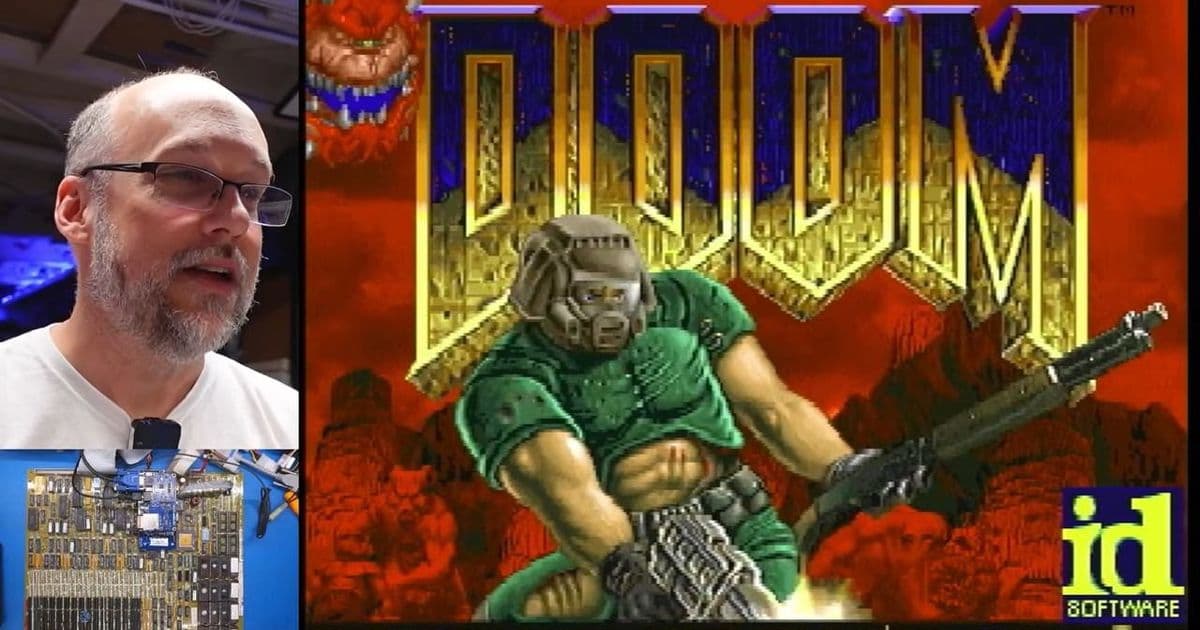
A vintage Agfa Compugraphic 9000PS print controller, powered by a Motorola 68020 CPU, has been transformed into a retro gaming machine capable of running Doom, showcasing the surprising capabilities of industrial hardware from the 1980s.
A vintage computing enthusiast has achieved what many thought impossible - getting Doom to run on a 40-year-old printer controller. The project, documented by Adrian's Digital Basement, showcases the surprising capabilities of industrial hardware from the 1980s and demonstrates how creative engineering can breathe new life into obsolete technology.
The Agfa Compugraphic 9000PS: More Than Just a Printer
The hardware in question isn't your typical office printer destined for e-waste. The Agfa Compugraphic 9000PS was a sophisticated piece of pre-press equipment designed to handle complex printing workflows. This beige box served as a Raster Image Processor (RIP), interpreting resolution-independent PostScript files sent by pre-press operators and converting them into raster images for downstream printing hardware, typically high-resolution imagesetters that produced printing plates.
What made this possible was the powerful hardware packed inside. The main motherboard featured a Motorola 68020 CPU running at 16 MHz - a processor that was considered high-performance for its era. The I/O controller board paired with it included its own 68000 CPU, making this a dual-processor system long before such configurations became common in consumer hardware.
The Technical Journey
The project required extensive reverse engineering work. Adrian had to decode the ROM code for this now-obscure hardware, which proved to be a significant challenge. The breakthrough came when he replaced the original Adobe PostScript interpreter in ROM with custom firmware based on AGFA-MON, available from GitHub. This new firmware provided a monitoring application, OS boot stub options, and even added a BASIC interpreter to the system.
Before gaming could begin, additional hardware modifications were necessary. Adrian installed the VERA 8-Bit Video Card, designed for homebrew computer projects, to provide display output capabilities that the original hardware lacked.
From Printer to Gaming Rig
After approximately 1 hour and 6 minutes of setup and configuration in the video, Adrian began demonstrating the repurposed hardware's capabilities. He started with CP/M software but quickly progressed to running a Unix operating system - specifically Minix. The culmination of the project was running the full shareware version of Doom 1.9 on what Adrian describes as "what was just a printer freakin' controller."
Performance Reality Check
For those familiar with 68020-based systems like the Amiga 1200, the performance expectations were realistic. Doom ran, but it was far from playable in any traditional sense. The game suffered from extremely low frame rates, reminiscent of recent experiments like the 4FPS Red Dead Redemption 2 gaming shenanigans that have become popular in the retro computing community.
The playability issues went beyond just poor performance. The system lacked PS/2-compatible keyboard support, making the game essentially uncontrollable. This limitation meant that while the game could technically run, it couldn't be played in any meaningful way.
Historical Context and Significance
This project highlights the computational demands of 1980s printing technology. Interpreting and outputting PostScript files was resource-intensive work that required significant processing power. The 68020 CPU, while modest by today's standards, was a workhorse processor that powered many professional and high-end systems of its time.
The Agfa Compugraphic 9000PS represents a fascinating intersection of industrial computing and gaming culture. It demonstrates how hardware designed for one specific purpose can be repurposed for entirely different applications with enough technical knowledge and creativity.
The Broader Impact
Projects like this serve multiple purposes in the tech community. They preserve knowledge about older hardware architectures, demonstrate reverse engineering techniques, and provide entertainment through creative problem-solving. For vintage computing enthusiasts, seeing Doom run on unexpected hardware has become something of a rite of passage - from microwaves to printers, if it has a processor, someone has probably tried to run Doom on it.
Adrian's Digital Basement has documented this as the fourth video in a series exploring the Agfa RIP hardware, indicating the depth of exploration possible with even seemingly single-purpose industrial equipment. The series has revealed numerous interesting components and capabilities within this unassuming beige box.
Conclusion
The transformation of the Agfa Compugraphic 9000PS from redundant industrial equipment to a retro gaming platform represents the creative spirit of the vintage computing community. While the resulting Doom experience may not be practical for actual gameplay, the technical achievement of getting the game to run at all on 40-year-old hardware is noteworthy.
This project serves as a reminder that technology from past decades often contains more potential than its original designers might have imagined. With sufficient expertise and determination, even hardware designed for the most mundane industrial tasks can be transformed into something that captures the imagination of modern tech enthusiasts.
For those interested in following similar projects or learning more about vintage computing, Adrian's Digital Basement provides detailed documentation and insights into the challenges and solutions involved in repurposing old hardware. The project also highlights the importance of preserving and understanding legacy systems, as they often contain valuable lessons about system design, performance optimization, and creative problem-solving that remain relevant today.
(Image credit: Adrian's Digital Basement)
(Image credit: Adrian's Digital Basement)
(Image credit: Adrian's Digital Basement)
Comments
Please log in or register to join the discussion