RevenueCat’s State of Subscription Apps 2026 – Part 2 reveals that only 5 % of users who cancel an annual plan ever reactivate, while monthly users return four times as often. The data highlights the importance of getting users past the first month and suggests strategies for improving retention on iOS and Android.
Annual App Subscribers Almost Never Return After Canceling, New RevenueCat Report Shows
RevenueCat has released the second half of its State of Subscription Apps 2026 report, focusing on how often users who cancel a subscription ever come back. The findings are especially relevant for developers who maintain iOS and Android apps with annual pricing tiers.
What the data says
- 95 % of canceled annual subscribers never return. Only 5 % reactivate within a year, compared with a 20 %‑plus re‑activation rate for monthly plans.
- First‑month churn dominates. For annual plans, 35 % of cancellations happen in month 1. Shopping apps are the most volatile, with half of their annual cancellations occurring in that initial month.
- Education apps fare better. Only 30 % of annual cancellations happen in the first 30 days for this category.
- Trial behavior has shifted. More than half of trial cancellations now happen on day 1, but churn drops below 10 % after day 2 for apps offering 14‑ or 30‑day trials.
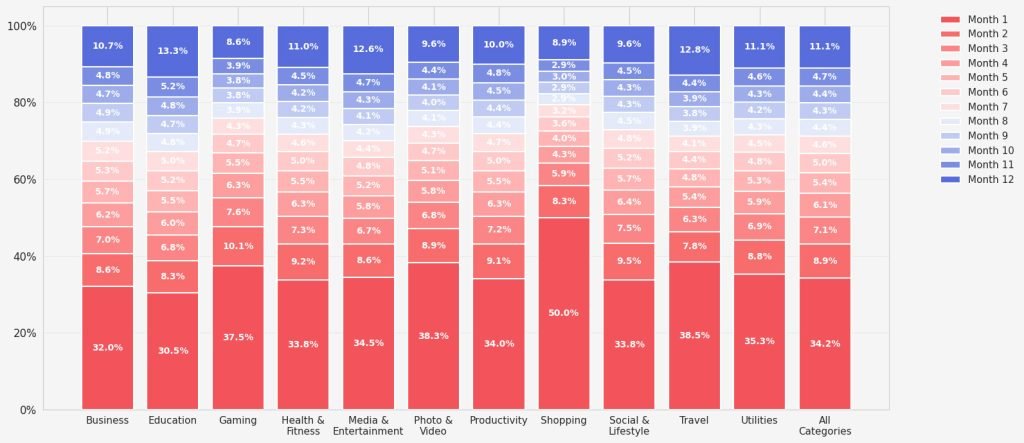 Cancellation timeline for annual subscriptions. Source: State of Subscription Apps 2026
Renewal strength of annual plans
Once a user makes it past the first renewal, the odds improve dramatically:
- First renewal: 23 %–40 % median retention
- Second renewal: 44 %–64 % median retention
- Third renewal: 56 %–70 % median retention
Overall, annual plans renew at 83.4 % across all categories, roughly four times the renewal rate of weekly subscriptions and twice that of monthly plans.
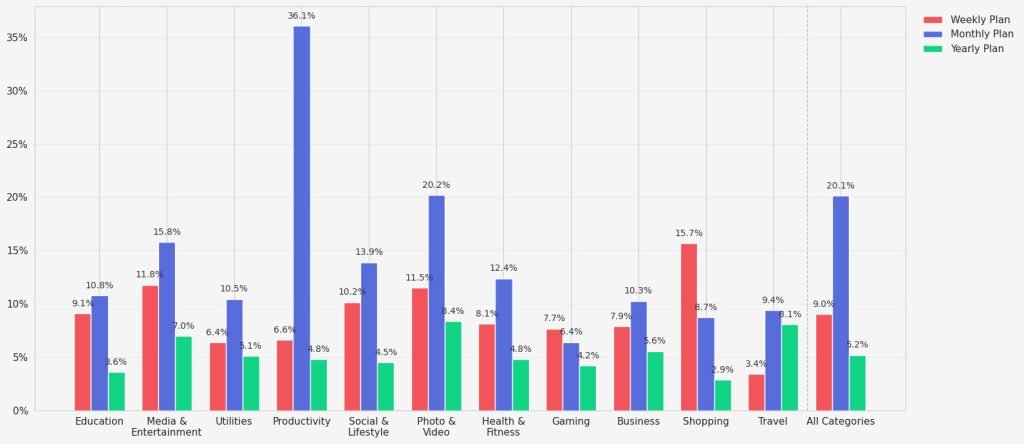 Reactivation rate within one year by app category. Source: State of Subscription Apps 2026
Why this matters for cross‑platform developers
iOS considerations
- App Store pricing tiers: Apple’s tiered pricing model means that moving a user from a monthly to an annual tier can boost long‑term revenue, but the risk of a permanent loss is high if the user cancels early. Use the App Store Connect pricing guide to experiment with introductory offers that extend the trial beyond day 1.
- StoreKit 2: The new
Transaction.currentEntitlementAPI makes it easier to detect when a user’s annual subscription is about to lapse, giving you a window to surface targeted retention prompts.
Android considerations
- Google Play Billing Library 6.0 offers similar entitlement APIs (
BillingClient.queryPurchasesAsync) and supports subscription upgrade/downgrade flows that can be used to shift a user from a monthly to an annual plan without a gap. - Dynamic pricing: Android’s flexible price‑point system lets you test regional price tiers more aggressively, which the report shows can affect re‑activation rates.
Both platforms now support server‑side receipt validation, which is essential for reliably tracking churn and re‑activation across devices.
Practical steps to improve retention and re‑activation
- Extend the trial window – The data shows a steep drop in churn after day 2. Offering a 7‑day or 14‑day trial can move users past the early‑cancellation spike.
- Introduce a “soft cancel” flow – Instead of an immediate full cancellation, allow users to pause their subscription for a month. This can capture the 5 % who would otherwise be lost forever.
- Targeted win‑back campaigns – Use the
SKPaymentQueueorBillingClientto listen forrevokedevents and trigger a personalized email or in‑app message with a limited‑time discount. - Leverage introductory pricing – Offer a discounted first year for users who convert from a monthly plan after three months of continuous usage. This aligns with the higher renewal rates observed after the first annual cycle.
- Analyze geography‑specific churn – The report notes regional differences. Use the RevenueCat dashboard to segment churn by country and adjust pricing or promotional calendars accordingly.
Migration checklist for teams moving between subscription models
| Task | iOS (StoreKit 2) | Android (Play Billing) |
|---|---|---|
| Detect upcoming renewal | Transaction.currentEntitlement |
BillingClient.queryPurchasesAsync |
| Offer upgrade path | SKPaymentDiscount with offerCode |
BillingFlowParams with setReplaceSkus |
| Validate receipts server‑side | Verify JWT with Apple’s endpoint | Verify signed response with Google’s API |
| Track churn events | RevenueCat cancelled webhook |
RevenueCat cancelled webhook |
| Run A/B test on trial length | Use SKMutablePayment with applicationUsername |
Use BillingFlowParams with setOfferToken |
Where to read the full report
The complete State of Subscription Apps 2026 – Part 2 is available on RevenueCat’s site: RevenueCat State of Subscription Apps 2026 – Part 2.
For developers who juggle both iOS and Android codebases, the key takeaway is clear: focus on getting users past the first month, use extended trials, and treat annual re‑activation as a high‑value, low‑probability event. With the right tooling and data‑driven prompts, you can turn the 5 % re‑activation rate into a more meaningful revenue stream.
Comments
Please log in or register to join the discussion