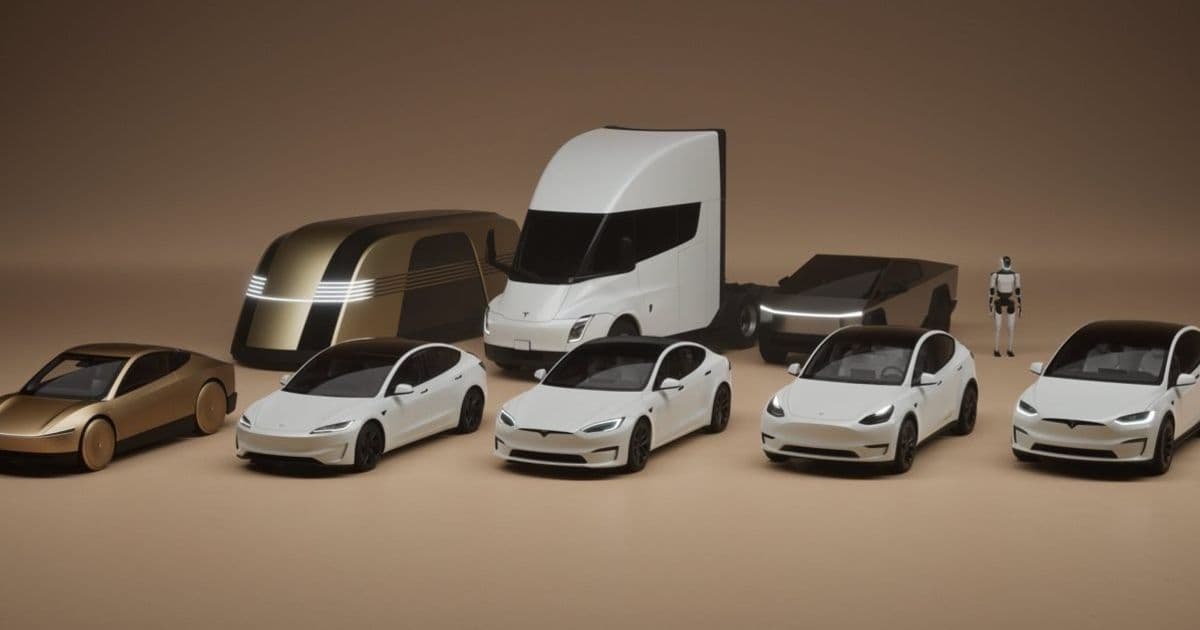
Tesla registrations in Europe fell 17% in January 2026 while the broader EV market grew 14%, with BYD now outselling Tesla by more than 2:1 in the region.
Tesla's European sales continued their downward spiral in January 2026, with registrations falling 17% to just 8,075 vehicles across the EU, EFTA, and UK. The decline comes as the broader battery-electric vehicle market surged 13.9% to 189,062 units, making Tesla's collapse increasingly difficult to explain away as a temporary blip.
The Numbers Don't Lie
The European Automobile Manufacturers' Association (ACEA) data paints a stark picture. While Tesla registered 8,075 vehicles in January 2026, BYD registered 18,242 vehicles - more than twice Tesla's volume and a staggering 165% increase year-over-year. BYD now holds a 1.9% market share in the EU+EFTA+UK compared to Tesla's 0.8%.
Even more telling is what happens when you remove Tesla from the equation. Without Tesla's numbers dragging it down, BEV registrations across the region were up 15.9% year-over-year. Tesla isn't just failing to contribute to Europe's EV transition - it's actively holding back the growth rate.
Beyond the Model Y Refresh Excuse
Tesla supporters had long pointed to the Model Y refresh as the culprit for declining sales. The production changeover to the "Juniper" refresh in early 2025 was supposed to cause a temporary dip. But January 2026 represents a full year after the new model launched, and it's widely available across Europe. The 17% decline compared to already-weak January 2025 numbers suggests the problem runs deeper than a simple production transition.
In the EU specifically, Tesla's decline was more modest at 1.6%, but this masks the severity of the situation in key markets. Norway, where Tesla historically dominated, saw total new car registrations plunge 76.3% due to the end of tax exemptions. Tesla, which relied heavily on Norway's favorable policies, is feeling the impact disproportionately.
The Broader Market Shift
While Tesla contracts, Europe's automotive market is rapidly electrifying. Petrol car registrations crashed 28.2% year-over-year, with France down 48.9% and Germany down 29.9%. Diesel continued its decline at -22.3%. The combined share of petrol and diesel fell to 30.1% in the EU, down from 39.5% in January 2025.
Plug-in hybrids surged 32.2% across the EU+EFTA+UK, reaching 99,654 units. Italy (+134.2%) and Spain (+66.7%) led the charge. Hybrid-electric vehicles remain the most popular powertrain choice at 38.6% EU market share.
Among traditional automakers, Stellantis grew 6.7% to 164,436 units, with Fiat up 24.6% and Opel/Vauxhall up 12.7%. Volkswagen Group, despite a 3.8% decline, still commanded a dominant 26.7% market share.
The Boycott Factor
The boycott movement that gained momentum across Europe in 2025 appears to have locked Tesla out of a significant part of the market. Combined with the end of subsidies in some markets, Tesla's demand slump is being compounded by both cultural and economic factors.
What This Means for Tesla's Future
Tesla's European collapse raises serious questions about the company's long-term viability in one of the world's largest EV markets. While competitors like BYD, Volkswagen, and Stellantis are filling the void, Tesla risks becoming irrelevant in Europe.
The company needs to find the bottom of this decline soon. As one Electrek commenter noted, "A new Board and CEO would likely fix Tesla problems within 3 or so years. Otherwise Tesla is doomed." The comment highlights a growing sentiment that Tesla's problems extend beyond any single product or market condition.
Tesla's struggles in Europe mirror challenges it faces globally. The company is falling behind in the technologies it's trying to shift into, notably robotics and autonomous driving. In a market where innovation and adaptation are crucial, Tesla's European performance suggests the company may be losing its competitive edge.
The data is clear: Europe's EV transition is accelerating, just not for Tesla. As traditional automakers and new entrants like BYD capture market share, Tesla's position as a European EV leader appears increasingly precarious. The question isn't whether Tesla can recover in Europe - it's whether it can find a bottom before it becomes irrelevant in one of its most important markets.
Comments
Please log in or register to join the discussion