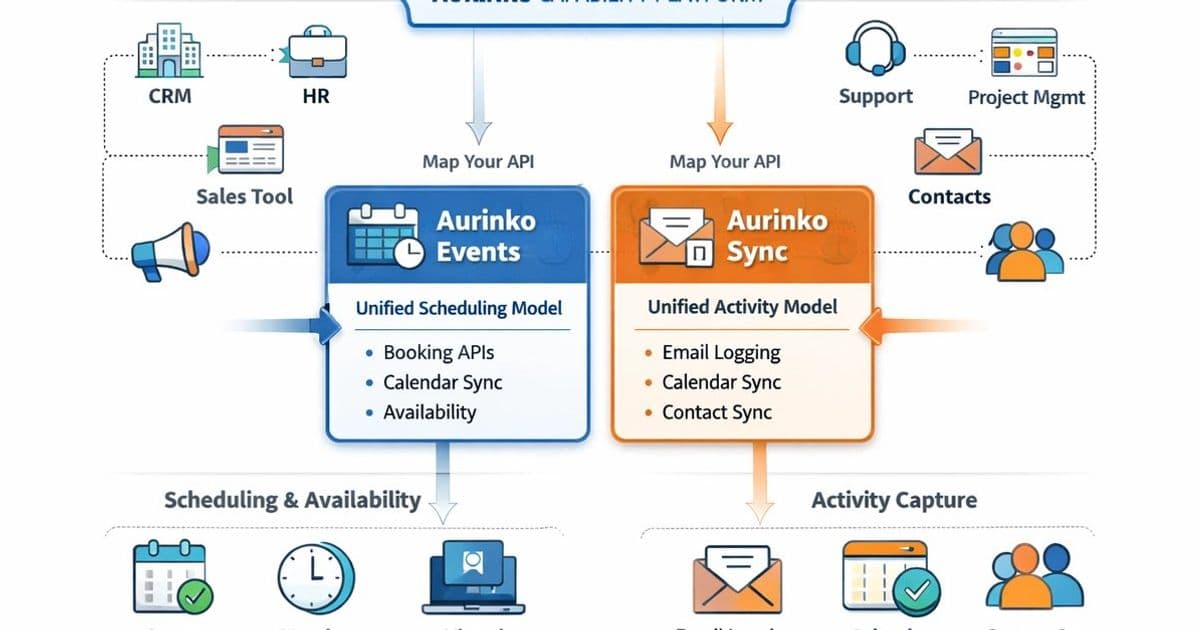
Exploring how capability platforms could solve the problem of SaaS teams repeatedly rebuilding the same infrastructure features, by shifting integration to the data model layer rather than the feature layer.
The Capability Platform: A New Layer for Shared SaaS Infrastructure
If you examine the architecture of modern SaaS products, a pattern emerges that reveals significant inefficiency. Across diverse platforms—CRMs, ATS systems, customer success tools, and vertical SaaS applications—teams consistently rebuild similar infrastructure capabilities. These include:
- Scheduling systems
- Email logging
- Calendar synchronization
- Contact synchronization
- Activity timelines
What's striking is that these features rarely constitute the core value proposition of the product. They're necessary infrastructure, yet most SaaS organizations develop them from scratch, consuming valuable engineering resources that could be allocated to differentiating features.
The Integration Burden in SaaS
Consider activity capture as a representative example. Many platforms need to automatically log:
- Emails
- Meetings
- Contact interactions
- Tasks
Implementing this functionality requires integration with numerous external systems:
- Gmail APIs
- Microsoft Graph/Outlook
- Google Calendar
- Exchange
The connection to these APIs represents merely the starting point. The substantial engineering effort involves building complex systems for:
- Data synchronization
- Deduplication
- Contact matching
- Recurring event handling
- Conflict resolution
Even seemingly straightforward functionality like meeting synchronization becomes complex when different providers represent events differently and handle edge cases inconsistently. Over time, SaaS teams accumulate significant technical debt maintaining these integration layers.
Current Approaches and Their Limitations
Several approaches attempt to simplify these integration challenges, yet each has fundamental limitations.
Unified APIs
Unified API providers normalize disparate APIs behind a single interface. They simplify connections to providers like Gmail or Microsoft Graph by abstracting away the differences between each API's implementation.
However, these solutions typically address only data access. The SaaS platform still needs to build:
- Activity capture systems
- Scheduling logic
- Synchronization engines
- Data reconciliation mechanisms
While unified APIs reduce integration complexity, they don't eliminate the need to build domain-specific capabilities on top of the data layer.
Integration Platforms
Automation tools such as Zapier or Workato facilitate data movement between systems. These powerful integration tools excel at connecting disparate applications but operate outside the product itself rather than enabling built-in capabilities.
For SaaS products that need these capabilities as native features, external automation tools create a disjointed user experience and require separate data flows that don't align with the product's core architecture.
The Capability Platform Alternative
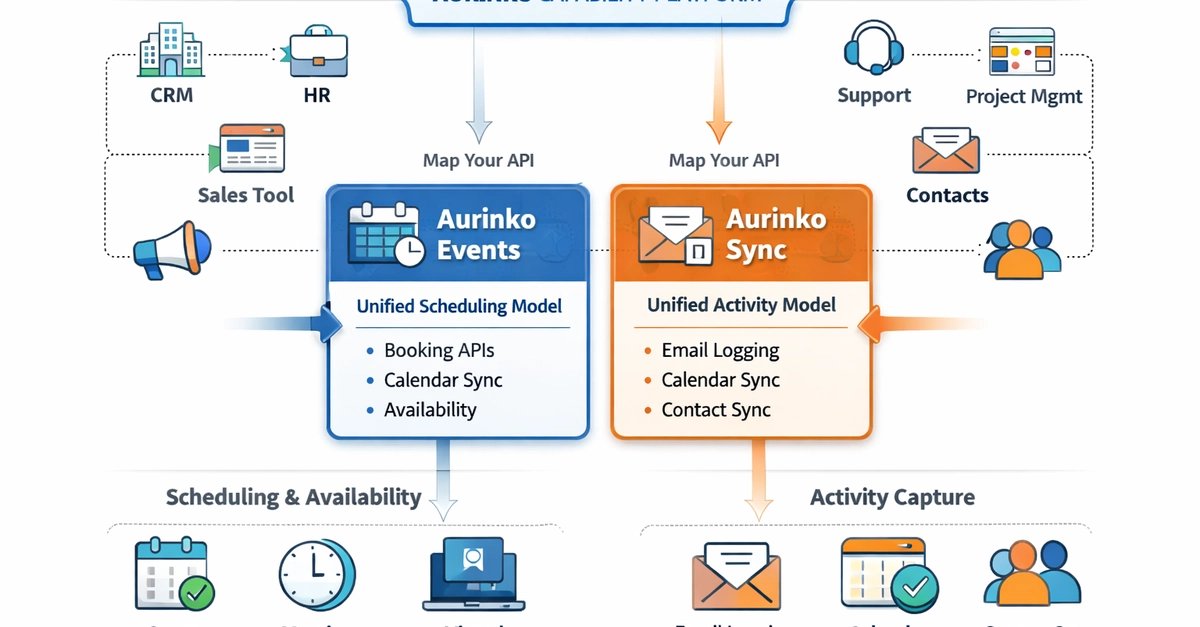
A more promising approach is what I call a Capability Platform. Instead of integrating APIs to build each feature individually, a SaaS platform maps its own data model to a canonical capability model. Once this mapping exists, capabilities can operate transparently on top of that model.
Conceptually, the difference is significant:
Traditional approach: SaaS platform → Build feature → Integrate provider APIs
Capability platform approach: SaaS platform → Map data model → Capabilities become available
The fundamental shift occurs at the integration layer. Rather than integrating at the feature level, integration happens at the data model level. This abstraction enables capabilities to function consistently regardless of the underlying providers.
Technical Implementation
From a distributed systems perspective, capability platforms require several key components:
- Canonical data models: Well-defined schemas that represent capabilities like events, contacts, or communications in a provider-agnostic way
- Mapping layer: Translation logic that converts between the canonical model and provider-specific APIs
- Capability APIs: Interfaces that expose functionality operating on the canonical model
- Consistency mechanisms: Systems to handle synchronization conflicts and ensure data integrity across providers
Example: Scheduling as a Capability
Consider a SaaS platform that wants to support meeting scheduling. Instead of building scheduling infrastructure directly, it maps its event model to a canonical event schema:
Provider events → Canonical event model → Scheduling APIs
Once mapped, the platform can enable sophisticated capabilities:
- Availability queries across multiple calendars
- Meeting booking with attendee management
- Rescheduling with conflict detection
- Time zone conversion
The scheduling functionality operates consistently on top of the canonical model rather than requiring individual implementations for each provider API.
Booking Into SaaS Calendars
In many cases, the SaaS platform itself serves as the system of record for meetings. Examples include:
- CRM platforms
- Vertical SaaS systems
- Booking systems
A canonical event model allows scheduling capabilities to work seamlessly regardless of whether meetings are booked into Google Calendar, Outlook, or the platform's native calendar.
Activity Capture as a Shared Capability
Activity capture represents another common requirement. Many SaaS products need to automatically log:
- Emails
- Meetings
- Contact interactions
- Communication timelines
Systems like Aurinko's BrightSync already synchronize mailbox data such as email, calendars, contacts, and tasks with business systems. The broader vision is that these capabilities could operate on shared models rather than requiring independent implementations.
Implementation Considerations
Moving toward capability platform architecture involves several technical considerations:
Data Consistency Models
Capability platforms must address consistency challenges inherent in distributed systems. When multiple providers maintain their own state, synchronization conflicts inevitably arise. Strategies include:
- Eventual consistency with conflict resolution
- Operational transformation for collaborative features
- Version vectors to detect conflicting updates
The choice of consistency model depends on the specific capability's requirements. For example, meeting scheduling might require stronger consistency than activity logging.
Provider Abstraction Layers
Effective capability platforms need robust provider abstraction that handles:
- Rate limiting and throttling
- Authentication and authorization
- API versioning
- Error handling and retries
These abstractions must be flexible enough to accommodate provider-specific nuances while maintaining a consistent interface for capability implementations.
Performance Optimization
Capability platforms introduce additional indirection that can impact performance. Optimization strategies include:
- Caching frequently accessed data
- Batch operations to reduce API calls
- Background synchronization for non-critical data
- Selective data fetching based on usage patterns
Trade-offs and Implications
Adopting capability platforms involves several trade-offs that organizations must carefully consider.
Benefits
- Reduced development overhead: Teams avoid rebuilding common capabilities
- Faster time-to-market: Pre-built capabilities accelerate product development
- Improved reliability: Shared platforms benefit from specialized expertise in complex integrations
- Consistent user experience: Native capabilities rather than bolted-on integrations
- Easier maintenance: Centralized updates benefit all platform users
Challenges
- Initial migration cost: Existing systems require refactoring to adopt canonical models
- Customization limitations: Standardized models may constrain unique requirements
- Vendor lock-in: Dependency on capability platform providers
- Performance considerations: Additional abstraction layers can introduce latency
- Security implications: Expanded attack surface through additional integrations
Organizational Impact
Capability platforms require shifts in both technical architecture and organizational structure:
- Teams must focus on data modeling rather than API integration
- Product managers need to distinguish between differentiating and commodity features
- Engineering organizations may reallocate resources from infrastructure to product development
- Cross-functional collaboration becomes essential between capability platform providers and SaaS product teams
The Future of SaaS Architecture
The technology industry has repeatedly witnessed infrastructure layers consolidate around shared capabilities. We've seen this pattern in several domains:
- Payments → Stripe
- Authentication → Auth0
- Messaging → Twilio
- File storage → AWS S3
It's plausible that common SaaS capabilities like scheduling, activity capture, and communication sync could follow a similar pattern. Rather than every product rebuilding them independently, specialized providers could offer these capabilities as shared infrastructure.
From a systems design perspective, capability platforms represent an evolution toward more modular, composable architectures. They enable SaaS products to focus on their core value while relying on specialized providers for complex integration challenges.
Conclusion
The repeated development of similar infrastructure capabilities across SaaS products represents a significant inefficiency in our industry. Capability platforms offer a compelling alternative by shifting integration to the data model layer rather than the feature layer.
While challenges remain in implementation and adoption, the potential benefits—reduced development overhead, faster time-to-market, and more reliable products—make this approach worthy of consideration.
As SaaS continues to evolve, we may see capability platforms emerge as a standard layer in the software stack, allowing product teams to focus on what truly differentiates their offerings while relying on specialized providers for complex integration challenges.
Originally published at https://www.aurinko.io/blog/the-case-for-a-capability-platform/
Comments
Please log in or register to join the discussion