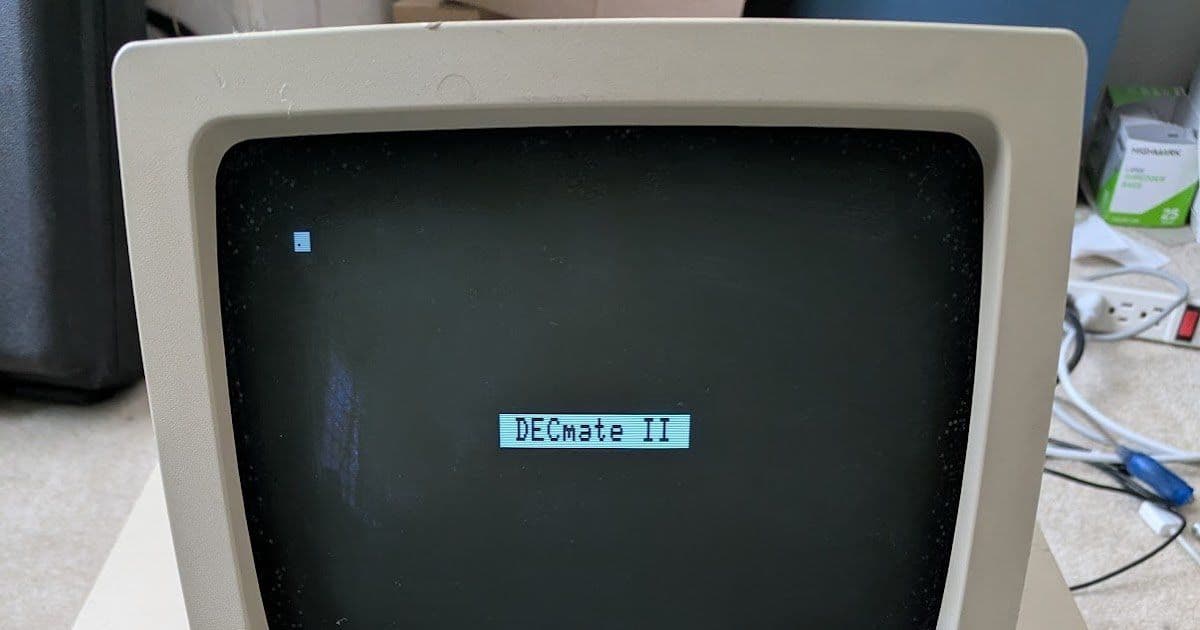
A deep dive into the architecture of the DECmate II, exploring its transition from the PDP-8 lineage to a CMOS-based office machine and the technical challenges of its unique RX50 disk system.
The DECmate II represents a fascinating architectural pivot. In the early 1980s, Digital Equipment Corporation (DEC) faced an existential crisis as the microcomputer market exploded. Their response was to shrink their venerable minicomputer architectures. While the DEC Professional attempted this with the PDP-11, the DECmate II was the culmination of the PDP-8's transition into a dedicated office tool. Launched in 1982, it was marketed as a streamlined word processing system, but under the hood, it is a specialized 12-bit machine with a complex relationship with its ancestors.
The Hardware Architecture
At the heart of the DECmate II is the HD-6120 CPU. This chip is a CMOS implementation of the PDP-8/E instruction set, but it introduces several critical modifications to handle the requirements of a desktop environment. Unlike the original PDP-8, which struggled with a 4kW addressing limit, the HD-6120 incorporates extended memory registers on-die, allowing for 32kW of standard address space.
One of the most distinct features of the HD-6120 is the second 32kW range known as "control panel" (CP) memory. This space is used for the system supervisor and is activated by periodic interrupts or special panel request instructions. This separation allows the machine to handle system-level tasks and display updates without completely halting user programs, though the overhead still results in occasional screen jitter during heavy I/O.
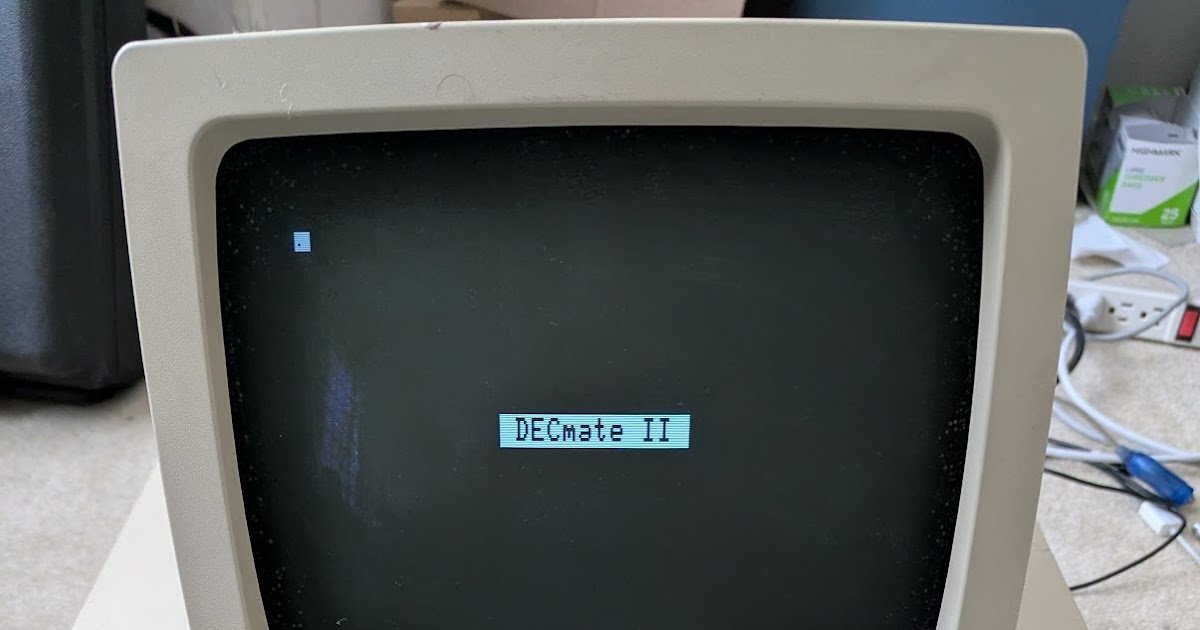
Component Breakdown
| Component | Specification | Role |
|---|---|---|
| CPU | HD-6120 (8MHz) | 12-bit PDP-8 compatible processor |
| RAM | 64kW (32kW Main / 32kW CP) | Hitachi 4164-equivalent DRAM |
| Video | SMC CRT9007 (VPAC) | VT100-compatible character generator |
| Storage | RX50 Dual 5.25" Floppy | Proprietary MFM storage system |
| I/O | Harris D1-6121 (IOC) | Programmable Interface Elements for device handshaking |
The RX50 Floppy System: A Mechanical Oddity
The RX50 drive is one of the most unusual storage devices of the era. Unlike standard 5.25" drives, the RX50 uses a stacked configuration where two drive slots share a common motor and a single head-stepper assembly.
Because the heads are located in the center of the drive, the disks are single-sided with the write surface facing inward. This means the lower disk must be inserted upside down. DEC handled this with red stripes and arrows on the media to guide the user. From a data perspective, the controller can access disks in 8-bit or 12-bit mode. While 12-bit mode is faster, it is effectively stored as 16-bit with four bits wasted, which cuts the usable capacity in half.
Low-Level Boot Process and "Slushware"
The boot sequence of the DECmate II is a study in architectural constraints. Because the PDP-8's subroutine jump instruction expects to store the return address in the callee's first word, running complex code directly from ROM is inefficient. To solve this, the DECmate II employs a multi-stage loader:
- ROM-to-RAM Copy: Upon power-on, the ROM copies a twenty-word stage-one loader into the lowest 128 words (one page) of CP RAM.
- Field Transfer: This loader then copies the remaining 4kW of ROM into the highest CP RAM field.
- Bank Switching: Once the copy is complete, the EPROMs are banked out, and the system executes from RAM.
This transition leads to the concept of "slushware." Rather than relying entirely on permanent firmware, the DECmate II loads its primary supervisor code from the floppy disk into CP RAM. This provided DEC with more flexibility for updates and reduced the cost of the internal ROMs, though it meant the system was entirely dependent on a valid boot disk to function.
Performance and Compatibility Trade-offs
While the DECmate II is PDP-8 adjacent, it is not fully compatible with classic PDP-8 software. The use of the Harris D1-6121 I/O controllers (IOC) introduced behavioral differences in how interrupts and flags are handled. Many classic OS/8 programs fail on the DECmate because they expect the hardware behavior of an Omnibus-based system, which the DECmate lacks.
To bridge the gap to the 16-bit world, DEC offered the Auxiliary Processor Unit (APU) and the Extension Processor Unit (XPU). The APU added a Z80 CPU and 64K of RAM, allowing the machine to run CP/M 2.2. In this mode, the HD-6120 is demoted to a mere I/O processor, handling the disks and display while the Z80 handles the logic. The XPU took this further by adding an 8086, enabling limited MS-DOS 2.11 support, effectively turning the machine into a primitive version of the DEC Rainbow.
Build Recommendations for Homelabbers
For those restoring these units, the primary failure points are the RX50 drives and the CRT adhesive. The "cataracts" seen on VR201 monitors are caused by the degeneration of the glue sealing the CRT to the glass. While aesthetically displeasing, they do not affect the image quality.
Modernization Path:
- Storage: Replacing the RX50 with Gotek floppy emulators running FlashFloppy firmware is the most reliable upgrade. Configuration requires setting
interface = shugartandhost = decin theFF.CFGfile. - Video: The VR201 output is high-quality monochrome composite. Tapping the video input lines (specifically pin 12 of the DA-15 connector) allows for a composite jack installation, enabling modern capture cards to record the output.
- Power: Ensure the 220W power supply is recapped, as the electrolytic capacitors from 1982 are well past their shelf life.
Conclusion
The DECmate II was a pragmatic attempt to bring the 12-bit world into the office. While it was eventually eclipsed by the IBM PC and the VAXmate, its implementation of the HD-6120 and the flexible CP RAM architecture make it a compelling piece of engineering. It remains a testament to a time when hardware designers had to be incredibly parsimonious with every single word of memory.
Comments
Please log in or register to join the discussion