Exploring the mathematical and physical implications of nonlinearity in pendulum motion, revealing how the common small-angle approximation obscures rich dynamics and leads to subtle but significant differences in pendulum behavior.
The equation of motion for a pendulum represents one of the most fundamental problems in classical mechanics, yet its apparent simplicity masks profound mathematical complexity. When we examine the differential equation for a pendulum, where g represents acceleration due to gravity and ℓ denotes the pendulum's length, we encounter a nonlinear relationship that fundamentally distinguishes it from the simplified versions typically presented in introductory physics courses.
In standard physics education, instructors often immediately introduce the approximation that for small angles θ, sin θ ≈ θ, transforming the nonlinear equation into a linear one. This pedagogical choice, while mathematically convenient, raises important questions that deserve deeper consideration. Why replace sin θ with θ? What justifies this approximation? How small must θ actually be for this simplification to remain valid? Most significantly, how do the solutions to these different equations—exact versus approximate—diverge in meaningful ways?
The mathematical heart of this issue lies in the nature of the sine function itself. Unlike the linear relationship implied by the small-angle approximation, sine is inherently nonlinear. This nonlinearity renders the exact pendulum equation resistant to solution using elementary mathematical techniques familiar to most students. While a closed-form solution does exist, it requires special functions—specifically the complete elliptic integral of the first kind—that extend far beyond the standard calculus curriculum.
The approximation sin θ ≈ θ finds its justification in Taylor series expansion, where sin θ = θ - θ³/6 + θ⁵/120 - ..., demonstrating that for small angles in radians, the higher-order terms become negligible. However, this seemingly straightforward approximation conceals subtle mathematical depth. The transition from linear to nonlinear behavior doesn't occur at a specific threshold but represents a gradual shift in dynamics that becomes increasingly pronounced as initial displacement grows.
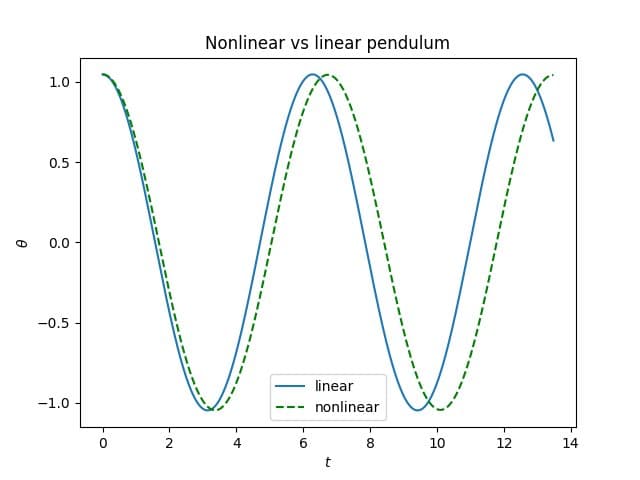
The most significant consequence of this nonlinearity manifests in the period of oscillation. While the linear pendulum equation yields solutions that are pure cosine functions with constant period regardless of amplitude, the nonlinear pendulum exhibits amplitude-dependent period lengthening. This fundamental difference challenges our intuitive understanding of oscillatory motion and reveals that the simple harmonic motion approximation becomes increasingly inadequate as initial displacement increases.
Quantifying this period difference reveals fascinating mathematical relationships. The period of the nonlinear pendulum exceeds that of its linear counterpart by a factor f(θ₀), where θ₀ represents the initial displacement. This factor can be expressed exactly in terms of the complete elliptic integral of the first kind, though a practical approximation emerges: f(θ₀) ≈ 1 + θ₀²/16 + 11θ₀⁴/3072 for moderate angles.
Consider an illustrative example with θ₀ = 60° (π/3 radians). Here, sin θ₀ ≈ 0.866 while θ₀ ≈ 1.047 radians—hardly the small angle implied by the approximation. Setting ℓ = g and assuming the pendulum starts from rest, the nonlinear solution exhibits a period 7.32% longer than its linear counterpart (the approximation estimates 7.46%). This seemingly modest difference accumulates over time, leading to increasingly divergent behavior between the two models.
An insightful alternative approach emerges when we recognize that the nonlinear pendulum's behavior resembles a linear pendulum with effectively increased length. By solving the linear equation but stretching the period by 7.32%, we obtain an approximation remarkably close to the true nonlinear solution. The difference between these approaches becomes apparent only when examining their residuals—subtracting one solution from the other reveals the accumulated error over time.
This effective lengthening suggests a fascinating physical interpretation: the nonlinearity in the pendulum equation effectively replaces the actual length ℓ with a longer effective length ℓeff. This conceptual framework helps bridge the mathematical abstraction with tangible physical understanding, revealing how nonlinear dynamics subtly alter the very geometry of oscillatory motion.
The implications of these nonlinear effects extend far beyond academic exercises. Precision timekeeping historically relied on pendulum clocks, where understanding period variations with amplitude was crucial for accuracy. Modern applications in seismology, MEMS devices, and gravitational wave detection all require grappling with nonlinear oscillatory behavior that simple harmonic motion cannot adequately describe.
Counterintuitively, the very approximation that simplifies pendulum analysis also constrains our physical intuition. By habitually thinking of pendulums as exhibiting simple harmonic motion, we develop an incomplete mental model that fails to capture the rich dynamics present in real-world oscillatory systems. This limitation becomes particularly apparent when examining large-amplitude oscillations, coupled pendulums, or chaotic dynamics that emerge under certain conditions.
The mathematical techniques developed to address nonlinear pendulum motion—perturbation methods, elliptic integrals, phase space analysis—form the foundation of much of modern dynamical systems theory. These approaches allow us to navigate the complex landscape of nonlinear phenomena, revealing patterns and structures that would otherwise remain hidden. The pendulum thus serves as an entry point to the broader world of nonlinear dynamics, where small changes in initial conditions can lead to dramatically different outcomes—a principle that echoes throughout physics from celestial mechanics to quantum chaos.
As we develop increasingly sophisticated computational tools, the historical tension between exact solutions and approximated ones takes on new dimensions. While numerical methods can now solve the nonlinear pendulum equation to arbitrary precision, understanding the mathematical structure of these solutions remains essential for developing physical intuition and recognizing when approximations remain valid. The pendulum thus exemplifies a fundamental principle of scientific modeling: the art of knowing which simplifications preserve essential features while eliminating inessential complexity.
In examining the nonlinear pendulum, we encounter not merely a mathematical curiosity but a gateway to deeper understanding of how approximation shapes our perception of physical reality. The transition from linear to nonlinear thinking represents a significant conceptual leap—one that separates elementary physics from the more nuanced understanding required to engage with the complex systems that populate our universe.
Comments
Please log in or register to join the discussion