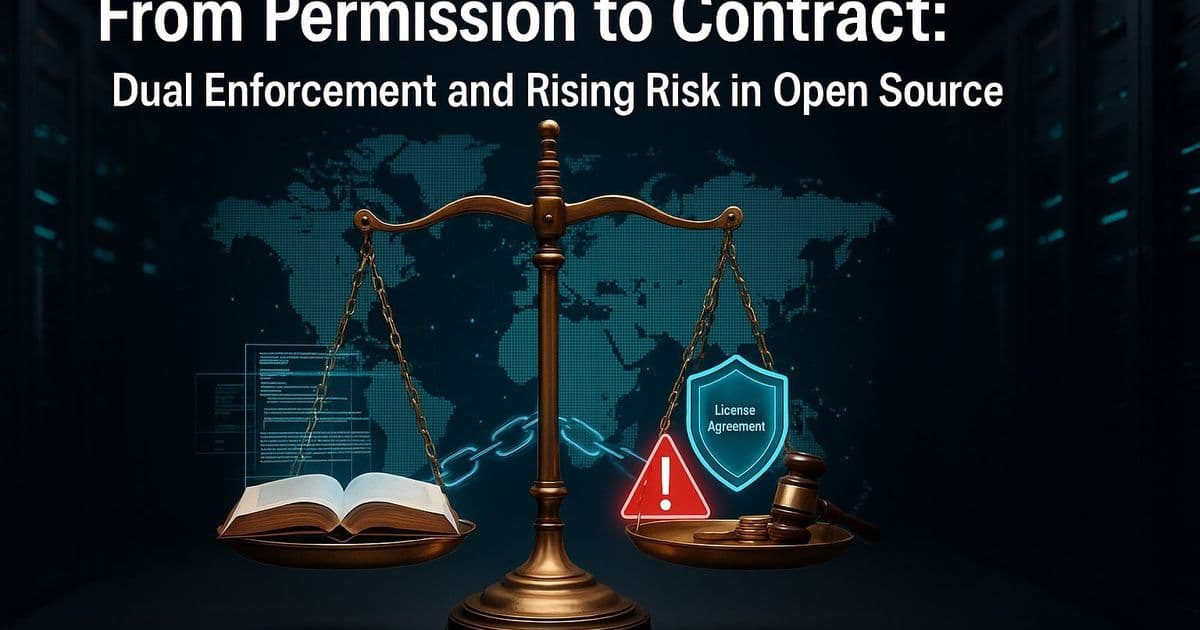
A stark legal divide exists in how open source licenses are enforced globally: U.S. law views them as unilateral permissions, not binding contracts, unlike the EU and Japan. This discrepancy heightens compliance risks for developers and companies operating across borders. Understanding this gap is essential for navigating open source innovation without legal pitfalls.

In the bustling world of open source software, where code flows freely across continents, a quiet legal schism threatens to destabilize collaboration. While developers in Tokyo or Berlin treat open source licenses as enforceable contracts, their counterparts in Silicon Valley operate under a different reality—one where these licenses are merely "unilateral permissions." This U.S.-centric view, rooted in decades of case law, isn't just a technicality; it's a tectonic shift in risk management that could fracture global software development.
The Core of the Conflict
At the heart of this divergence is a fundamental legal interpretation. In the United States, courts have consistently ruled—most notably in cases like Jacobsen v. Katzer—that open source licenses such as the GPL or Apache License grant permissions rather than form binding contracts. This means breaching license terms (e.g., failing to share source code) isn't a contract violation but a revocation of permission, potentially exposing infringers to copyright claims instead. As one legal expert puts it: "The U.S. treats open source like a gift with strings attached—break the rules, and the gift disappears."
Contrast this with Japan and the European Union, where licenses are upheld as contractual agreements. There, violations can lead to direct damages and injunctions, creating a more predictable enforcement landscape. For instance, EU courts have leveraged contract law to compel compliance in high-profile cases, emphasizing mutual obligations between licensors and users.
Why Developers Should Care
This isn't just lawyerly debate—it has teeth for anyone building with open source. Consider a U.S.-based startup using a Japanese library under an Apache License. If they violate terms, they might face minimal repercussions stateside, but when deploying in Europe, they could be slammed with lawsuits. The inconsistency complicates compliance strategies, forcing teams to navigate a patchwork of regional laws. "It's like driving with different traffic rules in every country," says a cybersecurity analyst. "One misstep in interpretation could lead to costly litigation or forced code rewrites."

Moreover, this legal ambiguity stifles innovation. Developers in the U.S. might undervalue license compliance, assuming weak enforcement, while international contributors face heightened scrutiny. Projects like Linux or Kubernetes, which thrive on global contributions, risk fragmentation if contributors fear uneven legal exposure. The Free Software Foundation's Community-Oriented Enforcement Principles advocate for consistency, but without harmonized laws, it remains an ideal.
The Ripple Effects and Path Forward
The stakes soar as open source underpins critical infrastructure, from cloud servers to AI models. A permission-based system in the U.S. might encourage more experimentation but could erode trust in communities reliant on reciprocal sharing. Meanwhile, contract-focused regions promote accountability but may deter adoption with their rigidity. For tech leaders, the solution lies in proactive measures: audit dependencies rigorously, adopt tools like SPDX for license tracking, and advocate for policy reforms that bridge this gap. As the open source ecosystem evolves, this legal fault line demands not just awareness, but action—because in a world built on shared code, justice shouldn't depend on geography.
Comments
Please log in or register to join the discussion