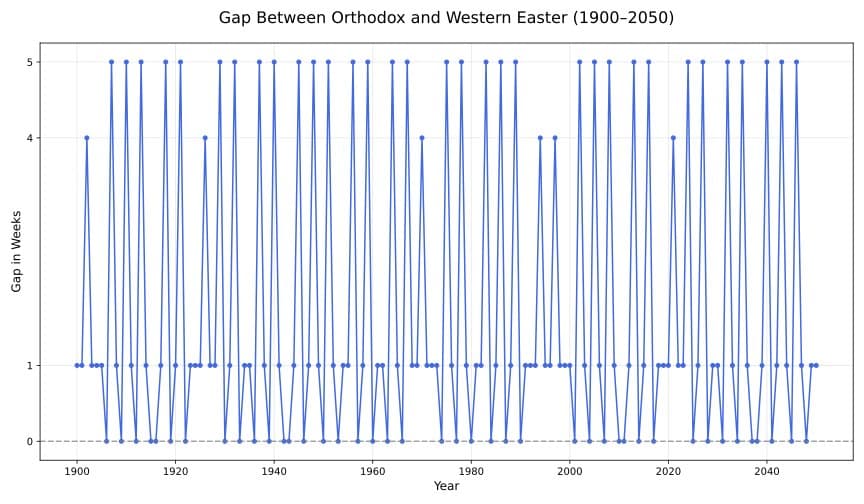
The divergence between Eastern and Western Easter dates stems from centuries-old calendar differences and astronomical approximations, creating a fascinating pattern of celebration timing that will continue to evolve over millennia.
The celebration of Easter, Christianity's most significant feast, presents an intriguing calendrical puzzle that divides the faithful across hemispheres and traditions. This year, as Western churches commemorated the resurrection last week, Orthodox Christians prepare to celebrate Pascha today. This temporal gap between Eastern and Western Easter is not arbitrary but emerges from a complex interplay of astronomical calculations, historical calendar reforms, and ecclesiastical tradition that has persisted for centuries.
The Astronomical Foundation
At its core, the determination of Easter rests on a seemingly straightforward astronomical principle: it falls on the first Sunday following the first full moon after the spring equinox. This definition, shared by both Eastern and Western churches, traces its origins to the early Christian church's desire to align the celebration with the Jewish Passover, during which Christ's crucifixion occurred. The resurrection, Christians believe, took place on the Sunday following Passover, establishing this pattern.
However, the simplicity of this definition belies the complexity that emerges when we examine how "full moon" and "spring" are interpreted. Neither term refers to precise astronomical measurements but rather to approximations codified in ecclesiastical tradition centuries ago. The spring equinox is fixed at March 21 for calculation purposes, but here lies the first divergence: the Western church uses March 21 on the Gregorian calendar, while the Eastern church uses March 21 on the Julian calendar.
The Calendar Divide
The Gregorian calendar, introduced by Pope Gregory XIII in 1582, was a reform of the Julian calendar established by Julius Caesar in 46 BCE. The Julian calendar assumed a year length of exactly 365.25 days, adding a leap day every four years without exception. This approximation, while functional, gradually drifted from the solar year, causing the calendar date of the equinox to shift earlier in the astronomical year.
The Gregorian reform addressed this drift by introducing a more precise year length of 365.2425 days. Under this system, century years are not leap years unless divisible by 400. Thus, 2000 was a leap year, but 1900 was not, and 2100 will not be. This refinement keeps the calendar synchronized with the solar year far more effectively than the Julian system.
Currently, the Julian and Gregorian calendars differ by 13 days, with the Julian calendar falling progressively behind. This gap increases by approximately three days every 400 years. By around 47,000 years from now, the calendars will align again, though by then the Julian calendar will be a full year behind the Gregorian—a fascinating temporal convergence that highlights the long-term implications of our calendrical choices.
The Paschal Moon Calculation
Beyond the calendar difference, Eastern and Western churches employ slightly different methods for calculating the date of the Paschal full moon. The Western church uses the ecclesiastical approximation known as the Metonic cycle, which assumes 235 lunar months in 19 years. The Eastern church uses a similar but distinct calculation that typically yields a later date for the full moon.
These combined factors—the calendar difference and the lunar calculation variation—create the characteristic pattern of Easter timing. Eastern Pascha never occurs before Western Easter; it either coincides with it or follows it. This is because the Julian calendar date of March 21 drifts later in the Gregorian year, and the Eastern lunar calculation typically produces a later full moon date.
The Pattern of Separation
The temporal gap between Eastern and Western Easter follows a fascinating mathematical pattern. The dates can coincide (a gap of zero weeks), or they can be separated by one, four, or five weeks—but never by two or three weeks. This constraint arises from the fact that Easter always falls on a Sunday, limiting the possible separations to whole weeks.
Currently, the most common gap is one week. The dates coincided last year and will do so again in 2028. This pattern, however, is not permanent. As the Julian calendar continues its gradual drift, the gaps will eventually increase beyond the current constraints. When the Julian March 21 drifts into summer or fall from the Gregorian perspective, the current pattern will break down.
Historical and Cultural Implications
This calendrical divergence has profound implications for Christian unity and practice. Families divided between Eastern and Western traditions must navigate celebrating the central feast of their faith on different days. Communities with mixed heritage often find themselves hosting two Easter celebrations in the same year, each with its own customs, foods, and liturgical observances.
The persistence of these differences also reflects deeper theological and cultural divisions within Christianity. The Eastern churches' retention of the Julian calendar for liturgical purposes represents a form of resistance to Western ecclesiastical authority and a preservation of ancient tradition. This calendrical choice becomes a symbol of Eastern Christian identity and autonomy.
Looking Forward: The Future of Easter Calculation
As the calendar gap continues to widen, Orthodox churches face a decision point. At some future date, when Julian March 21 drifts far enough from the astronomical and Gregorian March 21, the current system will become untenable. Some Orthodox jurisdictions have already adopted the Gregorian calendar for civil purposes while retaining the Julian for liturgical ones, creating a dual-calendar system.
The question of whether Eastern churches will eventually adopt a unified Easter calculation with their Western counterparts remains open. Proposals for a common date have surfaced periodically, including suggestions to fix Easter on a specific Sunday each year or to adopt a modified calculation that both traditions could accept. However, such changes face significant resistance due to the deep connection between liturgical practice and historical tradition.
The Mathematics of Faith
The Easter dating controversy exemplifies how mathematical and astronomical considerations intersect with religious practice and cultural identity. What appears to be a simple question—"When is Easter?"—reveals layers of historical development, scientific approximation, and theological significance. The current system, with its elegant mathematical constraints and gradual drift, represents a compromise between astronomical reality and ecclesiastical tradition that has endured for centuries.
As we observe the different celebrations this year, we witness not merely a scheduling quirk but a living testament to the complex relationship between faith, mathematics, and time. The gap between Eastern and Western Easter serves as a reminder that even in our modern, globalized world, ancient traditions continue to shape our experience of time and our celebration of the sacred. The dance between these two Easter dates, governed by the silent mathematics of calendars and lunar cycles, continues its slow, inexorable progression through the centuries, connecting us to our past while pointing toward an uncertain calendrical future.
The next time you notice that Easter falls on different dates in different Christian traditions, remember that you're observing the result of decisions made centuries ago, calculations performed by ancient astronomers, and the patient drift of calendars through astronomical time. In this gap between celebrations lies a story of human attempts to measure and sanctify time itself.
Comments
Please log in or register to join the discussion