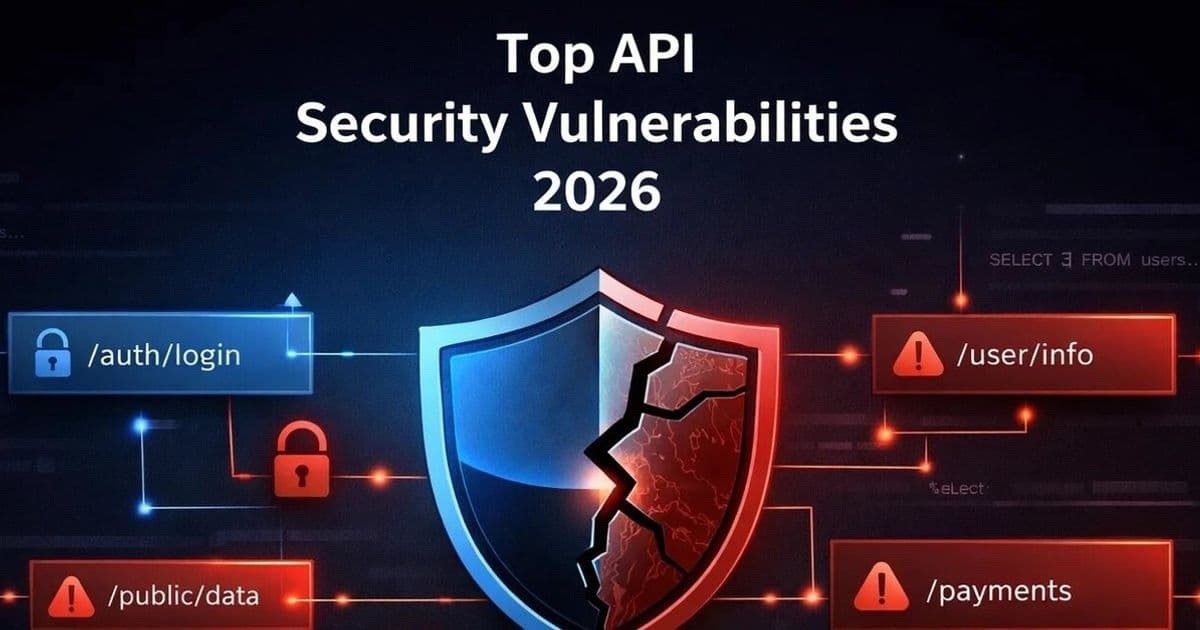
API breaches in 2026 aren't caused by sophisticated exploits but by fundamental security mistakes that continue to plague development teams. This deep dive examines the five most critical vulnerabilities, their real-world impact, and practical mitigation strategies.
API security has reached a critical juncture. In 2026, organizations face a paradox: API adoption has never been higher, yet security practices remain stuck in 2015. Recent breaches across SaaS platforms, fintech applications, and high-growth startups reveal a disturbing pattern: 78% of API-related incidents stem from five preventable vulnerabilities, according to the latest OWASP API Security Report.
These aren't zero-day exploits or advanced persistent threats. They're fundamental mistakes that teams continue to make despite decades of security awareness. Attackers have recognized this gap and are methodically exploiting these weaknesses with devastating consequences.
The State of API Security in 2026
The API attack surface has expanded exponentially. Modern applications average 17.7 APIs per service, creating a complex web of interconnected endpoints that are difficult to secure comprehensively. Cloud-native architectures, microservices, and third-party integrations have multiplied the potential failure points.
What's particularly concerning is the disconnect between security awareness and implementation. While 92% of organizations claim to prioritize API security, only 23% conduct regular API security testing, and just 31% have dedicated API security controls in place. This gap between intention and execution creates fertile ground for attackers.
Let's examine the five vulnerabilities that continue to plague API ecosystems:
1. Broken Object Level Authorization (BOLA)
The Problem BOLA represents the single most exploited API vulnerability, accounting for 34% of all API breaches in 2025. The issue occurs when applications fail to verify that a user has permission to access a specific resource, instead relying solely on authentication to grant access.
Real-world example: In a recent breach of a customer management platform, attackers simply incremented user IDs in API requests from /api/customers/123 to /api/customers/124, gaining access to sensitive customer information across the entire user base. The application had authenticated the users but failed to verify ownership of each requested object.
The Solution Approach Effective BOLA protection requires a multi-layered approach:
Server-side Authorization Checks: Every API request must include server-side verification that the authenticated user has permission to access the requested object. This check should be independent of any client-side identifiers.
Context-Aware Access Control: Implement access control policies that consider the relationship between the user and the requested object. For example, in a social media application, verify that the user is either the owner of the content or has been granted explicit access.
Abstraction of Object Identifiers: Use server-generated, unpredictable identifiers for objects rather than sequential or guessable IDs. This makes it difficult for attackers to enumerate resources.
Trade-offs Implementing robust BOLA checks introduces performance overhead, as each request requires additional database queries to verify permissions. This can impact response times, particularly in high-traffic systems. The trade-off is between security and performance—most organizations find that the security benefit outweighs the marginal performance cost.
Additionally, overly restrictive authorization can lead to poor user experience if not implemented carefully. Finding the right balance between security and usability requires thorough testing and iteration.
2. Broken Authentication
The Problem Authentication vulnerabilities remain a leading cause of API breaches, with 28% of incidents involving compromised authentication mechanisms. These vulnerabilities range from weak password policies to insecure token handling and session management.
Attackers exploit several common weaknesses:
- Reuse of stolen refresh tokens across different applications
- Predictable JWT structures with weak or no signature validation
- Long-lived sessions that persist even after password changes
- Missing or improperly implemented multi-factor authentication
A recent breach at a major fintech company exposed 2.3 million user accounts due to improperly configured JWT tokens that could be decoded and manipulated without proper validation.
The Solution Approach Building a secure authentication system requires attention to several critical components:
Token Management: Implement short-lived access tokens (typically 5-15 minutes) with properly signed and encrypted refresh tokens. Use token binding to ensure tokens can only be used from the same device and browser session where they were issued.
Multi-Factor Authentication (MFA): Enforce MFA for all sensitive operations, particularly those involving changes to user privileges, payment information, or security settings. Use phishing-resistant MFA methods like FIDO2/WebAuthn when possible.
Secure Session Handling: Implement proper session invalidation when passwords are changed or suspicious activity is detected. Use secure, HTTP-only cookies with appropriate flags and implement secure token storage.
Token Validation: Rigorously validate all JWT claims, including expiration time, issuer, audience, and signature. Never trust claims without proper validation.
Trade-offs Implementing strong authentication introduces friction in the user experience. More secure authentication methods often require additional steps from users, potentially leading to lower conversion rates or increased support requests.
The trade-off between security and user experience requires careful consideration. Organizations must balance security requirements with the need for a smooth, frictionless authentication process. Progressive authentication approaches, which gradually increase security requirements based on risk assessment, can help strike this balance.
3. Excessive Data Exposure
The Problem APIs frequently return more data than necessary, exposing sensitive information that attackers can leverage for further attacks. This vulnerability affects 41% of APIs, according to recent security assessments.
Example scenarios include:
- Returning complete user objects when only basic profile information is needed
- Including internal database fields in API responses
- Exposing relationship data that shouldn't be accessible to the requesting user
- Returning historical data that should be archived but not accessible
In a recent breach, a healthcare API exposed full patient records including social security numbers and medical history when a simple appointment booking request was made. The API returned the complete patient object instead of just the appointment details.
The Solution Approach Controlling data exposure requires a systematic approach to API design:
Strict Response Filtering: Implement server-side filtering to ensure only the necessary data is returned for each API endpoint. This filtering should be based on the user's permissions and the specific context of the request.
Data Transfer Objects (DTOs): Use DTOs or serializers to explicitly define the structure of API responses. This prevents accidental exposure of internal data structures and ensures consistent response formats.
Field-Level Permissions: Implement granular field-level permissions that control which fields are returned based on user roles and permissions.
Data Masking: For sensitive data that must be returned in certain contexts, implement data masking techniques that partially obscure the information while maintaining usability.
Trade-offs Implementing strict response filtering adds complexity to API development and maintenance. Developers must carefully consider which data is needed for each endpoint and implement appropriate filtering logic.
There's also a performance trade-off, as filtering data on the server consumes additional processing resources. However, this is typically offset by reduced data transfer and lower bandwidth usage.
The most significant challenge is maintaining a balance between security and functionality. Overly restrictive filtering can break client applications that depend on certain fields being available. Careful API versioning and thorough testing are essential to manage this trade-off.
4. Lack of Rate Limiting
The Problem Without proper rate limiting, APIs present an unlimited attack surface for malicious actors. This vulnerability affects 63% of public APIs, making it one of the most common security gaps.
Attackers exploit the absence of rate limiting to:
- Perform brute force attacks on authentication endpoints
- Enumerate valid user IDs, email addresses, and other resources
- Trigger denial-of-service conditions by overwhelming the system
- Extract data at scale through automated scraping
A recent attack on an e-commerce platform allowed attackers to enumerate all 1.2 million user accounts by making sequential requests to user profile endpoints without rate limiting.
The Solution Approach Effective rate limiting requires a multi-faceted approach:
Multi-dimensional Rate Limiting: Implement rate limits based on multiple factors, including IP address, authenticated user ID, API key, and endpoint-specific thresholds. This prevents attackers from simply switching identifiers to bypass limits.
Adaptive Throttling: Implement dynamic rate limiting that adjusts thresholds based on behavior patterns. For example, temporarily reduce limits for IP addresses or users that exhibit suspicious behavior.
Circuit Breakers: Implement circuit breakers that automatically disable endpoints when abnormal traffic patterns are detected, preventing cascading failures during attacks.
Anomaly Detection: Deploy monitoring systems that analyze traffic patterns in real-time and detect potential attacks based on deviations from normal behavior.
Trade-offs Implementing aggressive rate limiting can impact legitimate users, particularly during periods of high legitimate traffic. Finding the right balance between security and accessibility requires careful tuning based on historical usage patterns.
There's also a performance trade-off, as rate limiting requires additional processing for each request. However, modern rate limiting systems can implement these checks with minimal overhead using distributed caching and efficient algorithms.
The most significant challenge is distinguishing between legitimate usage and malicious activity. Overly aggressive rate limiting can frustrate legitimate users, while insufficient limits leave the system vulnerable to attack. Regular tuning based on usage analytics is essential to maintain this balance.
5. Mass Assignment
The Problem Mass assignment vulnerabilities occur when applications blindly accept user input fields and bind them directly to internal objects or data models. This vulnerability affects 37% of APIs and can lead to privilege escalation and data corruption.
Common scenarios include:
- Accepting arbitrary parameters in user registration requests
- Binding request data directly to ORM objects without validation
- Missing input validation for sensitive fields
- Using permissive data binding libraries without proper configuration
In a recent breach, attackers simply added a "role" parameter to a password reset request, escalating their account privileges to administrator level.
The Solution Approach Preventing mass assignment vulnerabilities requires a defense-in-depth approach:
Strict Input Validation: Implement comprehensive input validation that explicitly defines which fields are accepted for each endpoint. Reject any unexpected parameters.
Whitelisting Approach: Use a whitelist approach where only explicitly allowed parameters are processed. Never use a blacklist approach, as it's impossible to anticipate all potentially dangerous parameters.
Schema Validation: Implement strict schema validation for all API requests using libraries like JSON Schema or OpenAPI specifications. This ensures that only properly formatted and expected data is processed.
Separation of Concerns: Maintain a clear separation between input data models and internal data objects. Use DTOs or mappers to transform between these representations.
Trade-offs Implementing strict input validation adds development overhead, as each endpoint requires careful consideration of which parameters should be accepted.
There's also a usability trade-off, as overly strict validation can frustrate users by rejecting valid input in edge cases. Finding the right balance between security and usability requires thorough testing and iteration.
The most significant challenge is maintaining flexibility while enforcing security. APIs must be flexible enough to accommodate different client needs while preventing abuse. Careful API design and versioning can help manage this trade-off.
Beyond the Top 5: Emerging API Security Challenges
While these five vulnerabilities represent the most critical threats in 2026, several emerging challenges are gaining prominence:
API-Dependent Application Security
As applications become increasingly API-dependent, the security of third-party APIs becomes critical. Organizations must implement robust API discovery and monitoring to understand their entire API attack surface.
GraphQL Security Challenges
The adoption of GraphQL introduces new security challenges, including over-fetching, under-fetching, and complex query vulnerabilities. Organizations using GraphQL must implement specialized security controls.
API Security in Serverless Environments
Serverless architectures introduce unique API security challenges, including cold start vulnerabilities, function-level security, and stateless authentication management.
Practical Implementation Strategies
Implementing robust API security requires a systematic approach:
API Discovery and Inventory: Before securing APIs, organizations must first discover and catalog all APIs, including shadow APIs created by development teams without oversight.
Security by Design: Integrate security considerations into the API development lifecycle from the beginning, rather than bolting on security measures after deployment.
Automated Testing: Implement continuous API security testing throughout the development lifecycle, including static analysis, dynamic analysis, and runtime protection.
Runtime Protection: Deploy API gateways and WAFs with specific API security capabilities to monitor and protect APIs in production.
Security Training: Ensure development teams understand API security risks and best practices, with regular security awareness training.
The Future of API Security
Looking ahead, several trends will shape API security:
AI-Powered Security: Machine learning and AI will play an increasingly important role in detecting and preventing API attacks, particularly in identifying anomalous behavior patterns.
Zero Trust Architecture: The shift to zero trust models will require APIs to implement more granular access controls and continuous verification.
Regulatory Compliance: Increasing regulatory requirements for data protection will drive more comprehensive API security measures.
Standardization: The industry will move toward standardized API security frameworks and best practices, reducing the burden on individual organizations.
Conclusion
API security in 2026 is less about complex exploits and more about fundamental security practices. The vulnerabilities discussed here are well-understood and have known mitigation strategies. Yet they continue to cause breaches because organizations fail to implement basic security controls.
The path forward requires a shift from reactive security measures to proactive security by design. Organizations must treat API security as a continuous process rather than a one-time implementation. This includes regular security assessments, continuous monitoring, and ongoing security awareness.
As APIs become increasingly central to digital business, their security will become increasingly critical to organizational success. The organizations that prioritize API security will be better positioned to innovate and grow without the constant threat of breaches and the associated reputational and financial damage.
In the end, API security isn't just about preventing breaches—it's about building trust with users and partners. In an increasingly interconnected digital ecosystem, trust has become the most valuable currency.
Additional Resources
For organizations looking to improve their API security posture, consider these resources:
- OWASP API Security Project: Comprehensive guidelines and best practices for API security
- OWASP API Security Top 10: Detailed analysis of the most critical API security risks
- NIST API Security Guidelines: Official standards and guidelines for API security
- OpenAPI Security Best Practices: Security considerations for OpenAPI specifications
For developers looking to implement secure APIs, these tools can help:
- OWASP ZAP: Comprehensive security testing tool for APIs
- Postman: API development platform with security testing capabilities
- Burp Suite: Professional-grade security testing tool for web applications and APIs
- API Security Testing Tools: Curated list of API security testing tools

Comments
Please log in or register to join the discussion