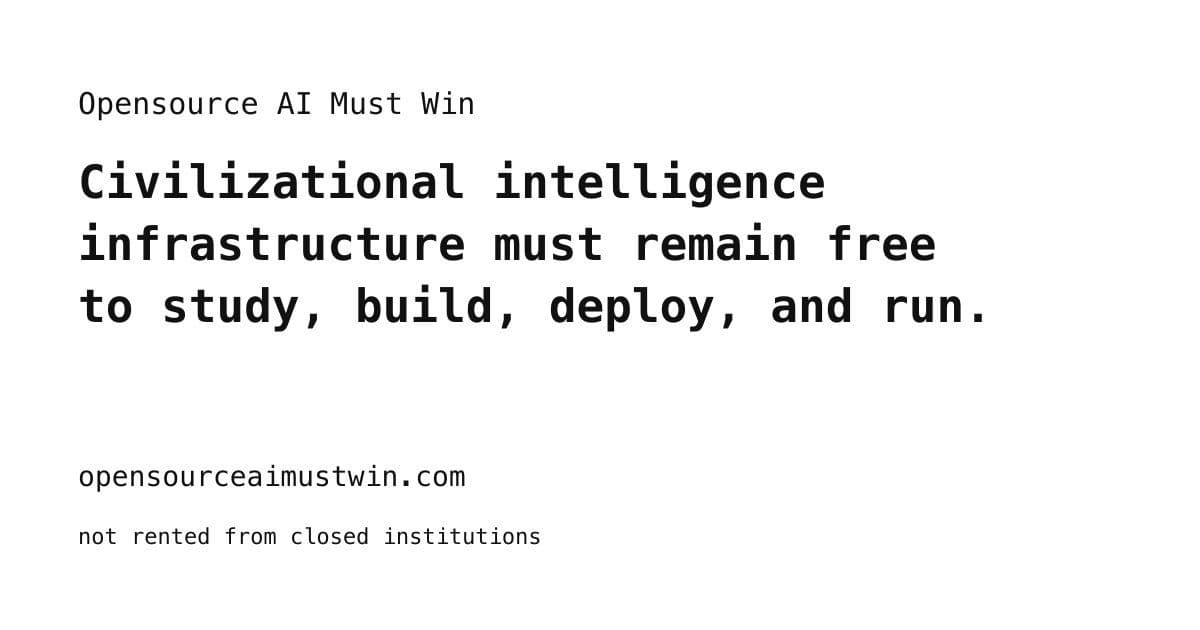
A one-page manifesto from developer Ahmad Osman frames open AI as a question of operational freedom, not just software licensing. It taps into a real anxiety about renting intelligence from a handful of labs, but the rallying cry runs into harder questions about who actually pays for frontier compute.
A single-page site titled Opensource AI Must Win has been making rounds in developer circles, and its core argument is less about code licenses than about something its author calls operational freedom. The pitch from Ahmad Osman is direct: if intelligence becomes something people can only rent from a few closed institutions, the public loses the ability to study, build, repair, deploy, audit, adapt, teach, preserve, and run these systems without asking permission.
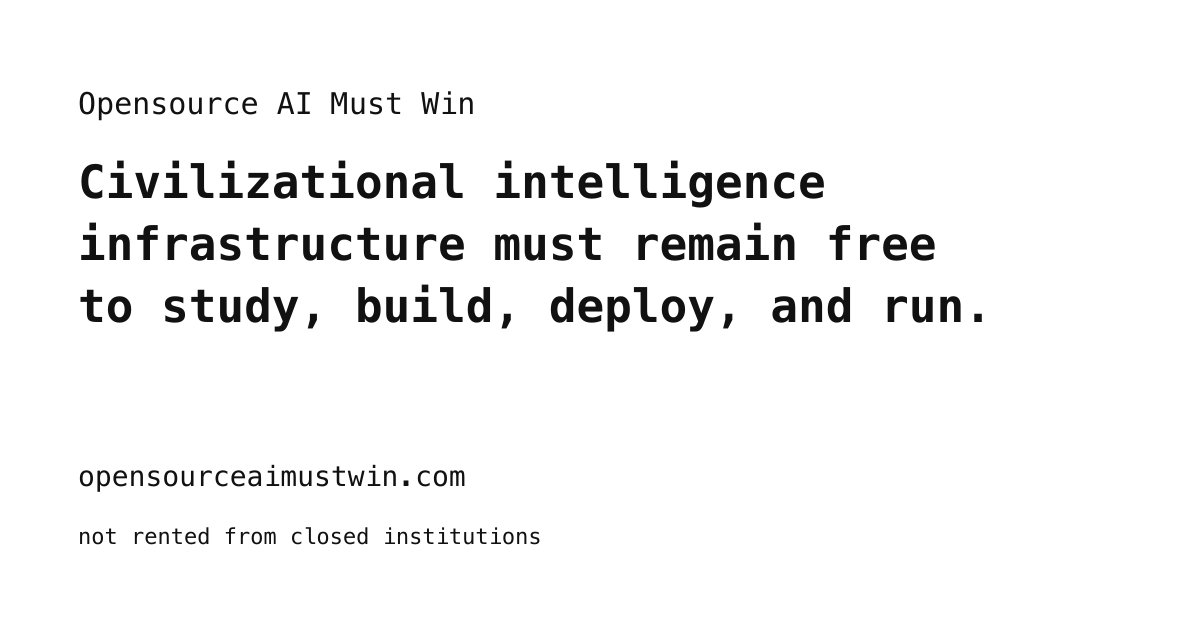
The framing is deliberately expansive. Where most open source advocacy stays anchored to the right to read and modify source code, this manifesto positions AI as civilizational infrastructure, on par with roads or electrical grids, spanning work, education, science, public services, and national capacity. The fear it names is specific and increasingly common in technical conversations: that access to capable models will depend on closed APIs, remote platforms, shifting terms of service, opaque moderation, and prices set by a handful of companies. The memorable phrase from the page is the warning that this infrastructure risks becoming "a subscription economy for cognition."
Why the message is landing
The manifesto resonates because the developer community has already lived through the volatility it describes. Anyone who built on top of a model API in the last two years has watched endpoints get deprecated, pricing tiers reshuffle, rate limits tighten, and model behavior change underneath production applications without warning. The release of capable open-weight models from Meta's Llama line, Mistral, and a wave of Chinese labs including DeepSeek and Alibaba's Qwen gave teams a sense that they had alternatives. Tooling like Ollama, llama.cpp, and vLLM made local inference genuinely practical on consumer and prosumer hardware.
That ecosystem is what gives the manifesto's checklist its weight. When it insists open AI should remain "usable, understandable, reproducible, locally deployable, economically viable, and community-governed," it is describing capabilities that already partly exist rather than a hypothetical. The sentiment shows up repeatedly in community spaces, where the appeal of a model you can run offline, fine-tune on private data, and audit for behavior is treated as a practical engineering advantage and not only an ideological preference.
The counter-arguments developers keep raising
The pushback is just as real, and it tends to cluster around a few points. The first is definitional. "Open source AI" is doing a lot of work in the manifesto, but most of the models people celebrate are open-weight, not open source in any traditional sense. You can download and run the weights, but the training data, the full training code, and the data pipeline are usually undisclosed. The Open Source Initiative spent over a year hammering out a formal definition precisely because the gap between "weights you can download" and "a system you can reproduce" is enormous. A model you cannot retrain from scratch is auditable only up to a point.
The second objection is economic, and it is the one the manifesto handles least convincingly. Training a frontier model still costs tens to hundreds of millions of dollars in compute, and inference at scale is not free either. The page asserts that open AI must remain "economically viable" without explaining who funds the next generation of base models when the dominant open-weight releases come from companies subsidizing them for strategic reasons. Meta open-weights Llama partly to commoditize a layer its rivals want to sell. That is a fragile foundation for a freedom movement, because the moment the strategic calculus shifts, the releases can stop.
The third tension is geopolitical, and the manifesto leans into it rather than away. It explicitly invokes American capacity, arguing that "America should not fall behind on the freedom to run, inspect, modify, benchmark, teach, and preserve intelligence infrastructure," while also calling for global open standards. Some readers see a coherent position: build domestic capability, then publish it openly. Others read a contradiction, since several of the most influential open-weight releases now come from Chinese labs, and a nationally framed open movement sits awkwardly next to a genuinely borderless one. The manifesto wants both the patriotic framing and the universalist one, and it does not fully reconcile them.
What the document actually is
It helps to be precise about the artifact. This is a manifesto, not a project, a license, a foundation, or a funded initiative. There is no repository of models, no governance body, no reference implementation attached. That is not a criticism so much as a category note. Its function is rhetorical, an attempt to give a diffuse anxiety a name and a banner. Movements often start exactly this way, with a statement of values that precedes any institution capable of carrying them out.
The risk of that format is that values without mechanisms tend to get absorbed by whoever has the resources to claim them. "Open" has already been stretched to cover everything from fully reproducible research to weights released under restrictive custom licenses that forbid certain commercial uses. A manifesto that does not define its terms tightly leaves room for the same companies it warns about to wave the same flag.
Still, the underlying worry deserves the attention it is getting. The history of computing offers a real precedent in the way the free software and open source movements preserved an alternative to fully proprietary platforms, and that alternative mattered enormously when it became the substrate for most of the modern internet. Whether intelligence infrastructure follows a similar path is genuinely unsettled. The manifesto's contribution is not a roadmap. It is a clear articulation of the stakes, and on that narrow point it has clearly struck a nerve that the rest of the community is still arguing about.
Comments
Please log in or register to join the discussion