
IBM's journey through the ATM industry reveals how even tech giants can stumble when market dynamics shift, leaving behind cryptographic legacies and design patterns that still shape modern banking.
IBM's journey through the automated teller machine industry offers a fascinating case study in technological innovation, market dynamics, and the challenges of maintaining dominance across evolving product categories. While IBM is often remembered for its mainframe computers and business machines, its ATM ventures reveal both remarkable technical achievements and strategic missteps that ultimately led to its exit from the market.
The Pre-ATM Era: Banking Automation's Foundation
The story begins not with ATMs themselves, but with the broader automation of banking operations. In the 1930s, bank branches maintained customer account information through manual ledger systems. Each transaction required physical documentation, and reconciling accounts across multiple branches involved armies of clerks manually processing paper records. This system worked for an era of infrequent transactions, but the post-World War II economic boom and increasing mobility created demands that manual processing could not meet.
Banks turned to unit record equipment—punched card machines that could sort, total, and process transactions mechanically. These machines represented the first wave of business computing, allowing banks to handle larger volumes of transactions without proportionally increasing staff. The evolution from simple mechanical sorters to sophisticated "posting machines" that could automatically update account ledgers marked a crucial step toward the computerized banking systems that would eventually support ATMs.
The First Cash Dispensers: Token-Based Systems
When ATMs first appeared in the 1960s, they bore little resemblance to today's machines. The earliest "cash machines" were token-based systems that required customers to obtain special cards from bank tellers during business hours. These tokens, often paper cards with punched holes encoding account information, could be inserted into machines after hours to receive cash.
This approach seems primitive by modern standards, but it addressed a real need: providing customers access to cash outside of banking hours without requiring real-time communication with central accounting systems. The tokens were thought to be relatively secure because they were issued under bank supervision and could be revoked if lost. Some early systems even experimented with unusual security features, like Barclaycash machines that used Carbon-14 ink detectable by beta radiation sensors.
IBM's Entry: The 2984 Cash Issuing Terminal
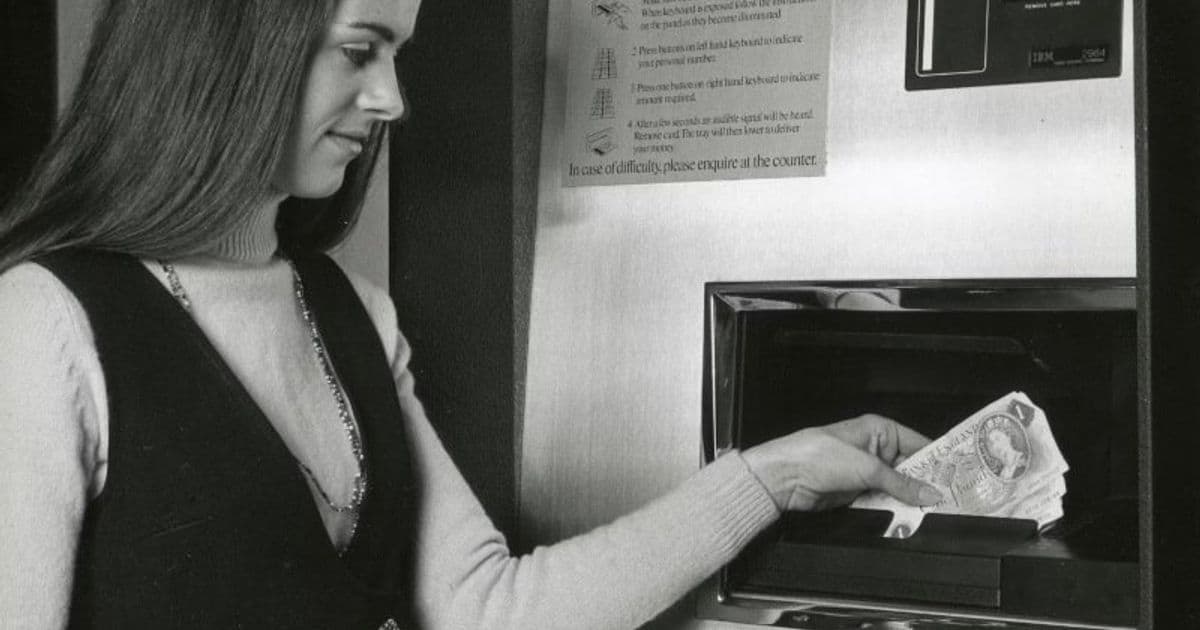
IBM's first significant ATM offering, the 2984 Cash Issuing Terminal, represented a quantum leap forward. Introduced in 1972 as Lloyds Bank's "Cashpoint" in the UK, the 2984 was essentially a modern ATM in concept and operation. Customers inserted magnetic cards containing account numbers and entered Personal Identification Numbers (PINs). The machine communicated with a central computer over dedicated telephone lines to verify account balances and authorize cash dispensing in real time.
This seemingly simple innovation required solving complex technical challenges. The most significant was security: how to prevent attackers from intercepting communications between remote ATMs and central computers to issue fraudulent cash-dispensing commands. IBM's solution was to encrypt the communications channel using a modified version of Horst Feistel's LUCIFER block cipher algorithm. This cryptographic work would later evolve into the Data Encryption Standard (DES), making the humble ATM a crucial contributor to the development of modern computer cryptography.
The 2984's architecture was remarkably similar to modern ATMs. It functioned as a "dumb terminal" connected to a mainframe computer running CICS (Customer Information Control System), IBM's online transaction processing system. The ATM displayed whatever the computer sent, dispensed cash when commanded, and sent all user input directly to the host. This thin-client model, where the ATM handles only physical interactions while the host manages all business logic, remains the standard architecture for ATMs today.
The 3614 and 3624: IBM's ATM Breakthrough
Despite the 2984's technical sophistication, it achieved limited commercial success outside of Lloyds Bank. The machine was essentially a custom peripheral designed for specific IBM System/360 environments, making it expensive and inflexible for other banks. By the time IBM developed a more general-purpose ATM, competitors like Docutel had already captured significant market share in the United States.
IBM's breakthrough came with the 3614 Consumer Transaction Facility in 1977, followed by the 3624 in 1978. These machines shared the same basic architecture as the 2984 but were designed as standard catalog items rather than custom solutions. The 3624, in particular, became widely adopted and established several conventions still used in modern ATMs.
One of the 3624's most enduring contributions was its approach to PIN management. The machine used a cryptographic algorithm to calculate an "intermediate PIN" from the card number and a secret key, then added a "PIN offset" stored on the card itself to produce the actual PIN the user entered. This system allowed banks to let customers choose their own PINs while maintaining security through the underlying cryptographic relationship. Today, this approach is known as the "3624 algorithm" and remains in widespread use.
The 3624 also introduced practical features like envelope deposit systems and receipt printing. Its receipt printer used an unusual mechanism: it printed transaction statements onto 96-column punch cards originally designed for IBM's System/3 midrange computers. This repurposing of existing technology exemplifies IBM's approach of leveraging its broader product ecosystem.
The 4700 System and 473x ATMs: Strategic Missteps
IBM's dominance in ATMs was short-lived. In 1983, the company completely redesigned its branch banking solution with the 4700 Finance Communication System. While technically advanced—introducing CRT displays, distributed processing capabilities, and offline operation—the 4700 represented a strategic error that would cost IBM its ATM market share.
The fundamental problem was compatibility. The 4700 was designed as a complete replacement for the 3600 system, with no backward compatibility for existing peripherals or software. Banks that had invested heavily in 3600 systems faced the prospect of replacing their entire infrastructure to adopt the new ATMs. Meanwhile, competitors like NCR offered ATMs that could emulate 3624 functionality, providing a drop-in upgrade path for existing installations.
This incompatibility issue reflected a broader strategic difference. IBM approached ATMs as part of a complete banking solution, while competitors treated them as standalone devices that could integrate with various backend systems. For banks, the flexibility to upgrade ATMs without overhauling their entire computer infrastructure was more attractive than IBM's integrated approach.
The 473x series ATMs (including models 4732, 4730, 4731, 4736, 4737, and 4738) introduced from 1983 to 1988 were technically capable machines with features like full CRT interfaces and envelope deposits. However, they sold poorly, earning descriptions like "debacle" in trade press. The combination of high costs, infrastructure incompatibility, and competitive alternatives made them unattractive to most banks.
The InterBold Joint Venture: IBM's Exit Strategy
After the failure of the 473x series, IBM exited the ATM manufacturing business for nearly a decade. In 1996, the company formed a joint venture with Diebold called InterBold, with IBM handling international sales and Diebold managing the U.S. market. This arrangement allowed IBM to maintain a presence in the ATM industry without the manufacturing and support overhead.
The joint venture was successful, becoming the dominant ATM manufacturer in the United States. In 1998, Diebold bought out IBM's share, marking the end of IBM's direct involvement in the ATM market. Ironically, IBM had achieved market leadership, but only by partnering with a company that had learned from IBM's earlier mistakes.
Legacy and Lessons
IBM's ATM journey left several lasting legacies. The cryptographic work on the 2984 contributed to the development of DES, a standard that secured computer communications for decades. The 3624's PIN management algorithm remains in use today. The thin-client architecture pioneered by IBM's ATMs continues to define the industry standard.
More broadly, IBM's ATM experience illustrates the challenges of maintaining technological leadership across product categories. The company's initial success with the 2984 and 3624 demonstrated its ability to innovate and solve complex technical problems. However, its failure with the 4700 system showed how strategic decisions about product architecture and market positioning could undermine even superior technology.
The ATM industry's evolution from token-based systems to sophisticated networked devices mirrors broader trends in computing: the shift from batch processing to real-time transactions, the importance of security in networked systems, and the tension between integrated solutions and modular flexibility. IBM's journey through this evolution offers valuable lessons about innovation, market dynamics, and the importance of understanding customer needs beyond technical capabilities.
Today's ATMs, with their touchscreens, multilingual interfaces, and complex transaction capabilities, bear little resemblance to the 2984 that started it all. Yet the fundamental architecture—a dumb terminal connected to a central computer, with encrypted communications and PIN-based security—remains essentially unchanged. In this sense, IBM's ATM legacy lives on, not in the machines themselves, but in the patterns and principles that continue to shape how we interact with our money.
Comments
Please log in or register to join the discussion