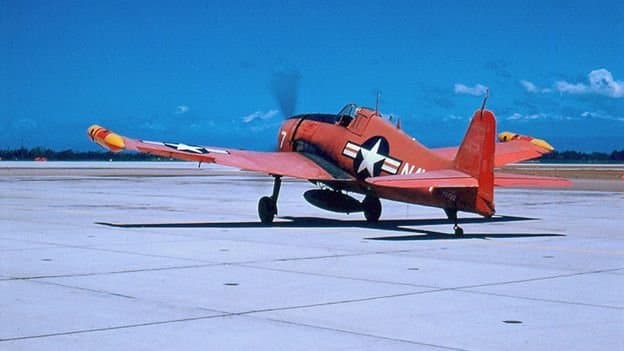
Sixty years ago, a malfunctioning drone sparked a chaotic aerial battle over Los Angeles, with fighter planes firing 208 rockets at the runaway aircraft. This historical incident reveals the challenges of early drone technology and offers lessons still relevant today.
The Runaway Drone That Sparked a Cold War Air Battle
Sixty years ago, a malfunctioning drone sparked a chaotic aerial battle over Los Angeles, with fighter planes firing 208 rockets at the runaway aircraft. This historical incident reveals the challenges of early drone technology and offers lessons still relevant today.
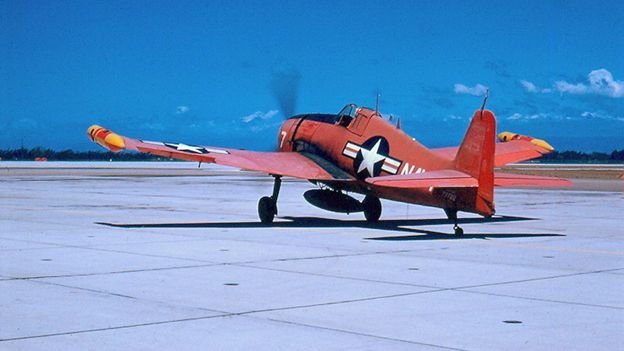
A decade after the end of World War II, US fighter planes were scrambled to protect the city of Los Angeles from an unexpected aerial threat. Nearby residents would soon run for cover as rockets rained down on American soil. The threat wasn't from Soviet intruders. And the pilots did not succeed in their mission. It's now known by some as the Battle of Palmdale.
The Unintended Target
At 11:34 am on Thursday, August 16, 1956, a special aircraft was launched from a naval air station in California. It was a Grumman F6F Hellcat fighter plane, but refitted as an unmanned vehicle – a drone. Painted bright red, it was about to be used as a target during a missile test. It would take off and fly at a leisurely pace over the Pacific Ocean before being blown to smithereens. At least, that was the plan.
Instead of taking the desired course, the drone stopped responding to commands from its remote controllers and veered southeast, towards the huge city of Los Angeles. It was an immediate danger – a crash in the wrong place could be lethal. Navy officers quickly got on the phone to nearby Oxnard Air Force Base, which had pilots on alert in case of a Russian bomber attack. Two fighters were scrambled to chase the drone, which was now nearing the city.
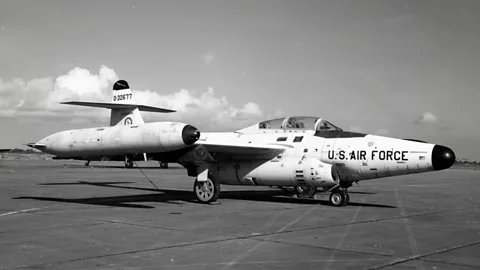
The F-89D Scorpions were designed to shoot down lumbering Soviet bombers, not nimble drones.
The Battle Unfolds
As the fighter pilots caught up with it, the Hellcat crossed over Los Angeles' airspace and eventually into an area above unpopulated land. This was their first chance. The pilots' F-89D Scorpions were equipped with "Mighty Mouse" rockets. They were unguided rockets, armed with an explosive warhead, and could easily take down a drone of the target's size – if they scored a direct hit.
But there was a problem. The rockets failed to launch when the pilots first attempted to fire them using an automatic system – they would have to switch to manual. But at that point the drone changed its course again, this time back towards Los Angeles. The situation was becoming more urgent.
An initial volley of 42 rockets was fired, to no avail. The second plane fired another 42 – still no hit. The drone was now nearing a suburban town called Newhall. Another volley. All the rockets missed.
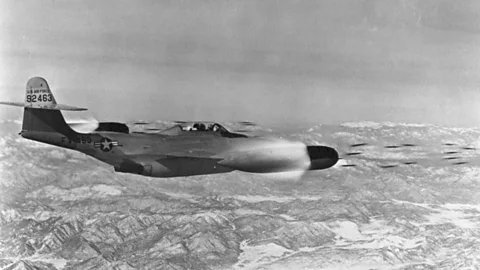
Dozens of Mighty Mouse rockets were fired at the Hellcat - but none of them hit.
Finally, as the drone turned in the direction of Palmdale, each plane fired off another round of rockets – this time 30 each. It was their last chance. But every rocket missed; 208 rockets fired and no luck. The drone flew on but ran out of fuel. Eventually, it crashed eight miles east of Palmdale, cutting through electric cables as it ploughed into the ground.
Aftermath and Significance
Incredibly, no-one was hurt or killed. But all those rockets hadn't landed without incident. All along the flight path of the fighters and their bright red quarry lay destruction caused by the F-89s' wayward salvoes. The newspapers of the day reveal the full extent of the damage.
Fires raged across 350 acres near Newhall – and it took hundreds of firemen to deal with them. Shrapnel burst through windows and into homes. One teenager driving in Palmdale had debris blast through his windshield; luckily he escaped unscathed.
One newspaper wryly wrote up the consequences of an "unintentional bombing attack" while the Los Angeles Times described as best it could the "uncontrolled and dangerous circle" of the drone's flight.
Many of the rockets hit the ground without exploding, but there was every chance that a slight disturbance could set them off. The US Air Force circulated a description of the weapons to residents in an attempt to avoid any fatal accidents.
"It was just such a bizarre story," says aviation archaeologist Peter Merlin, who stumbled across the incident 20 years ago. He had been reading some old local newspapers from the era while researching aircraft experiments and unexpectedly discovered the tale of the runaway Hellcat.
Merlin is fascinated with the number of military aircraft that flew in California at this time. Indeed, he's amassed a list of 700 crash sites since the 1930s. "Most of them are military or experimental planes," he says.
In 1997, Merlin and fellow investigator Tony Moore managed to find the Hellcat's crash site. He says they could even see the scars of damage still left on the repaired powerlines. And in the dirt were obvious pieces of aluminium – with red paint and markings proving it was indeed the aircraft they were looking for.
Why Couldn't They Hit It?
As Doug Barrie of the International Institute for Strategic Studies in London says, the task was a lot easier said than done.
"You've got these two vehicles moving in three dimensions and you're firing an unguided rocket which is itself moving along at a fair old lick," he says. "It's not the easiest thing in the world to do and the more you miss, the harder it gets."
Firing a salvo of rockets into an enemy bomber formation was one thing, it seems, but trying to hit a small single target was quite another, as the Air Force found out that day.
Lessons for Today
Could something similar happen now? Barrie says it could, but there are more safeguards in place.
For one thing, remotely guided weapons and vehicles are often equipped with self-destruct mechanisms should they go awry. "And if the data link is lost for any amount of time you have a number of options – one of which is for the UAV to enter a loiter pattern so that it can attempt to reacquire the data link," says Barrie. "If that doesn't happen within enough time and it has enough fuel, it will attempt to return to base."
The Palmdale incident certainly isn't the only example of a runaway aircraft littering the annals of military history. In 2009, the Air Force had better success in shooting down a runaway drone – this time a modern Reaper – that nearly flew out of Afghan airspace.
And manned aircraft can sometimes wriggle out of human control, too. In 1970, a Convair F-106 jet went into a spin over Montana, prompting the pilot to eject. Amazingly, the plane stabilized and landed in a snowy field. It was in such good condition that, following repairs, it was returned to service. It earned the nickname "The Cornfield Bomber."
But a more tragic case occurred in 1989, when a Soviet pilot ejected from a MiG-23 fighter that seemed to have suffered power loss. At that point the jet was in Polish airspace, but following the ejection it continued to fly on autopilot towards the West. It flew right over East and then West Germany. US Air Force pilots were scrambled from a base in the Netherlands and told to shoot the MiG down over the North Sea. But before it reached that point, the wayward aircraft ran low on fuel, turned south and eventually crashed into a house – killing a Belgian teenager.
"Technology," says Barrie, "is fallible". And it probably always will be.
But Merlin, who is more aware than most of how accident-prone the development of these machines can be, points out that failures have always been a part of aviation history.
"The area where I live is full of aviation history – experimental vehicles, X-planes, the development of the Space Shuttle – so many different things were done out here," he says. "There was a very steep learning curve so crash sites kind of represent that legacy."
Military and local law enforcement personnel examine the crash site of the drone near Palmdale.
The Enduring Legacy
Thankfully, the Battle of Palmdale, as it was later dubbed, did not result in any deaths. But it certainly was extraordinary. A contest between man and a machine with a mind of its own, 60 years ago – in the bright blue skies above Los Angeles.
The incident serves as a reminder that as technology advances, so too do the challenges of controlling it. From early drones to modern autonomous systems, the fundamental question remains: how do we ensure these technologies remain under human control when things go wrong?
The answer, then as now, lies in robust fail-safes, thorough testing, and acknowledging that even the most advanced systems can—and sometimes will—fail.
Source: BBC Future, "The runaway drone that caused a Cold War air battle," originally published August 15, 2016
Comments
Please log in or register to join the discussion