Tesla faces compounding crises across its core businesses - from declining EV sales to failing autonomous driving systems and battery technology setbacks - all stemming from Elon Musk's repeated rejection of expert advice and insistence on flawed technical approaches.

Tesla's compounding operational crises trace back to Elon Musk's repeated dismissal of expert advice and insistence on flawed technical approaches. The company now faces simultaneous failures across its core business units, all stemming from leadership decisions that prioritized aesthetics and hype over functionality and safety.
Electric Vehicle Market Erosion
Tesla's position as EV market leader has evaporated. BYD surpassed Tesla in 2025 battery electric vehicle sales, delivering 38% more units while Tesla's sales declined 9%. In Europe, Volkswagen Group brands outsold Tesla three-to-one with 78% BEV sales growth versus Tesla's 33% decline. Competitors succeeded by focusing on affordable, mass-market models like Renault 5 and Škoda Elroq - precisely the segment Tesla abandoned when Musk canceled the promised Model 2 to fund autonomous driving projects.
This strategic misstep followed Tesla's failure to execute its own growth plan: The Cybertruck's design flaws (directed by Musk) made it commercially unviable, while the proprietary 4680 battery never achieved promised cost reductions due to Musk's insistence on unproven dry-coating technology.
Autonomous Driving Debacle

Tesla's Full Self-Driving (FSD) system remains dangerously unreliable. Despite Musk's 2024 prediction of unsupervised robotaxis by 2025, FSD requires intervention every 670 miles according to user-reported data - meaning a taxi using FSD would crash approximately every three days. Regulatory approvals remain distant, with Austin's supervised robotaxi trial operating just 5-10 vehicles concurrently.
Musk's 2021 decision to remove sensor redundancy - against engineers' advice - fundamentally compromised the system. The camera-only approach requires near-perfect accuracy that AI cannot achieve, creating inherent safety limitations. Customer adoption reflects this reality: After slashing FSD's price by 50% and offering free trials, only 2% of trial users converted to paying customers. CFO Vaibhav Taneja recently confirmed paid FSD adoption remains at just 12% of Tesla's fleet while revenue declines.
Battery Technology Setbacks
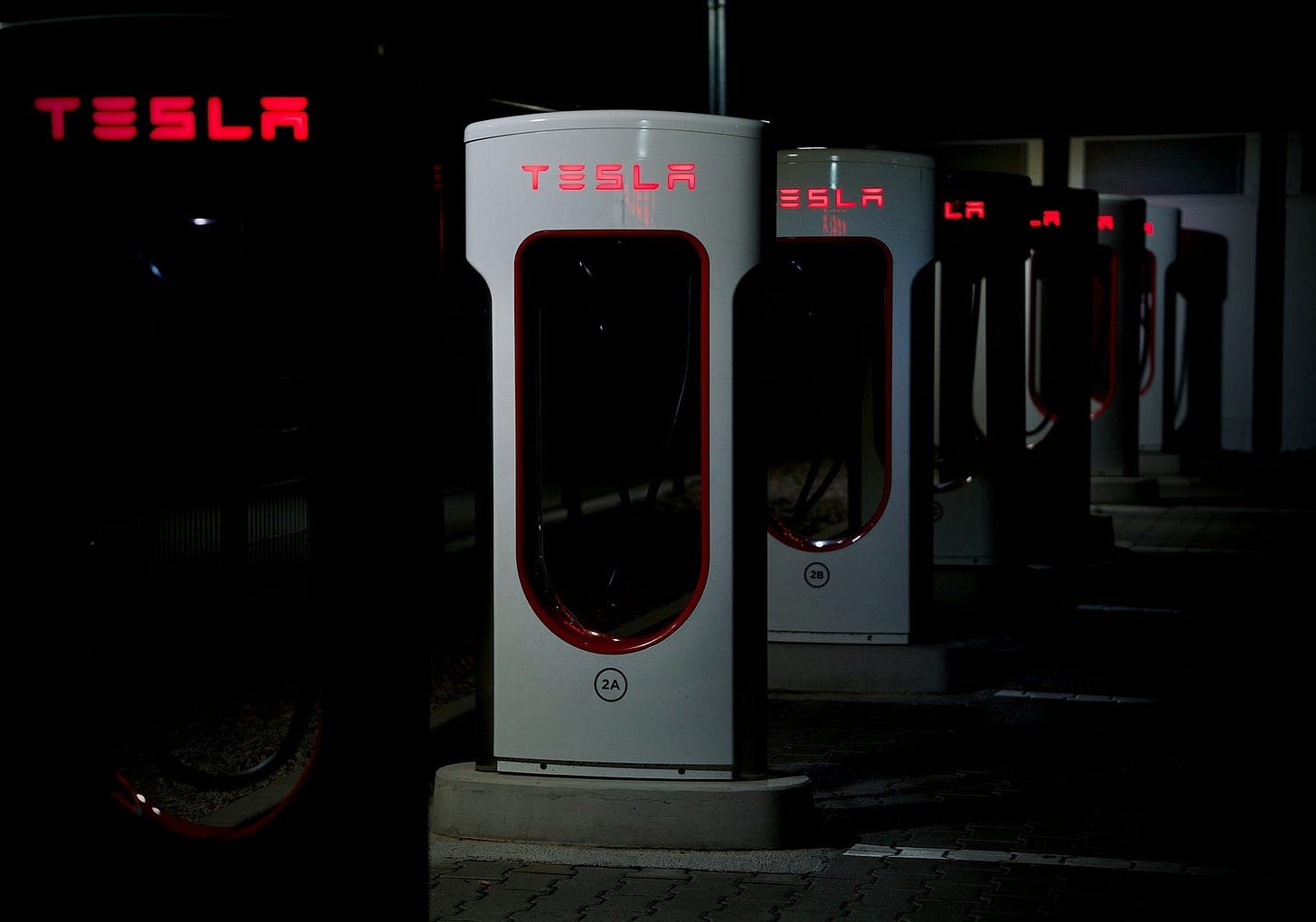
Caption: Tesla's Cybertruck production issues exacerbated battery problems (Photo by Prometheus 🔥 on Unsplash)
Tesla's energy storage division shows modest growth, but this masks critical failures in battery development. The much-hyped 4680 battery cells - intended to power Cybertrucks, Megapacks and Powerwalls - failed commercially due to production issues and the Cybertruck's flop. Key supplier L&F recently slashed a $2.9 billion cathode material contract to just $7,000, effectively terminating the program.
The 4680's failure resulted from Musk's dual miscalculations: His Cybertruck micromanagement created an unmarketable vehicle, while his insistence on unproven dry-coating tech prevented cost-effective 4680 production. Competitors like BYD pursued proven prismatic LFP technology instead, creating batteries 53% cheaper per MWh than Tesla's grid storage solutions. Tesla now retrofits 4680 production lines to manufacture LFP cells it previously outsourced.
Robotic Distractions
Optimus humanoid robots represent Tesla's latest diversion from core problems. Without expertise in robotics or real-world AI systems (as FSD's failure demonstrates), Tesla trails industry leaders like Boston Dynamics. Even as PR tools, Optimus prototypes compare poorly to Hyundai-owned Boston Dynamics' Atlas robots executing complex parkour maneuvers. With no commercial application or technical advantage, Optimus only highlights Tesla's misplaced priorities.
Strategic Crossroads
Tesla retains financial resources to correct course: Developing affordable EVs, partnering on sensor-based autonomy, and focusing on practical robotics could rebuild advantages. However, Musk's history of ignoring experts and doubling down on failed approaches makes meaningful change unlikely. The company's trajectory now points toward continued erosion across all divisions unless leadership fundamentally rethinks its approach to technology development and market strategy.
Comments
Please log in or register to join the discussion