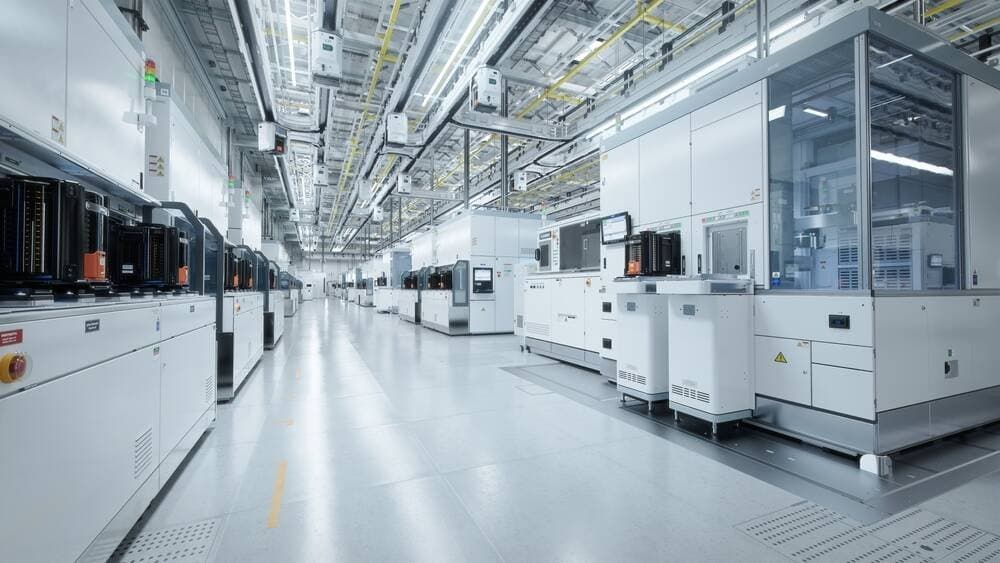
Intel's Foundry division is nearing major advanced packaging contracts worth billions annually, while CEO Lip-Bu Tan reconsiders 18A process tech for external customers after positive internal results.
Intel's Foundry division is on the verge of securing advanced packaging deals worth billions of dollars annually, according to CFO David Zinsner, who spoke at the Morgan Stanley Technology, Media and Telecom conference on Wednesday.
Advanced packaging deals could transform Intel's foundry business
Zinsner revealed that Intel has received strong customer interest in its advanced packaging technology, which has become increasingly critical as AI accelerators grow more complex. Modern GPUs often combine multiple compute and memory dies that must be fused together, creating demand for sophisticated packaging solutions.
"We've gotten really good engagement from customers on this business," Zinsner said. "We're close to closing some deals that are in the billions of dollars per year in terms of revenue."
The company has invested heavily in EMIB and Foveros 2.5D and 3D packaging technologies to support multi-die processors like its Xeon CPUs and the discontinued Ponte Vecchio GPU family. Importantly, this technology isn't limited to Intel's own manufacturing - the company has already used it to combine in-house silicon with chips manufactured by TSMC.
This development comes as welcome news for shareholders who have watched Intel's Foundry Division lose billions each quarter. However, Zinsner cautioned that there's no guarantee these deals will materialize, and even if they do, Intel's track record on timely delivery remains questionable.
18A process technology gains external customer interest
Perhaps more significantly, Intel CEO Lip-Bu Tan appears to have reversed his position on the company's 18A process technology. After initially planning to reserve 18A for internal use while offering 14A as the first mainstream commercial node, Tan is now reconsidering.
"While Lip-Bu was thinking that we probably should focus on 14A as a foundry node and make 18A just an internal node, now that we've seen some real progress there, I think he's now starting to recognize that this is actually a good node to offer to external customers as well," Zinsner explained.
The first products based on Intel's 18A process technology, codenamed Panther Lake, began shipping in PCs and notebooks earlier this year. Zinsner noted that Intel has received "some inbound interest in 18A-P as a foundry node," though he didn't name potential customers.
Intel 18A-P represents an upgraded version of 18A that promises eight percent higher performance per watt compared to the base technology, making it competitive with TSMC's 2nm process.
Financial outlook remains cautious
Despite the positive developments, Zinsner maintained that Intel's Foundry business is still at least a year away from breaking even. The company's original guidance projected exiting 2027 at break-even operating margins for Foundry.
One potential complication could be higher-than-expected external demand, which would require Intel to invest more in manufacturing capacity. "It'll be a good problem to have," Zinsner said, acknowledging the irony of success creating additional capital requirements.
These announcements suggest Intel is making tangible progress in its foundry ambitions, though significant challenges remain in execution and market penetration. The combination of advanced packaging deals and renewed interest in 18A technology could provide the momentum needed to transform Intel's Foundry division from a perennial money-loser into a competitive player in the semiconductor manufacturing landscape.
For more information about Intel's manufacturing technologies, visit Intel's official foundry page.
Comments
Please log in or register to join the discussion