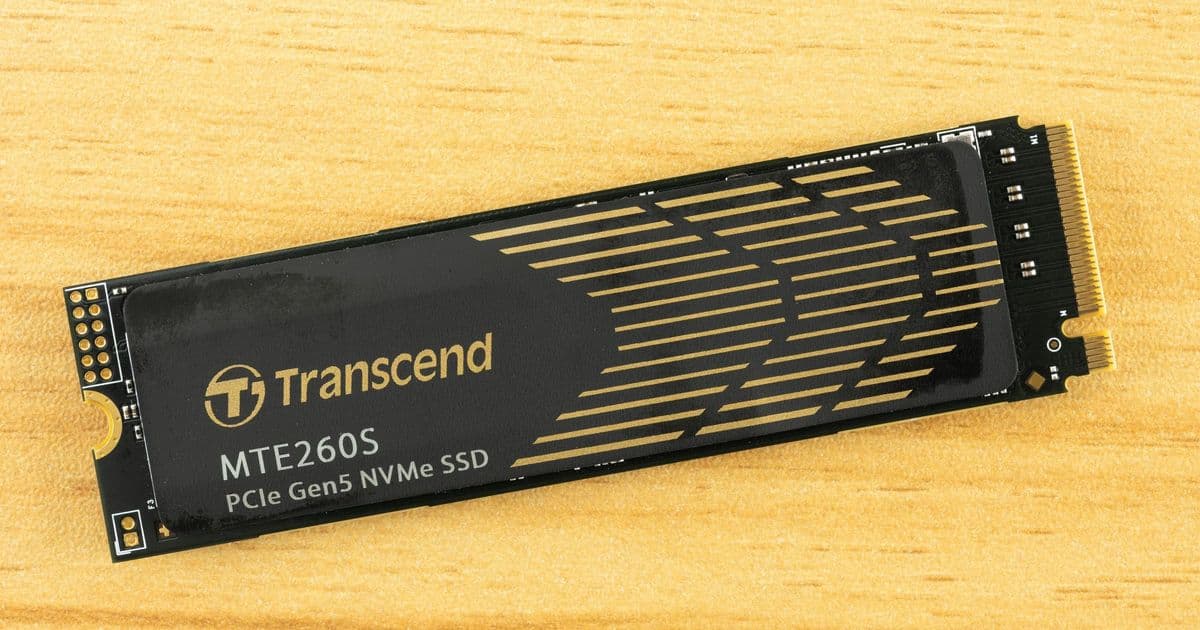
Transcend's 260S delivers consistent PCIe 5.0 performance with a focus on reliability over peak specs, making it a solid choice for pre-built systems and business applications.
The Transcend 260S 2TB SSD represents a calculated approach to PCIe 5.0 storage, prioritizing consistency and reliability over headline-grabbing performance figures. In a market where manufacturers often compete on sequential read/write speeds, Transcend has taken a different path with this drive, targeting the OEM and client system builder segment where operational stability matters more than benchmark dominance.
Performance That Prioritizes Consistency
The 260S delivers solid numbers that reflect its intended use case. With sequential read speeds reaching 14,500 MB/s and writes at 13,500 MB/s, the drive sits comfortably in the upper tier of PCIe 5.0 offerings. Random performance shows 2,000K IOPS for reads and 1,400K IOPS for writes, figures that might seem modest compared to enthusiast-class drives but are more than adequate for real-world usage.
What's particularly noteworthy is how Transcend achieves these numbers. The drive uses the Silicon Motion SM2508 controller, a component we've seen deliver excellent results across multiple implementations. Paired with Micron's 232-layer TLC NAND flash, the 260S benefits from mature, proven technology rather than cutting-edge but potentially less reliable components.
[Image:1]
Design Philosophy: Reliability Over Raw Speed
Transcend's approach becomes clearer when examining the 260S's specifications in context. The drive operates at around 10W, which is perfectly reasonable for a high-end PCIe 5.0 SSD. More importantly, the thermal design includes a graphene heatspreader that effectively manages temperatures without the need for bulky heatsinks.
The double-sided design houses four NAND packages - two on each side of the PCB. This configuration, while potentially limiting maximum cooling surface area, actually benefits from the graphene label's heatspreading capabilities. The material's effectiveness is enhanced by the physical distance between components on a full-length M.2 2280 drive.
Component Choices That Make Sense
Under the hood, the 260S reveals thoughtful engineering decisions. The drive includes 2GB of Samsung DDR4 DRAM cache, maintaining the standard 1GB:1TB ratio that ensures optimal performance under heavy workloads. This is particularly important for client drives that may face sustained operations in pre-built systems.
The NAND flash uses smaller BGA packages, which might seem like a cost-cutting measure but actually serves specific purposes. Smaller packages work better with tight PCB layouts and can be advantageous for I/O-sensitive flash like Micron's 232-layer TLC. The multiplexor arrangement seen on similar drives like the 4TB Crucial T500 demonstrates how this approach can optimize performance within physical constraints.
[Image:2]
Software and Support That Add Value
Transcend includes SSD Scope, its comprehensive toolbox application, with the 260S. While not the most visually impressive utility, SSD Scope provides all essential functions: drive health monitoring, secure erase capabilities, TRIM operations, firmware updates, and data backup/clone features. This level of software support is particularly valuable for the drive's target market of system builders and small businesses.
The warranty coverage deserves special mention. At five years with 750TBW per terabyte of capacity, the 260S exceeds typical client drive specifications. Most drives in this category offer 600TBW, making Transcend's 25% increase significant for users concerned about long-term reliability.
Market Position and Target Audience
The 260S clearly positions itself as an alternative to drives like the Kioxia Exceria Plus G4. Like those drives, it uses licensed controllers but distinguishes itself through custom firmware and potentially hand-picked components. This approach results in drives that may not achieve the absolute highest benchmark scores but offer superior consistency and reliability.
This strategy makes particular sense for pre-built systems and business applications where predictable performance and operational stability outweigh the need for peak benchmark numbers. The drive's conservative tuning means it's less likely to encounter thermal throttling or other performance anomalies that can plague more aggressively configured SSDs.
[Image:3]
Real-World Considerations
While the 260S's specifications might not dominate spec sheets, they reflect practical engineering decisions. The sequential performance numbers, for instance, are achieved under ideal conditions with high queue depths - scenarios that rarely occur in typical client usage. The drive's firmware tuning prioritizes consistent performance across various workloads rather than maximizing numbers in synthetic benchmarks.
The power efficiency of the 260S is another practical advantage. Running relatively cool compared to some competitors, the drive can maintain performance without requiring elaborate cooling solutions. This makes it particularly suitable for compact systems where thermal management is challenging.
[Image:4]
Value Proposition in a Competitive Market
Currently out of stock, the 260S has historically been available at competitive prices - a hallmark of Transcend's positioning strategy. The combination of reliable performance, comprehensive software support, and generous warranty coverage creates a compelling value proposition, especially for system builders and businesses looking for dependable storage solutions.
The drive's reliability track record, stemming from Transcend's focus on the OEM market, provides additional peace of mind. While performance enthusiasts might gravitate toward drives with higher peak specifications, users prioritizing long-term stability and consistent operation will find much to appreciate in the 260S's balanced approach.
[Image:5]
Conclusion: A Dependable Choice for Practical Users
The Transcend 260S succeeds by understanding its target market and delivering accordingly. It won't win awards for absolute performance, but it provides reliable, consistent operation that's well-suited to its intended applications. The combination of mature components, thoughtful thermal design, comprehensive software support, and generous warranty coverage makes it a strong contender in the PCIe 5.0 client drive segment.
For users building pre-configured systems, managing small business IT infrastructure, or simply seeking a dependable high-performance SSD without the potential reliability concerns of more aggressively tuned drives, the 260S represents a sensible choice. It demonstrates that in the SSD market, as in many technology segments, the best product isn't always the one with the highest specifications, but rather the one that best meets its users' actual needs.
Comments
Please log in or register to join the discussion