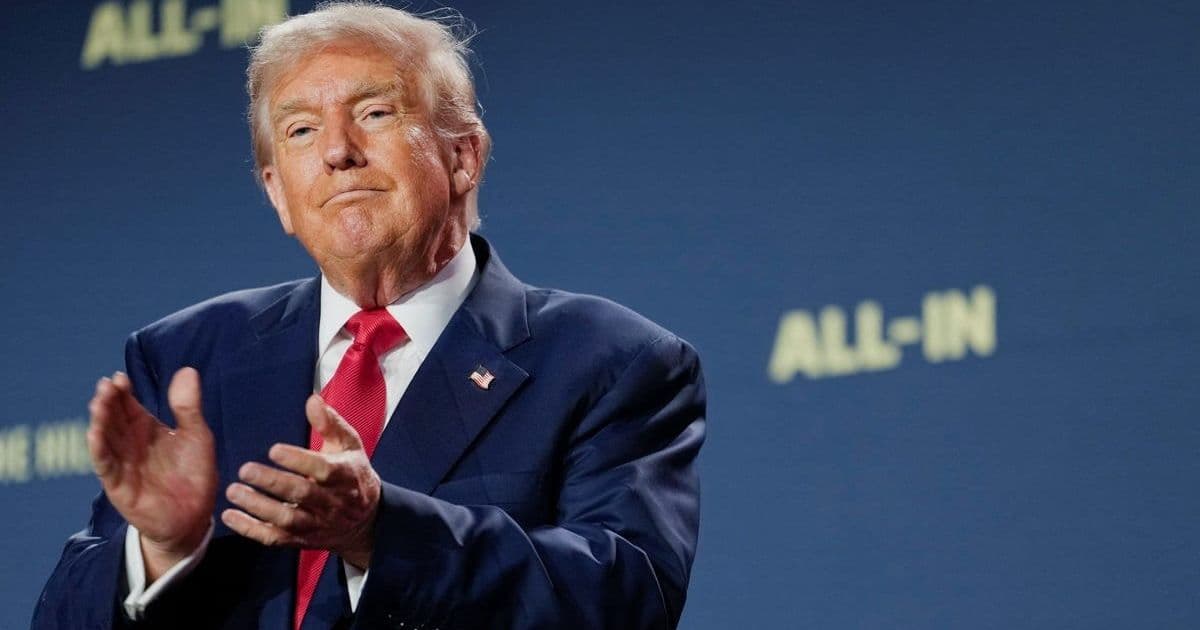
President Trump is set to sign an executive order establishing a federal framework for AI, aiming to preempt state-level regulations. The move has ignited a fierce debate between tech industry advocates seeking unified standards and state officials concerned about protecting citizens from AI harms.
President Donald Trump will sign an executive order this week establishing a federal framework around artificial intelligence, a move aimed at preempting states from imposing their own laws on the rapidly evolving technology. The announcement has sent ripples through the tech community, raising critical questions about the balance between innovation and regulation in the AI era.
"There must be only One Rulebook if we are going to continue to lead in AI," Trump wrote on Truth Social on Dec. 8. "We are beating ALL COUNTRIES at this point in the race, but that won't last long if we are going to have 50 States, many of them bad actors, involved in RULES and the APPROVAL PROCESS."
The executive order represents the latest chapter in an ongoing battle over AI governance, with tech companies increasingly advocating for a cohesive federal approach to avoid a patchwork of conflicting regulations across state lines.
A Patchwork of State Regulations
The push for federal oversight comes as states have moved aggressively to establish their own AI regulations. All 50 states, along with Puerto Rico, the Virgin Islands, and Washington, D.C., have introduced AI-focused legislation this year. According to the National Conference of State Legislatures, at least 38 states have adopted approximately 100 AI measures in 2025 alone.
This state-level activity reflects growing concerns about AI applications ranging from deepfakes to autonomous vehicles. "Two years ago, no one would have thought an AI chatbot would coach kids to take their lives," said South Carolina State Rep. Brandon Guffey, who serves on the South Carolina House of Representatives Committee on AI. "We sit here today with that knowledge yet those that took an oath to defend us, are considering a moratorium on any AI regulations, regardless of harm."
The tech industry's perspective
From a developer and industry perspective, the prospect of navigating 50 different regulatory landscapes presents significant challenges. "AI would be AI WILL BE DESTROYED IN ITS INFANCY!" Trump warned in his Truth Social post. "You can't expect a company to get 50 Approvals every time they want to do something. THAT WILL NEVER WORK!"
This sentiment resonates with many tech leaders who argue that consistent federal standards would provide the stability needed for innovation to flourish. The fear is that divergent state requirements could stifle development, particularly for startups and smaller companies lacking the resources to comply with multiple regulatory regimes.

The deepfake dilemma
The debate comes amid rising concerns about AI misuse, particularly the proliferation of deepfakes. Earlier this year, Grok AI was used to create pornographic deepfakes of women, including feminist X user Evie, highlighting the urgent need for effective governance.
"States can fight robocalls, deepfakes and provide safe autonomous vehicle laws," argued Sen. Maria Cantwell, D-Washington, during a July Senate debate. "This also allows us to work together nationally to provide a new federal framework on Artificial Intelligence that accelerates U.S. leadership in AI while still protecting consumers."
A Failed Federal Precedent
Trump's push for federal oversight follows a failed attempt to preempt state AI regulations earlier this year. When Trump signed his tax and spending bill into law on July 4, a previously proposed 10-year federal ban on state and local AI had already been stripped from it.
Just days before the vote, the Senate voted 99-1 in favor of an amendment co-sponsored by Cantwell and Sen. Marsha Blackburn, R-Tennessee, to remove a 10-year moratorium on state AI regulations from the Republican-backed legislation. "States can fight robocalls, deepfakes and provide safe autonomous vehicle laws," Cantwell argued at the time.
"It makes zero sense to remove the state's ability to protect citizens," Guffey told Public Citizen, a nonprofit consumer advocacy organization. "This is done in the interest of the world's richest companies and at the expense of our children."
The Path Forward
As the executive order takes shape, the tech community watches closely, recognizing that the approach to AI regulation will have far-reaching implications for innovation, security, and civil liberties. The tension between federal uniformity and state flexibility represents one of the most significant policy challenges of the AI age.
For developers and engineers, the coming regulatory landscape will likely shape everything from product development timelines to compliance requirements. The question remains whether the administration can craft a framework that both protects citizens and preserves America's competitive edge in the global AI race.
Comments
Please log in or register to join the discussion