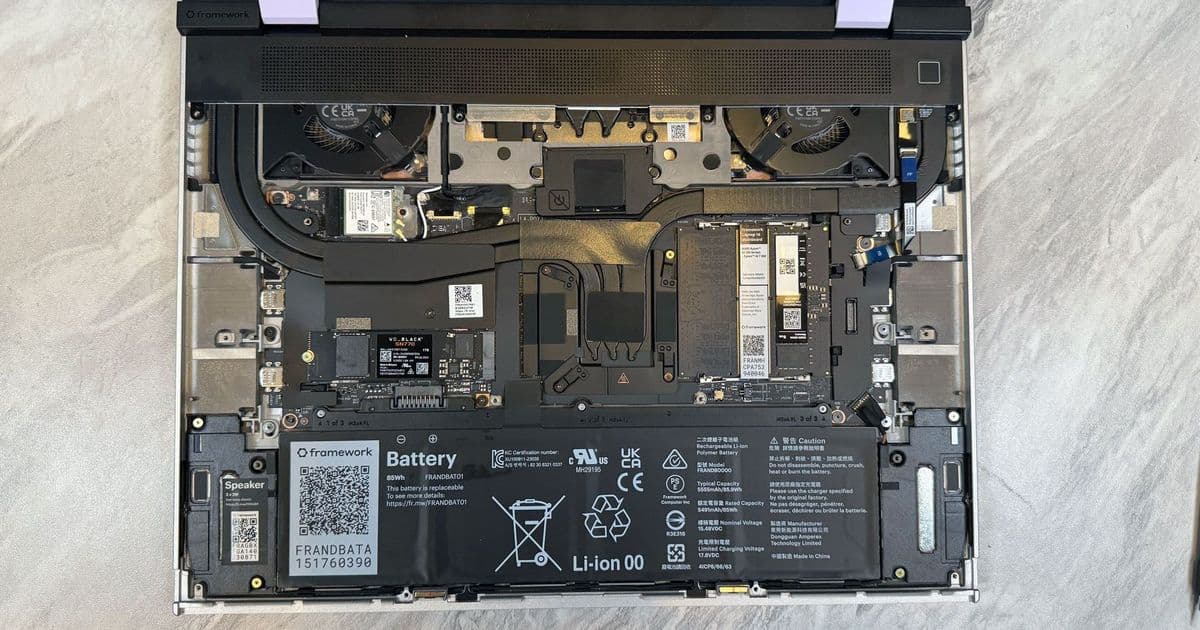
Modular laptop maker Framework announces third monthly RAM price increase while warning of dwindling Intel CPU supplies and depleted SSD inventory, highlighting the ongoing impact of AI-driven component shortages.
Modular laptop manufacturer Framework has announced its third consecutive monthly price increase for RAM, with DDR5 SO-DIMMs now costing between $13 to $18 per GB depending on capacity. This latest hike follows two previous increases in December 2025 ($10-$13/GB) and February 2026 ($12-$16/GB), representing a cumulative price surge of approximately 166% since last summer when prices were just $3.75-$5 per GB.
The company's monthly newsletter reveals that the AI-driven memory and storage shortage shows no signs of abating. While this month's increase is smaller than previous jumps—just $1-$2 per GB compared to $2-$3 increases earlier—Framework warns that the situation remains volatile and future increases cannot be ruled out.
Storage prices are now also affected, with Framework confirming it has depleted its inventory of lower-cost components. The company has been forced to re-price certain capacities to reflect current market costs for new orders. However, Framework still maintains inventory of 2TB, 4TB, and 8TB SN850X SSDs at prices "substantially below market," encouraging customers to purchase now if they need high-capacity storage.
CPU Supply Constraints Emerge
Beyond memory and storage, Framework is experiencing supply constraints on specific Intel processors. The company reports limited availability of the Intel Core i5-1334U processor used in its Framework Laptop 12 model. Framework is actively working to secure additional supply, though the company acknowledges the challenge of meeting demand.
This CPU scarcity reflects broader industry trends as AI infrastructure build-out drives demand across the entire computing stack. The transition from reasoning AI LLMs to complete agent workflows requires GPUs, NPUs, and CPUs working in concert, increasing pressure on all processor categories. Additionally, Intel's focus on upcoming releases like Arrow Lake Refresh, Panther Lake, and Nova Lake may be diverting production capacity away from current-generation parts.
Industry Context and Market Impact
The shortages affecting Framework are part of a larger semiconductor supply chain crisis. Memory makers are projected to earn $551 billion from the AI boom, creating pricing power shifts back to suppliers. Samsung and SK hynix have already shortened memory contracts as demand from AI data centers continues to outstrip supply.
The automotive industry has also been severely impacted by chip scarcity, with the worsening Nexperia and DRAM crisis disrupting production schedules and forcing manufacturers to prioritize certain models over others.
Framework's Transparent Approach
Unlike major manufacturers such as Dell and Apple that maintain opaque pricing structures with significant markups on RAM and component upgrades, Framework has taken a different approach. The company has been transparent about price increases, providing monthly updates to customers and pricing components as close to cost as possible.
This transparency extends to inventory management, with Framework openly acknowledging when it's running low on specific components and warning customers about potential delays or price increases. The company's willingness to share detailed information about supply chain challenges represents a stark contrast to the typical manufacturer approach of absorbing costs or maintaining fixed pricing despite market fluctuations.
What This Means for Consumers
For potential Framework customers, the current situation presents both challenges and opportunities. While RAM prices have increased significantly, the company's remaining inventory of SN850X SSDs at below-market prices represents a potential value opportunity for those needing high-capacity storage.
The CPU supply constraints suggest that popular configurations may become harder to obtain, particularly the Framework Laptop 12 with its Intel Core i5-1334U processor. Customers interested in specific configurations should consider ordering sooner rather than later to avoid potential shortages or price increases.
Looking ahead, the persistence of these shortages suggests that the AI-driven demand for components will continue to impact the broader PC market throughout 2026. Framework's experience may serve as an early indicator of challenges that other manufacturers will face as they attempt to balance AI infrastructure demands with consumer product availability.
The company's transparent approach to communicating these challenges provides valuable insight into the real-world impact of the AI boom on component pricing and availability, offering a level of visibility that's rare in the typically opaque PC component market.
Comments
Please log in or register to join the discussion