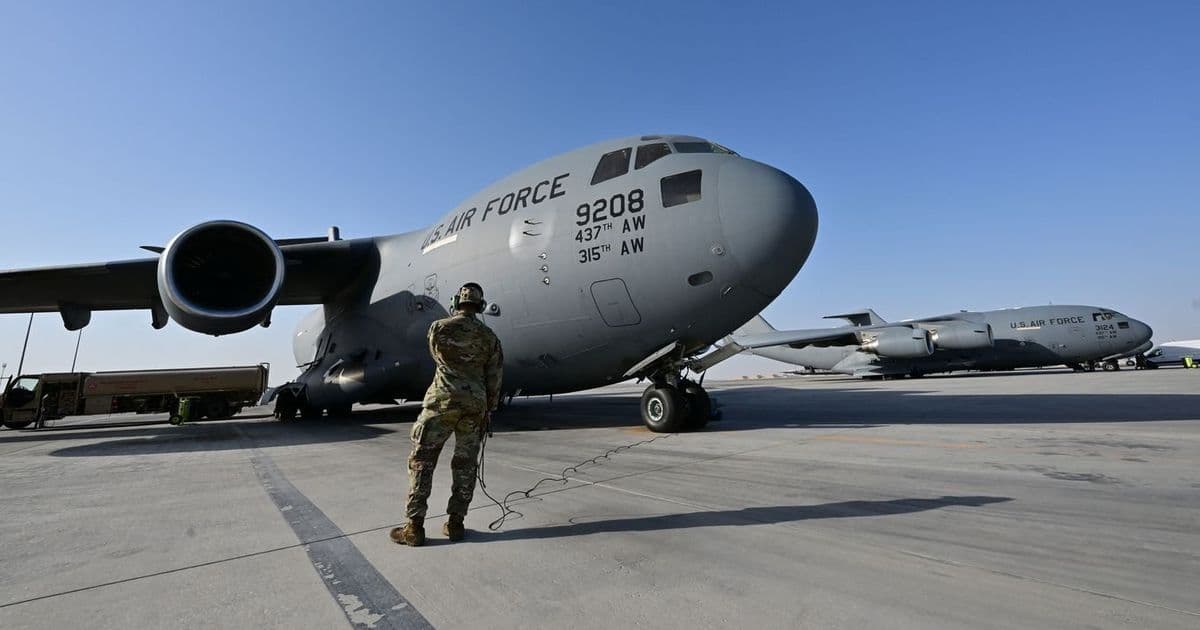
The Pentagon has ordered non-essential personnel and families to evacuate multiple bases across the Middle East, signaling heightened preparation for potential military action against Iran as diplomatic channels close.
The United States began evacuating non-essential personnel and military families from bases across the Middle East on Tuesday, a clear signal that the Trump administration is seriously weighing military strikes against Iran following the breakdown of nuclear negotiations.
The evacuation order covers facilities in Iraq, Kuwait, Bahrain, and the United Arab Emirates, according to defense officials. The move comes as satellite imagery shows increased Iranian naval activity in the Strait of Hormuz and as intelligence reports indicate Tehran has accelerated its uranium enrichment to near weapons-grade levels.
Financial and Strategic Implications
Defense contractors have seen immediate market reactions. Lockheed Martin shares rose 3.2% in after-hours trading, while General Dynamics gained 2.8%. The broader aerospace and defense index jumped 4.1% as investors priced in the possibility of sustained military operations.
The evacuation itself carries significant costs. Relocating approximately 12,000 military families and civilian contractors will cost an estimated $450 million over the next 90 days, according to Pentagon budget projections. This includes chartered flights, temporary housing, and storage of personal property.
More significantly, the move signals that diplomatic solutions have likely been exhausted. Secretary of State Mike Pompeo canceled his scheduled trip to Brussels, while the State Department issued a Level 4 "Do Not Travel" advisory for the entire region.
Base Vulnerabilities and Iranian Response
The evacuated facilities include Al Udeid Air Base in Qatar, which houses the forward headquarters of U.S. Central Command and approximately 10,000 American personnel. The base sits within Iran's ballistic missile range, and recent intelligence suggests Iran has positioned short-range missiles capable of striking the facility.
Kuwait's Camp Arifjan, home to the Army's 1st Theater Sustainment Command, is also partially evacuating. The base serves as the logistical hub for all U.S. operations in the region, making it a prime target for Iranian retaliation.
Iran's Revolutionary Guard has already responded. On state television, they broadcast footage of underground missile silos and fast-attack craft conducting exercises in the Persian Gulf. Oil prices reflected the tension, with Brent crude rising $4.70 to $89.23 per barrel, a 5.6% increase that adds approximately $18 billion in monthly global energy costs.
Military Options on the Table
Defense officials confirm the Pentagon has presented President Trump with three primary options:
Limited strikes: Targeting specific nuclear facilities at Natanz and Fordow with precision munitions, similar to the 2018 strike on Syria's chemical weapons sites. This would take 48-72 hours and carry an estimated cost of $2.3 billion.
Sustained air campaign: A weeks-long operation to degrade Iran's air defenses and missile capabilities before striking nuclear infrastructure. This mirrors the 1991 Gulf War air campaign and would cost $15-25 billion.
Full-scale intervention: Including potential naval blockades and ground operations, which defense planners estimate could exceed $100 billion in the first year alone.
The White House has not confirmed which option is preferred, though National Security Advisor John Bolton has publicly advocated for more aggressive action. Trump, however, has expressed reluctance to commit to prolonged foreign conflicts, creating uncertainty within the military chain of command.
Market and Economic Fallout
Beyond defense stocks, the evacuation has triggered broader market volatility. The VIX volatility index, known as Wall Street's fear gauge, spiked 34% to 28.4, its highest level since October 2019. Tech stocks, particularly those with significant Middle East revenue exposure, saw sharp declines. Microsoft dropped 2.1% and Oracle fell 3.4% as investors worried about disrupted cloud services contracts in the region.
Insurance rates for shipping through the Persian Gulf have already increased 250%, according to Lloyd's of London. The Strait of Hormuz handles approximately 21 million barrels of oil daily, representing 21% of global petroleum consumption. Any disruption there would have immediate inflationary effects worldwide.
What Comes Next
Military analysts expect a decision within 72-96 hours. The evacuation timeline suggests the administration wants non-combatants clear before any action, but doesn't necessarily indicate an imminent strike. Similar evacuations occurred in 2011 before the raid that killed Osama bin Laden and in early 2003 before the Iraq invasion.
For now, the Pentagon has elevated its force protection condition at all remaining bases. Troops have been instructed to wear body armor at all times, and air defense systems have been placed on heightened alert.
The next diplomatic window closes Friday, when the UN Security Council is scheduled to vote on a resolution calling for renewed inspections. U.S. Ambassador to the UN Nikki Haley has already indicated the United States would veto any measure that doesn't include immediate, unrestricted access to all Iranian facilities.
Defense Secretary James Mattis, who has consistently argued for diplomatic solutions, is scheduled to brief congressional leaders Thursday morning. The closed-door session will likely determine whether the administration seeks congressional authorization for military action or proceeds under the 2001 Authorization for Use of Military Force that has been interpreted broadly for counterterrorism operations.
The evacuation order remains in effect until further notice, with personnel instructed to prepare for a minimum 90-day absence. Military families have been told to bring essential documents, medications, and valuables, while leaving most personal belongings in government storage.
This marks the most significant U.S. military repositioning in the Middle East since the 2003 Iraq invasion, and it comes at a time when the region is already destabilized by the ongoing civil war in Syria, the Saudi-Yemen conflict, and rising tensions between Israel and Hezbollah.
The financial markets will be watching closely tomorrow morning. Defense sector analysts predict further gains for contractors, while energy sector volatility will likely continue until there is clarity on whether military action will actually occur.
Comments
Please log in or register to join the discussion