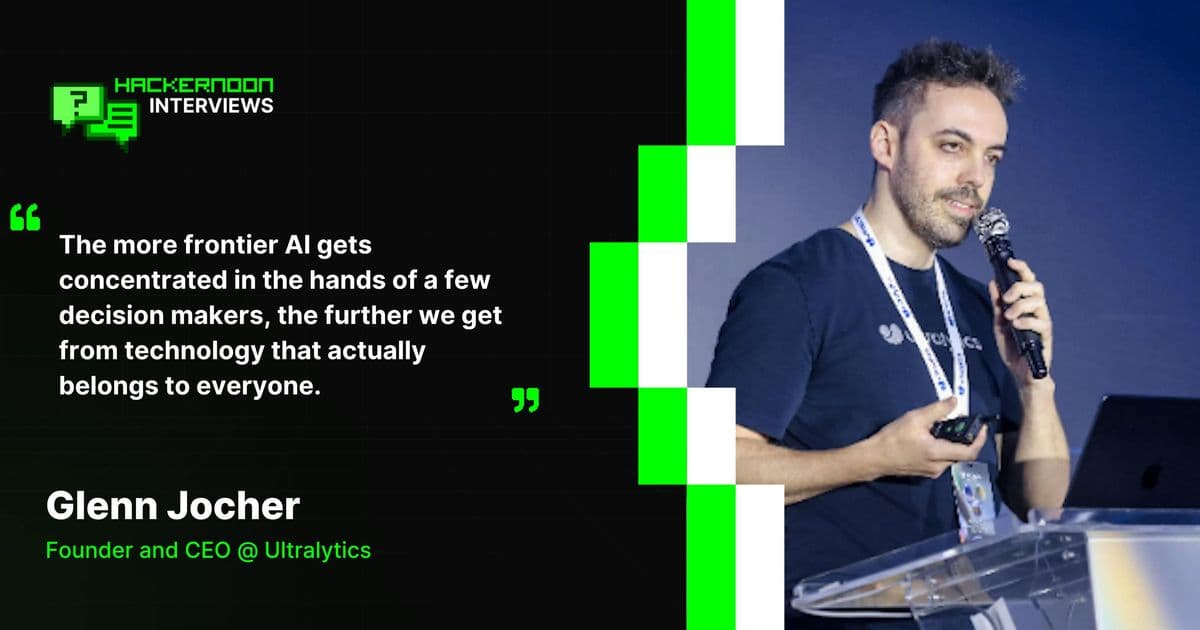
Ultralytics built the YOLO models that quietly run inside warehouses, farms, and traffic cameras. Founder Glenn Jocher's pitch in a recent HackerNoon interview is that computer vision should be cheap, fast, and usable by people who never read a research paper. That ambition is bigger than the buzzword that surrounds it.
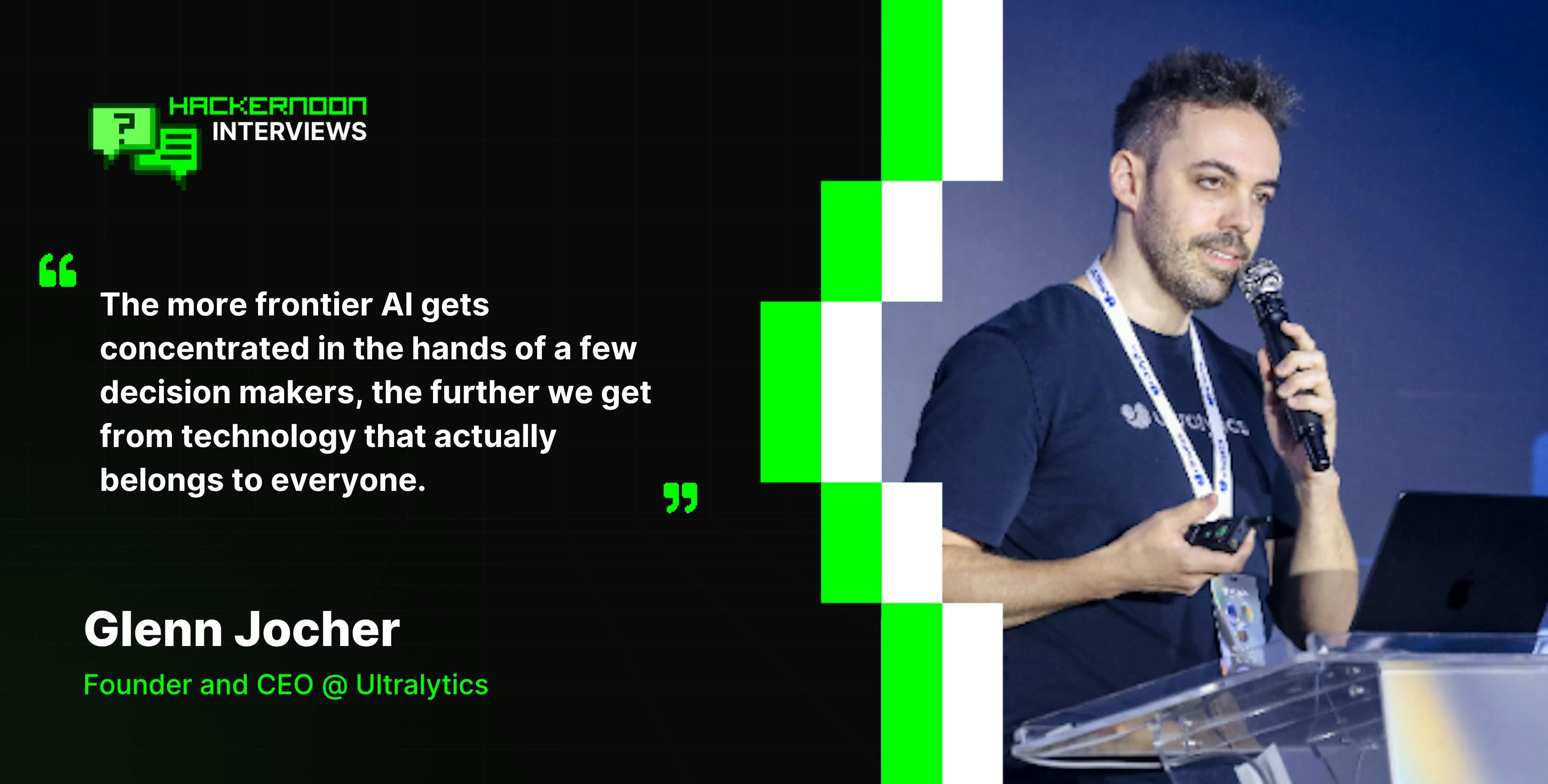
Most startups in the AI wave sell access to a model you cannot see, running on hardware you will never touch. Ultralytics sells something closer to the opposite. Its YOLO family of object detection models is open source, downloadable in minutes, and small enough to run on a Raspberry Pi or a phone. In a recent HackerNoon Writers Spotlight interview, founder and CEO Glenn Jocher framed the company's mission as democratizing vision AI for everyone, a phrase that usually signals marketing fog. In this case the product backs it up.
This is worth examining precisely because computer vision tends to get discussed in abstractions. Ultralytics is a useful case study in what actually happens when a hard research problem becomes a commodity tool, and what kind of business you can build on top of that.
The problem they solve
Object detection answers a deceptively simple question: what is in this image, and where exactly is it? A self-checkout kiosk needs to know a banana from a barcode. A factory line needs to spot a cracked weld before it ships. A drone counting cattle needs to separate one animal from the next in a blurry overhead frame.
For years, building that capability meant assembling a research team, labeling enormous datasets, and training models that demanded expensive GPUs to run. The skill was scarce and the infrastructure was heavy. That gap is the actual market Ultralytics serves. Not the frontier of AI research, but the long tail of practical, unglamorous detection problems that thousands of companies have and very few can afford to solve from scratch.
The YOLO architecture, short for You Only Look Once, attacks this with a single insight that still drives the franchise. Instead of scanning an image region by region in multiple passes, the model looks at the whole frame once and predicts all bounding boxes and class labels in a single forward pass. That design choice is why YOLO runs fast enough for live video on modest hardware, and speed on cheap hardware is the entire value proposition for edge deployment.
How the technology actually reaches people
Ultralytics did not invent the original YOLO concept, which traces back to Joseph Redmon's 2015 research. What the company did was turn it into software a working developer can use without a PhD. The current Ultralytics Python package reduces a detection pipeline to a few lines of code. You install the library, point it at a pretrained model, and run inference on an image or video stream. Training a custom model on your own labeled data is similarly compressed into a single command and a folder of images.
That ergonomic shift is the real product. The models matter, but the reason Ultralytics shows up in so many production systems is that the friction to get started collapsed from weeks to an afternoon. The package handles the unglamorous parts that usually sink projects: data loading, augmentation, exporting to formats like ONNX, CoreML, and TensorRT so the model can run on a phone, a browser, or an embedded chip.
The trade-offs are real and the company is reasonably honest about them. YOLO optimizes for inference speed, which means it sometimes trades a few points of accuracy against slower, heavier architectures that academic benchmarks favor. For a research lab chasing a leaderboard, that matters. For a logistics company counting boxes on a conveyor belt at thirty frames per second, it does not. Ultralytics has bet, correctly so far, that most of the market lives in the second category.
The business underneath the open source
Here is where the skepticism earns its keep. Open source is not a business model, it is a distribution strategy. Plenty of widely adopted projects have generated enormous usage and almost no revenue. The interesting question for any company built this way is how the free tool converts into something that pays the bills.
Ultralytics runs a familiar open-core playbook. The core library is free under the AGPL-3.0 license, which is deliberate. AGPL is a strong copyleft license: if you build a product on top of YOLO and distribute it, you are obligated to open your own source as well, unless you buy a commercial license. That single licensing decision is the revenue engine. Hobbyists, students, and researchers use the software for nothing. Companies embedding YOLO in a commercial product face a choice between opening their code or paying Ultralytics for an enterprise license. Layered on top is Ultralytics HUB, a hosted platform for training, managing, and deploying models without wrangling infrastructure.
This structure tells you something about market positioning. Ultralytics is not trying to compete with the foundation-model labs raising billions to chase general intelligence. It occupies a narrower, more defensible niche: the default toolkit for applied object detection. When a developer's first instinct for a vision problem is to reach for YOLO, the company has already won the distribution battle, and distribution is what converts into licensing revenue later.
What the adoption signals tell us
The traction is visible in places that resist hype. The GitHub repository carries tens of thousands of stars and a steady stream of contributions, which measures developer attention rather than press releases. More telling is where the models turn up in practice: agricultural monitoring, manufacturing quality control, retail analytics, wildlife conservation counts, medical imaging research, and traffic systems. These are domains where someone needed a working detector, found YOLO, and shipped. That breadth is harder to manufacture than a funding announcement.
The pattern here echoes other successful developer-tool companies. Win the workflow first, monetize the serious users second. Companies like Hugging Face followed a comparable arc in natural language processing, becoming the default place people reach for models before figuring out the enterprise layer. Ultralytics is running that same play in the narrower lane of vision.
None of this guarantees a durable outcome. Open-core companies live with permanent tension between the free tier that drives adoption and the paid tier that funds the company, and a more permissive competitor can always undercut the licensing model. Computer vision tooling is not immune to that pressure. But the company has done the hard part that most AI startups skip, which is building something a large number of people actually use to get real work done. The phrase democratizing vision AI gets thrown around loosely. Ultralytics has at least earned the right to use it, because the tool genuinely lowered the barrier to a problem that used to require a specialist.
The broader lesson for anyone watching the startup ecosystem is that the most consequential AI companies may not be the ones with the largest models or the loudest valuations. Some of them are the ones quietly becoming infrastructure, the default import statement at the top of a developer's file, monetizing a sliver of an enormous user base. That is a less exciting story than artificial general intelligence. It also tends to be the kind that lasts.
Comments
Please log in or register to join the discussion