
MIT researchers have developed the first comprehensive global dataset quantifying costs and emissions across ammonia production pathways, revealing how regional factors influence decarbonization strategies for this emerging energy carrier.
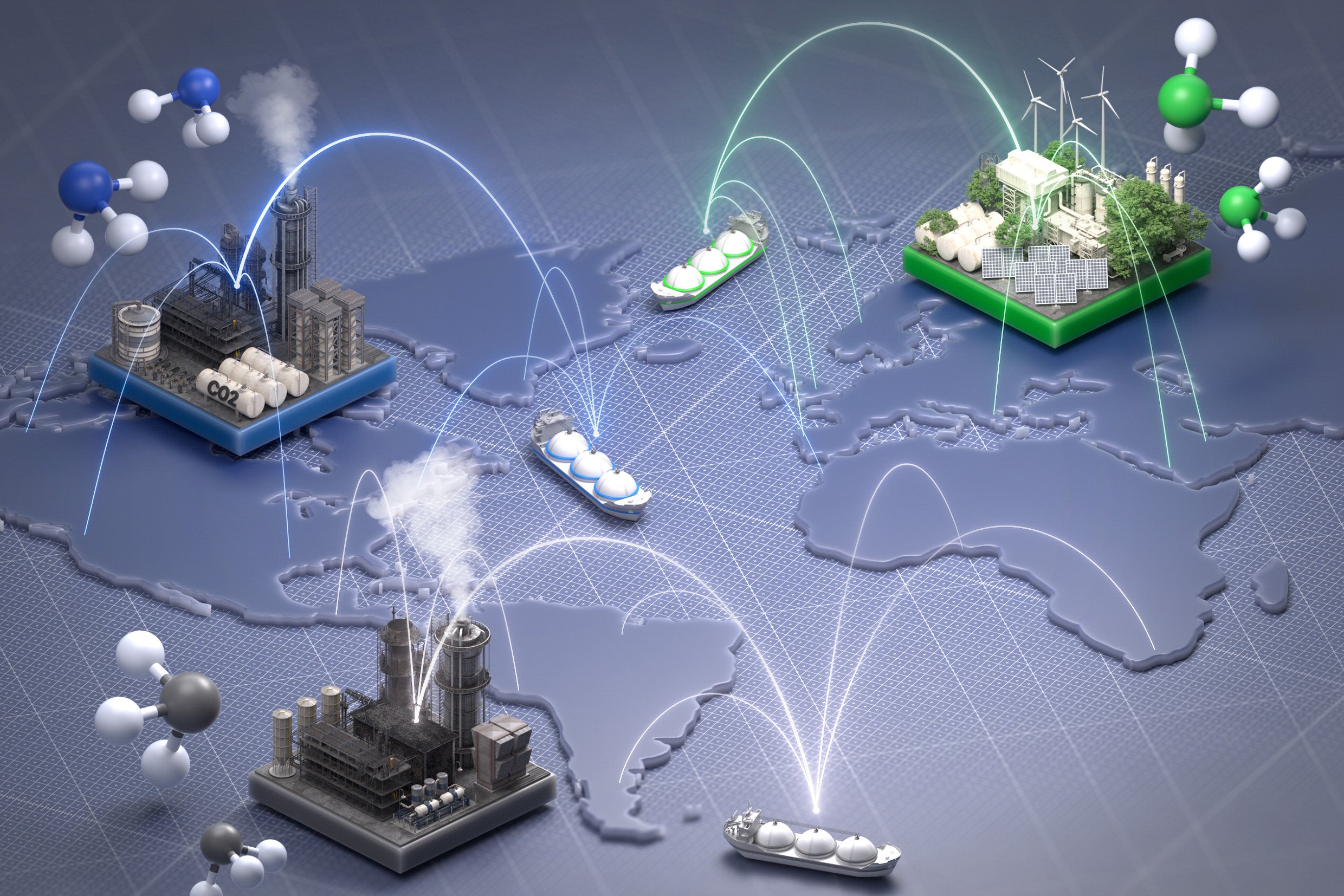
Ammonia's potential as a carbon-free energy carrier hinges on solving its production dilemma: while abundant and easily transportable, conventional manufacturing emits substantial greenhouse gases. MIT Energy Initiative researchers have now created the most extensive analysis to date, mapping economic and environmental tradeoffs across 63 countries to guide ammonia's role in the clean energy transition.
Conventional ammonia production via the Haber-Bosch process accounts for nearly 2% of global emissions. The MIT team developed a harmonized database quantifying levelized costs and lifecycle emissions for six production pathways:
- Gray ammonia: Traditional natural gas steam methane reforming (SMR) without carbon capture
- Blue ammonia: SMR or auto-thermal reforming (ATR) paired with carbon capture
- Green ammonia: Electrolysis powered by renewables
- Pink ammonia: Nuclear-powered electrolysis
- Yellow ammonia: Grid electricity-based production
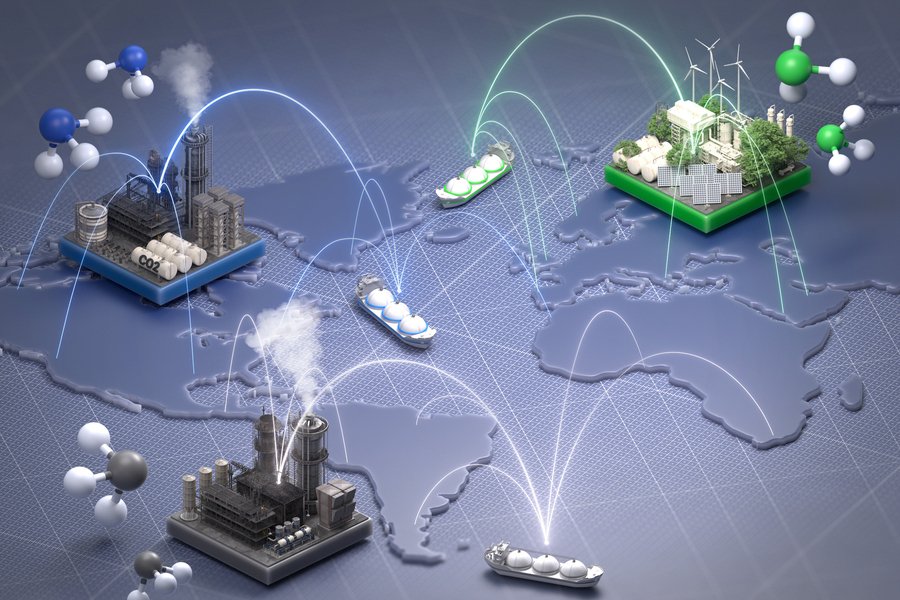
The analysis reveals stark regional variations driven by local energy costs and infrastructure. In the U.S., conventional gray ammonia costs approximately $0.48/kg but emits 2.46kg CO₂ equivalent per kg. Transitioning to blue ammonia (ATR with carbon capture) reduces emissions by 70% to 0.75kg CO₂e/kg while increasing costs by 29%. Pink ammonia achieves near-zero emissions (0.03kg CO₂e/kg) at $0.57/kg—demonstrating nuclear's potential for deep decarbonization where feasible.
Globally, renewable-rich regions like China and the Middle East emerge as optimal green ammonia suppliers. Blue ammonia proves most viable in areas with abundant low-cost natural gas and carbon storage capacity, such as the Gulf Coast. 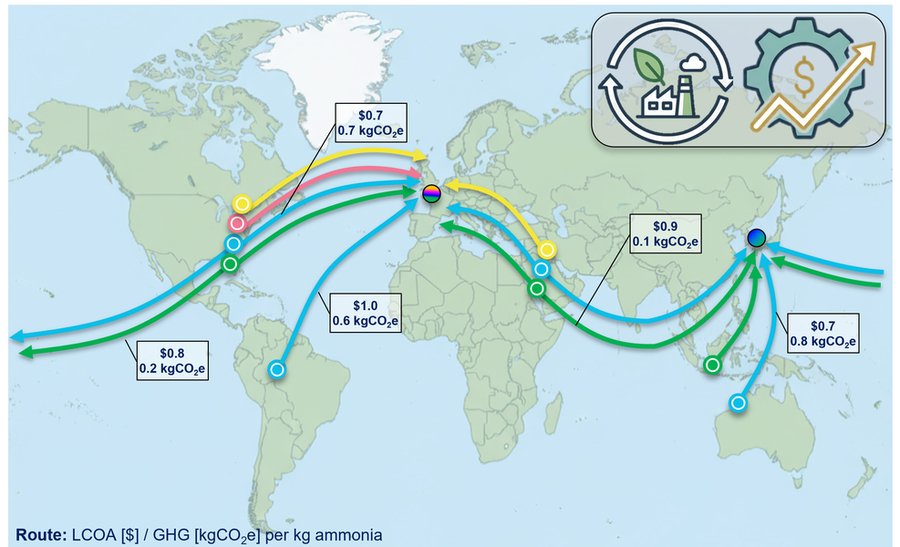 Houston specifically stands out as a strategic future export hub due to existing infrastructure and resource availability.
Crucially, the data shows decarbonization isn't monolithic:
- A full shift to carbon-captured blue ammonia could cut global ammonia emissions by 71% for a 23% cost increase
- Green ammonia adoption achieves 99.7% emission reduction but increases costs by 46%
- Grid-powered yellow ammonia often costs more than gray ammonia while emitting more carbon due to fossil-dependent electricity
These granular insights fill a critical knowledge gap for policymakers designing ammonia integration strategies. Countries like Japan and South Korea—already testing ammonia co-firing in power plants—can now evaluate import options based on verified emissions and cost data. Industry stakeholders similarly gain tools to assess production site viability and trade route optimization.
The MIT framework enables dynamic modeling of parameters like fluctuating natural gas prices, renewable energy costs, and carbon policies. As senior researcher Guiyan Zang notes, "Hydrogen and ammonia are the only carbon-free fuels at scale. Our harmonized models allow better cost-benefit analyses for nations building clean ammonia ecosystems."
With ammonia demand projected to surge 300% by 2050 according to the IEA, this research provides the foundational data needed to navigate the economic and environmental complexities of scaling a hydrogen-rich, transportable energy carrier.
Access the full study in Energy and Environmental Science. Explore MIT's ammonia supply chain visualization tools via the MITEI research portal.
Comments
Please log in or register to join the discussion