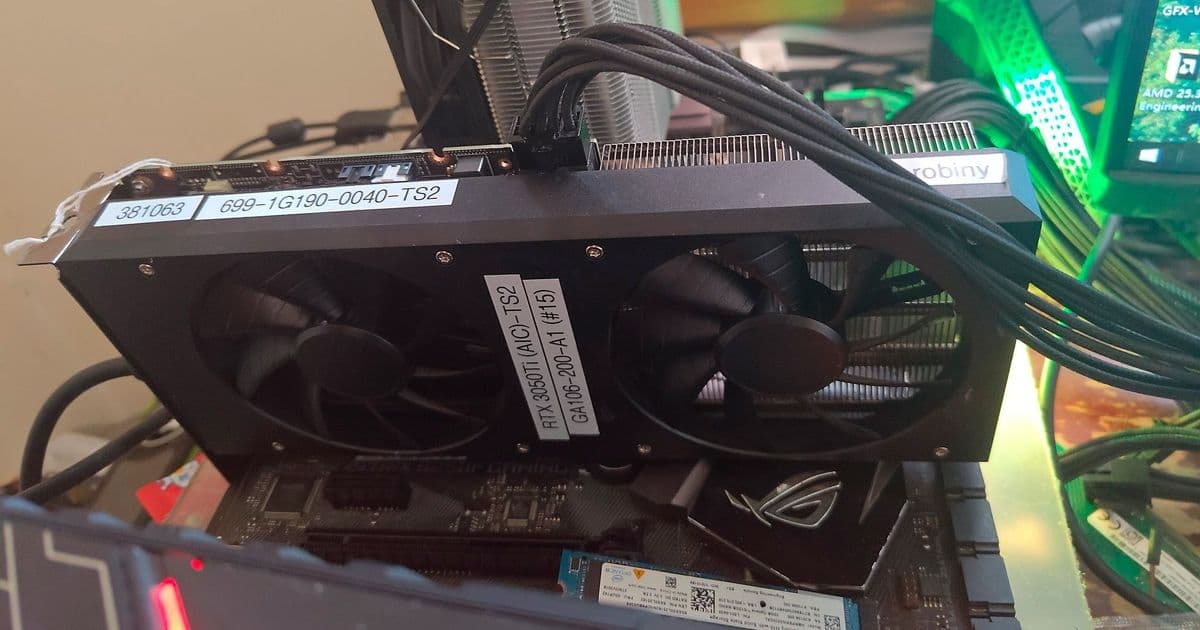
Leaked specifications and benchmarks of an unreleased desktop RTX 3050 Ti reveal a graphics card that could have filled a crucial price-performance gap in Nvidia's Ampere generation, highlighting how supply chain constraints during the cryptocurrency mining boom and COVID- pandemic may have prevented its release.
The discovery of an unreleased desktop version of the GeForce RTX 3050 Ti provides fascinating insights into Nvidia's product strategy during the Ampere generation and the external factors that influenced their release decisions. Engineering samples with specifications and benchmarks, recently shared by hardware leaker Gok, confirm that Nvidia had developed a desktop RTX 3050 Ti that never reached the market, despite a laptop version being successfully launched.
Technical Specifications and Architecture
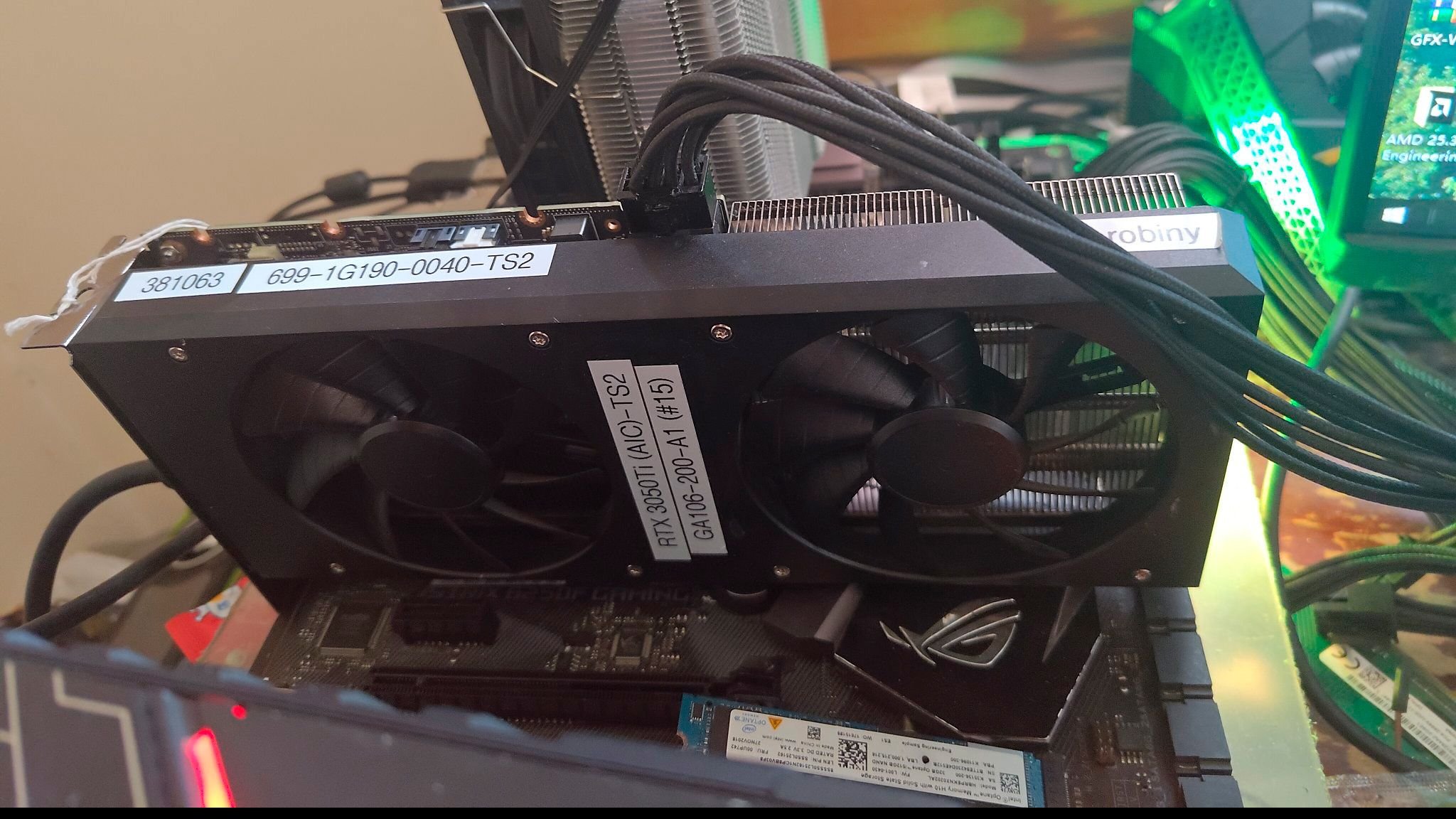
The unreleased desktop RTX 3050 Ti engineering sample, reportedly from a company named Robiny, leverages the PG190 SKU 40 design board and utilizes the GA106 silicon die—the same fundamental architecture found in other popular Ampere products including the RTX 3050 and RTX 3060. This silicon recycling strategy represents a common industry practice where manufacturers create multiple product tiers from the same fundamental silicon design by selectively disabling components.
A perfect GA106 silicon die contains 30 Streaming Multiprocessors (SMs), but the RTX 3050 Ti prototype has only 26 enabled, resulting in approximately 87% die utilization. This configuration yields 3,328 CUDA cores—placing it between the RTX 3050 (2,560 cores) and RTX 3060 (3,584 cores) in terms of raw computational capacity. The card also features 104 Tensor Cores and 26 RT Cores, maintaining the proportional relationship between core types that characterizes the Ampere architecture.
The memory configuration presents an interesting compromise. While the RTX 3050 Ti utilizes the same 14 Gb/s GDDR6 memory modules found in the standard RTX 3050, it employs a wider 192-bit memory interface—identical to the RTX 3060. This results in 360 GB/s of memory bandwidth, representing a 50% improvement over the RTX 3050's 224 GB/s while still trailing the RTX 3060's 336 GB/s by approximately 7%.
Notably, the RTX 3050 Ti appears to feature 6GB of GDDR6 memory—half the capacity of the original RTX 3060 and 2GB less than the standard RTX 3050. This memory capacity reduction likely served as a key differentiator to prevent the card from cannibalizing sales of higher-margin products.
Performance Analysis
Benchmark data from the engineering sample shows the RTX 3050 Ti achieving a graphics score of 7,787 points in 3DMark's Time Spy benchmark. Comparative analysis reveals that this positions the card approximately midway between the RTX 3050 (5,300-6,400 points) and RTX 3060 (8,200-9,000 points). Specifically, the unreleased card could be up to 22% faster than the RTX 3050 or up to 13% slower than a RTX 3060.
The clock speed configuration reflects Nvidia's balancing act for this mid-range product. With 26 SMs active, the RTX 3050 Ti features base and boost clocks of 1,320 MHz and 1,777 MHz respectively. These clock speeds are higher than the RTX 3060 (1,410 MHz base, 1,665 MHz boost) due to the reduced computational load, but somewhat lower than the RTX 3050 (1,552 MHz base, 1,777 MHz boost) despite having more CUDA cores.
The power consumption of the engineering sample is reported at 170 watts, positioning it between the RTX 3050 (130 watts) and RTX 3060 (170 watts). This power efficiency represents a significant improvement over previous generations, continuing Ampere's trend of enhanced performance-per-watt metrics.
Market Context and Supply Chain Constraints
The absence of a desktop RTX 3050 Ti from the market likely stems from the extraordinary circumstances surrounding the Ampere launch. The graphics card industry faced unprecedented challenges during this period, beginning with the cryptocurrency mining boom that created artificial demand, followed by supply chain disruptions caused by the COVID-19 pandemic. These factors resulted in a severe graphics card shortage where actual market prices significantly exceeded manufacturer suggested retail prices (MSRPs).
Under normal market conditions, the RTX 3050 Ti would have filled an ideal price-performance gap between the RTX 3050 ($249 MSRP) and RTX 3060 ($329 MSRP), likely positioned around $289. However, during the shortage period, the RTX 3060 became the most popular graphics card on Steam—a position it maintains to this day—potentially reducing Nvidia's incentive to introduce another product that might fragment their market positioning.
The RTX 3050 Ti's specifications reveal Nvidia's sophisticated understanding of market segmentation. By disabling 4 of the 30 SMs on the GA106 die, the company could create a product that offered approximately 93% of the RTX 3060's performance at a significantly lower cost point. This approach maximizes yield efficiency, as silicon dies with minor defects can still be repurposed for lower-tier products.
Strategic Implications
The existence of the RTX 3050 Ti desktop prototype highlights several key aspects of Nvidia's product strategy:
Portfolio Optimization: The card represents a calculated approach to market segmentation, designed to capture value across multiple price points without overlapping product tiers.
Yield Management: By selectively disabling SMs, Nvidia could optimize production efficiency, using silicon that might not meet the requirements for higher-tier products.
Market Timing Flexibility: The ability to develop and hold back engineering samples provides flexibility to respond to changing market conditions, as we saw with Ampere's launch during extraordinary circumstances.
Competitive Positioning: The RTX 3050 Ti would have strengthened Nvidia's position against AMD in the crucial mid-range segment, particularly important given the RTX 3060's continued popularity.
Current Market Relevance
In today's GPU market, where custom RTX 3060 cards start at approximately $479, the unreleased RTX 3050 Ti could have provided a compelling alternative for budget-conscious gamers. The card's performance would likely place it between current-generation entry-level and mid-range offerings, potentially serving as a bridge for users upgrading from older graphics hardware.
The RTX 3050 Ti's specifications also reflect the evolution of gaming requirements. With 6GB of VRAM and performance exceeding the original RTX 3050 by up to 22%, the card would handle modern gaming titles at 1080p resolution with reasonable settings, targeting the same market segment currently served by budget-oriented cards from both Nvidia and AMD.

Conclusion
The discovery of the unreleased RTX 3050 Ti desktop engineering sample offers valuable insights into Nvidia's product development process and the external factors that influence hardware releases. The card represents a technically sound product that would have filled a strategic gap in the Ampere generation lineup, potentially strengthening Nvidia's market position during a challenging period.
The absence of this card from the market underscores how extraordinary circumstances can influence product release decisions, even for companies with resources like Nvidia. The engineering sample serves as a reminder that the hardware we see represents only a fraction of what manufacturers develop, with many products held back due to market conditions, competitive considerations, or strategic positioning.
For consumers and industry analysts alike, the unreleased RTX 3050 Ti provides a fascinating case study in GPU product strategy, highlighting the complex interplay between technical specifications, market positioning, and external economic factors that shape the hardware landscape.
Comments
Please log in or register to join the discussion