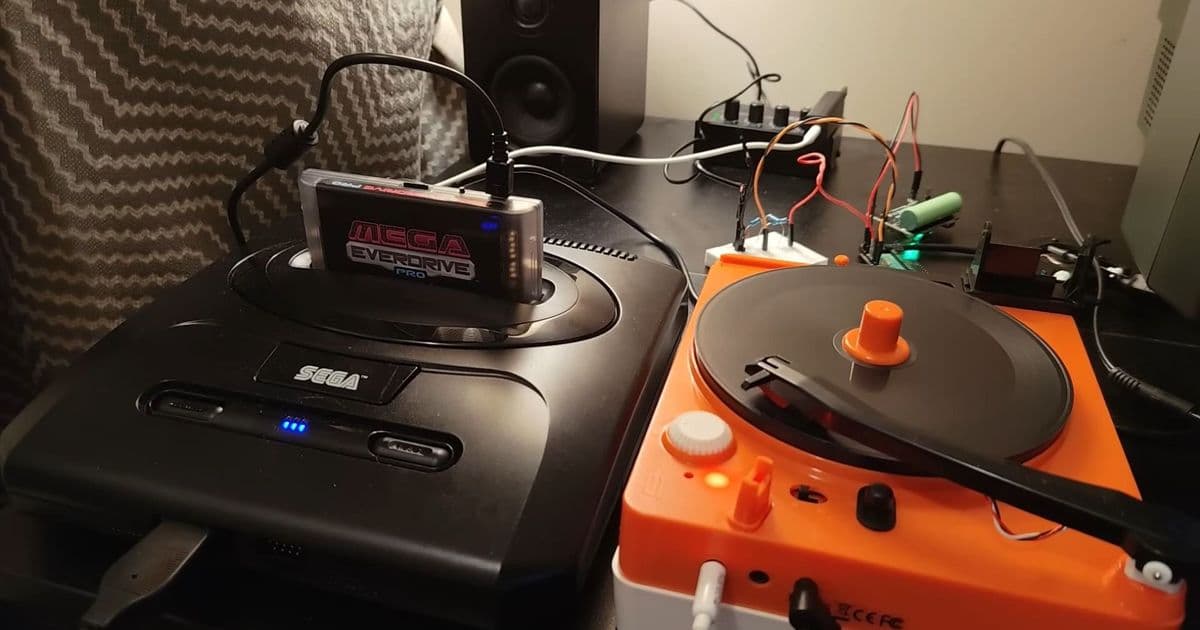
A DIY‑maker tried to encode Sega Genesis game data onto a vinyl record and play it back through a turntable, but the lo‑fi audio path introduced too much distortion and timing error for reliable loading, highlighting the strict bandwidth and error‑correction requirements of console ROM interfaces.
Announcement
Tech‑enthusiast Throaty Mumbo attempted a quirky proof‑of‑concept: record a Sega Genesis ROM as an audio waveform, press it onto a 5‑inch vinyl disc with a Teenage Engineering PO‑80 Record Factory, then feed the playback into a Mega EverDrive Pro backed by a Raspberry Pi Pico 2. The goal was to demonstrate that a purely analog medium could act as a storage carrier for a 16‑bit console that originally relied on cartridge‑based ROMs.
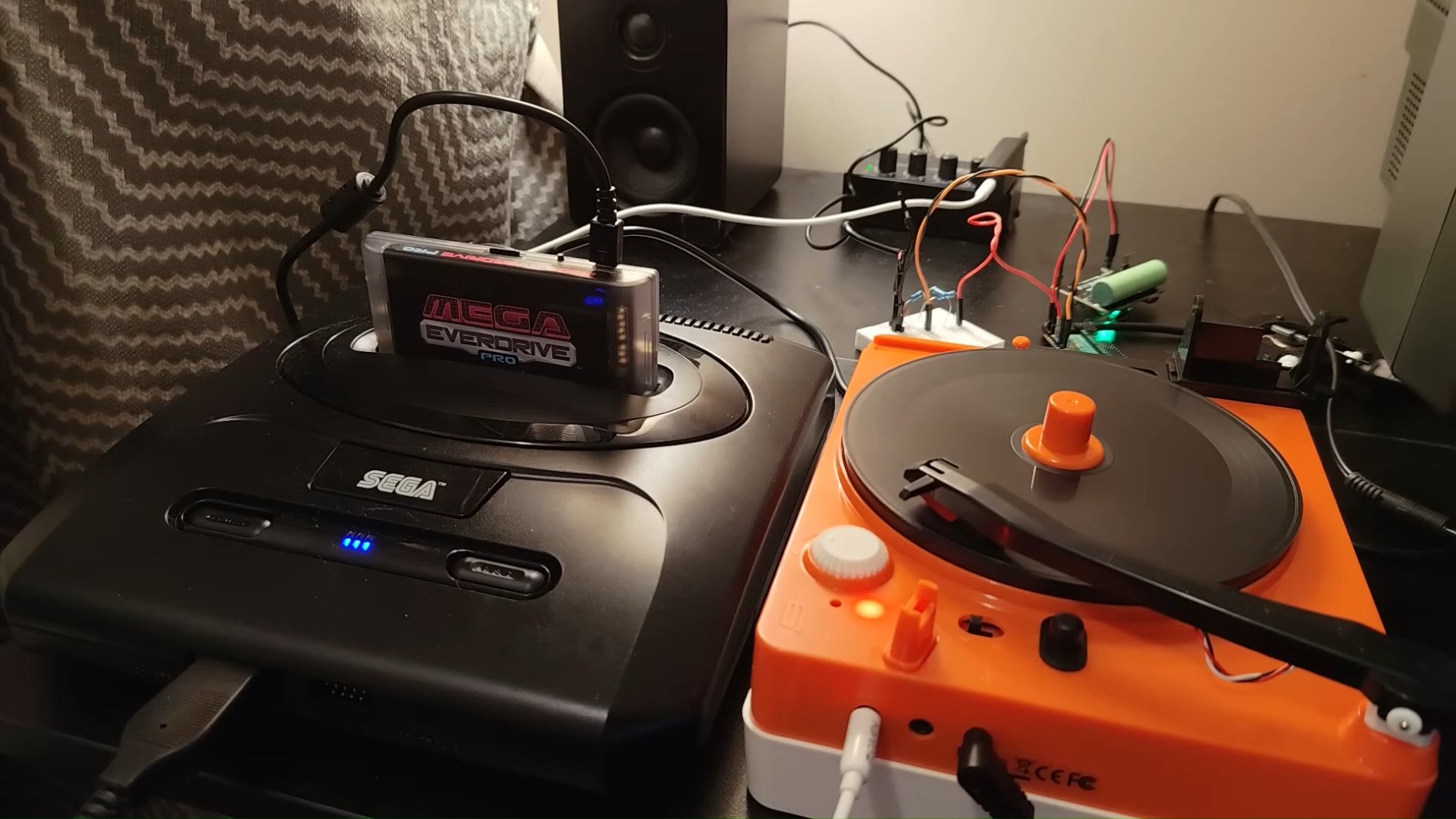
The experiment was documented on YouTube under the title “Can We Load Sega Games Off a Vinyl Record?” and quickly attracted attention from retro‑gaming forums and hobbyist circles.
Technical specs and why it matters
| Component | Key specification | Role in the experiment |
|---|---|---|
| Sega Genesis | 7.6 MHz Motorola 68000 CPU, 64 KB VRAM, 8‑bit Z80 co‑processor | Target console that expects a parallel ROM bus with ~2 µs access time per byte |
| Mega EverDrive Pro | SD‑card based cartridge emulator, supports up to 512 MiB per slot, USB‑type‑C interface | Provides a bridge between the Pi and the Genesis, presenting the decoded ROM as a virtual cartridge |
| Raspberry Pi Pico 2 | Dual‑core Arm Cortex‑M33, 264 kB SRAM, USB 2.0 device | Captures analog audio from the turntable, runs a custom ADC‑to‑binary conversion routine, streams data over USB to the EverDrive |
| Teenage Engineering PO‑80 | 5‑inch vinyl cutter/player, 44.1 kHz playback, ±3 dB frequency response, output via 3.5 mm jack | Encodes the binary stream onto a physical record and later reproduces it for the Pi |
Bandwidth and timing constraints
A Genesis cartridge delivers data at roughly 2 MB/s (considering the 7.6 MHz bus and 16‑bit data width). Even a modest homebrew ROM of 128 KB therefore requires ~64 ms of continuous, error‑free data transfer. Vinyl playback at 33⅓ rpm yields a linear velocity of about 0.2 m/s under the stylus, which translates to a maximum usable audio bandwidth of ~20 kHz before distortion climbs. Converting a binary stream to an audible waveform typically uses frequency‑shift keying (FSK) or phase‑shift keying (PSK), each demanding a carrier well within the audible range and a symbol rate that stays under the medium’s bandwidth.
Assuming a conservative 2 kbaud symbol rate (2 000 bits per second) – already near the limit for reliable vinyl reproduction – the effective data throughput would be ~250 B/s, more than 8000× slower than the cartridge bus. The experiment therefore relied on heavy buffering inside the Pi and the EverDrive, but any jitter, wow, or surface noise would corrupt the stream.
Error‑correction reality check
Cassette‑based loading on 1980s home computers used Manchester encoding with simple parity checks, tolerating the high error rates of magnetic tape. Vinyl, however, is optimized for music, not digital fidelity. The PO‑80’s “lo‑fi” spec means its signal‑to‑noise ratio (SNR) hovers around 55 dB, and harmonic distortion can exceed 2 % at the levels needed to push a clean square‑wave carrier. The resulting bit‑error rate (BER) in the captured audio easily surpasses 1 %, far beyond what the Pi’s conversion routine can correct without a robust forward‑error‑correction (FEC) scheme – which would further reduce the already limited data rate.
What succeeded, what failed
- Cassette test – Using a vintage Famicom data recorder, the team loaded small homebrew ROMs (a fractal demo, a Breakout clone) via the Pi‑EverDrive link. The analog bandwidth of tape (≈15 kHz) and the ability to drive the signal harder made this marginally viable.
- Vinyl attempt – Transfer to the PO‑80 introduced clipping when the signal was amplified enough to be readable, and silence when the level was reduced to avoid distortion. Even after extensive gain staging, the playback produced sporadic drop‑outs that halted the ROM loading routine within seconds.
Market and supply‑chain implications
While the project itself is a novelty, it underscores a broader point for the semiconductor and storage ecosystem: legacy analog media cannot compete with modern digital interfaces for high‑speed, low‑latency data transfer. The Genesis cartridge architecture, though designed in the late 1980s, still demands a deterministic timing envelope that only solid‑state memory or high‑density magnetic media can satisfy.
- Flash‑based cartridge emulators like the Mega EverDrive Pro continue to thrive because they leverage inexpensive NAND flash (average price $0.08 per GB in Q4 2025) and provide a direct‑parallel interface that matches the console’s bus timing.
- Supply‑chain pressure on legacy components (e.g., 74‑series TTL logic still used in some retro‑hardware mods) remains modest; demand is driven by hobbyists, not mass production, keeping lead times under six weeks.
- The experiment also highlights the limits of repurposing consumer‑grade audio hardware for data storage. Even as high‑resolution audio codecs push sample rates to 384 kHz, the mechanical constraints of turntables (wow, flutter, groove wear) keep them unsuitable for reliable binary transport.
For manufacturers of retro‑gaming accessories, the takeaway is clear: focus on robust digital bridges (USB‑to‑parallel adapters, FPGA‑based cartridge clones) rather than chasing analog gimmicks. The modest cost of a Raspberry Pi Pico 2 (≈$4) combined with an EverDrive‑compatible SD card offers a scalable, reproducible solution that can be produced in volume without the variability inherent in vinyl pressing.
The video of the experiment can be watched on YouTube: Can We Load Sega Games Off a Vinyl Record?.
Comments
Please log in or register to join the discussion