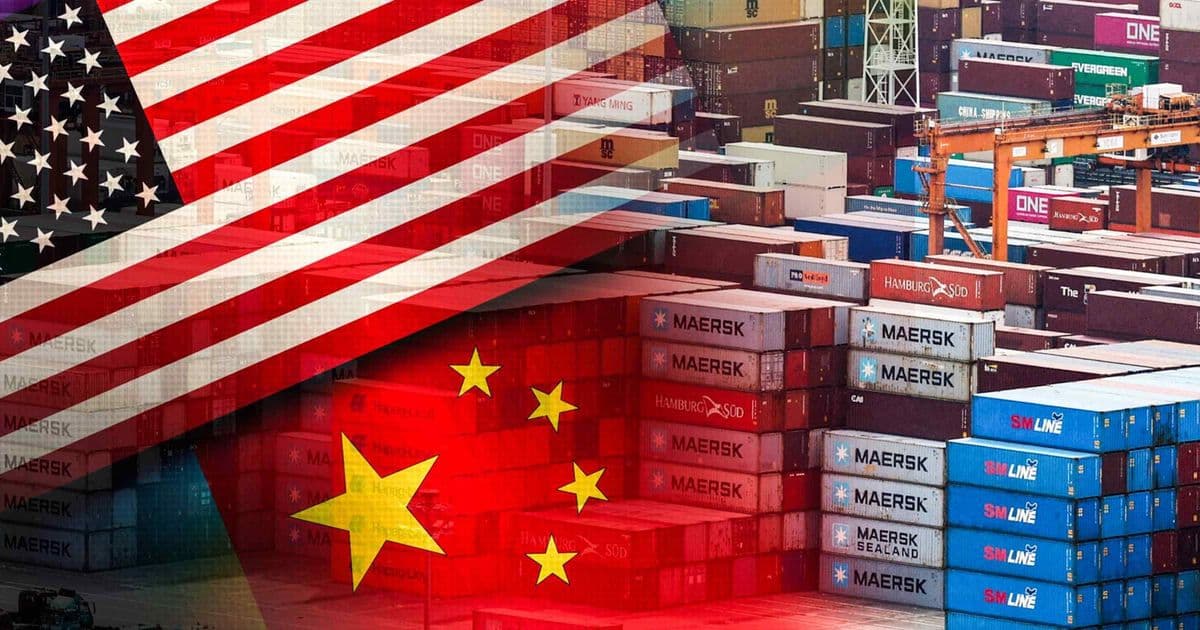
An annual US-China Business Council survey finds American firms treating the Chinese market as indispensable even as slowing growth climbs to their No. 2 concern. Profitability is recovering, but tariffs and political risk keep margins under pressure.
American companies are recommitting to China. According to the latest annual survey from the US-China Business Council, profitability among U.S. firms operating in the Chinese market is recovering, and many are choosing to expand rather than retreat, even as the country's deceleration and a thickening layer of political risk weigh on sentiment.
The headline tension is straightforward. Businesses say China remains essential to their global strategy, yet the reasons to be nervous keep multiplying. Concerns about China's slowing growth jumped to the No. 2 challenge cited by U.S. companies this year, up from No. 5 in the prior survey. That kind of movement up a ranked list is rarely noise. It signals that macroeconomic softness has moved from a background worry to a board-level problem.
What the survey actually shows
The core finding is a split screen. On one side, margins are healing. After several difficult years marked by pandemic disruption, weak domestic demand, and a property sector unwind that drained Chinese consumer confidence, U.S. firms are reporting better profitability. That improvement is the single biggest reason companies are willing to keep capital deployed in the market rather than diverting it to Southeast Asia, India, or Mexico.
On the other side, the cost structure remains distorted by trade policy. Tariffs continue to function as a standing tax on cross-border operations, and respondents flagged them as a persistent burden rather than a one-time shock. The practical effect is that a company can post a recovering bottom line in China and still describe its operating environment as more expensive and less predictable than it was five years ago.
The two facts coexist because they operate on different timelines. Profitability reflects current demand and pricing power inside China. Tariffs and political risk reflect the structural relationship between Washington and Beijing, which has only grown more adversarial regardless of which administration sets the terms.
The market context
China's growth story has changed shape. The double-digit expansion that justified almost any level of investment is gone, replaced by a slower, more uneven economy where consumer spending is cautious and industrial overcapacity has become a recurring complaint from trading partners. An OECD report recently pulled Beijing into a public debate over industrial subsidies, and the European Union has pressed similar concerns. For U.S. multinationals, a slower China means the market is no longer a guaranteed growth engine. It is a large, mature, competitive market that has to be earned share by share.
That reframing matters for how companies justify staying. When growth was abundant, China was a bet on the future. Now it is a bet on scale and proximity to supply chains that cannot be replicated elsewhere at comparable cost. The survey's signal that firms are doubling down suggests that, for most of them, the second rationale still holds. The manufacturing base, the supplier networks, and the sheer size of the addressable customer base outweigh the temptation to leave.
The political backdrop is harder to price. The Pentagon recently moved to blacklist major Chinese firms including Alibaba, BYD, and Baidu over alleged military ties, and the Trump administration has floated new tariffs on dozens of economies, China among them, tied to forced labor concerns. At the same time, Washington has solicited comment on the possibility of cutting some China tariffs, a reminder that policy can swing in both directions within a single news cycle. For a chief financial officer trying to model the next three years, that volatility is itself a cost.
What it means
The strategic takeaway is that decoupling, as a clean corporate strategy, is not what is happening on the ground. "De-risking" is closer to the reality: firms are hedging supply chains, building redundancy in other countries, and reducing single-point dependencies, while keeping their core China operations intact because the economics still work. The survey reinforces a pattern visible across earnings calls and capital expenditure plans, where executives talk publicly about diversification while quietly maintaining or expanding their Chinese footprint.
For investors, the implication is that exposure to China is becoming a more deliberate, more defended line item. Companies are no longer treating it as an automatic growth premium. They are treating it as a position that has to be justified against rising compliance costs, export-control complexity, and the possibility of being caught in a tariff crossfire.
There is also a competitive dimension. European firms, surveyed separately by the EU Chamber of Commerce in China, have reported a rebound in business confidence as well. If American companies were to pull back unilaterally, they would cede ground not only to Chinese domestic champions but to European and Asian rivals willing to absorb the same risks for the same access. That dynamic creates a powerful incentive to stay, even when the political mood in Washington runs the other way.
The recovering profitability documented in this survey is the variable that keeps the whole calculation balanced. As long as the numbers improve, firms can absorb the friction. The open question is what happens if growth slows further while tariffs hold or climb. That is the scenario where the current consensus, that China is essential, would face its real test. For now, the money is voting to stay.
Comments
Please log in or register to join the discussion