A national security directive ordering Anthropic to block foreign nationals from accessing its most advanced AI models has resulted in a global shutdown of Fable 5 and Mythos 5, affecting millions of users just days after a free rollout.
The US government has forced Anthropic to take its two most capable AI models offline for every user on the planet, not just foreign nationals, after issuing an export control directive that the company says it cannot selectively enforce.
Anthropic received the directive at 5:21pm ET on June 12, citing national security authorities under US export control law. The order bars access to both Fable 5 and Mythos 5 by any foreign national, whether inside or outside the United States. That includes Anthropic's own foreign-national employees. The company's interpretation is straightforward: complying with the order while keeping the models online for US nationals is not technically feasible, so it pulled both models for everyone.
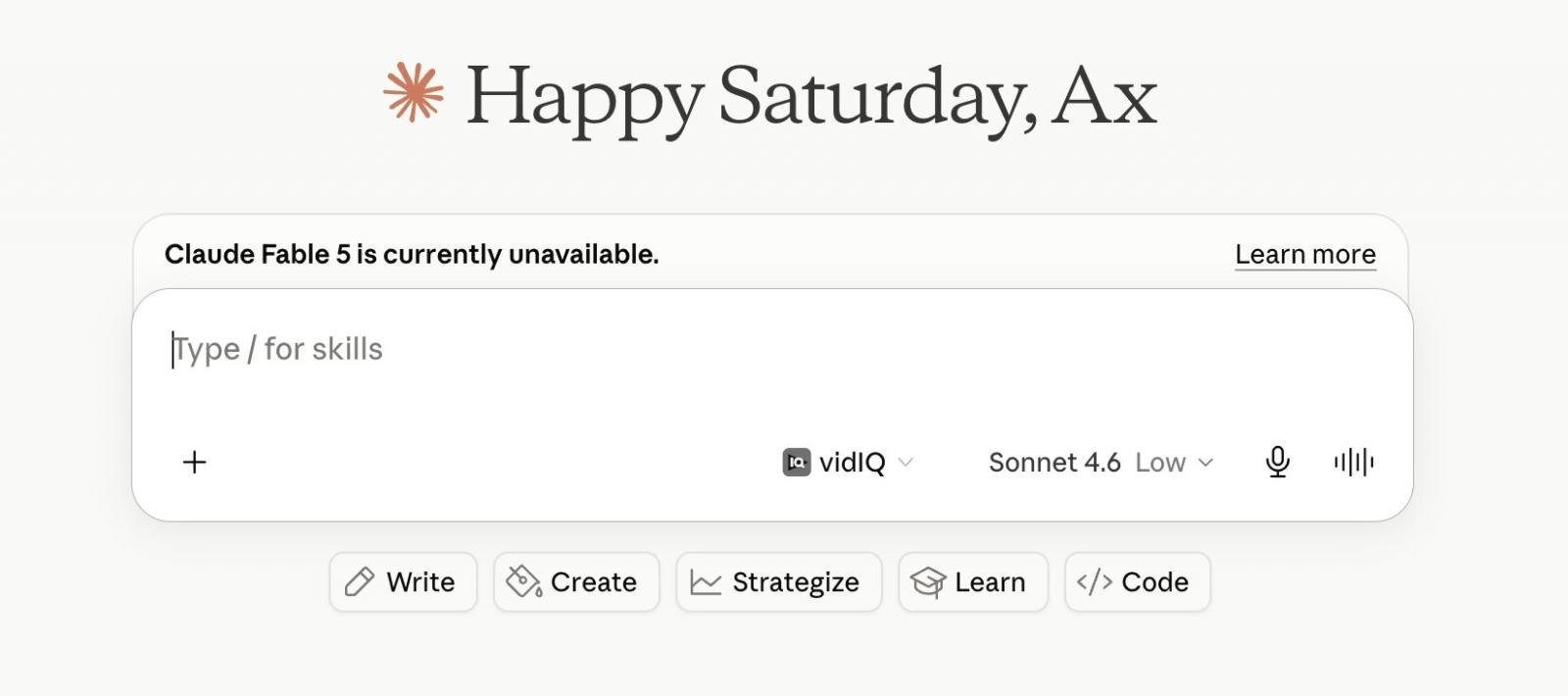
The timing is particularly painful. Anthropic began rolling out Fable 5 on June 9 as a free offering for all Pro, Max, and Enterprise customers through June 22. Millions of users had access to the model for exactly three days before it went dark. The company confirmed that new sessions will fall back to a user's default model or Opus 4.8, existing Fable 5 sessions will terminate with an error, and Platform API requests to Fable 5 will also fail. Integrators building on the model were told to migrate to alternatives.
What Fable 5 and Mythos 5 Actually Are
To understand the stakes, you need to know how these models differ from Anthropic's standard lineup. Fable 5 and Mythos 5 share the same underlying model architecture. The difference is in the safety layer. Fable 5 includes safeguards that block or divert sensitive queries in cybersecurity, biology, and chemistry. It is designed for broad commercial deployment, including the free rollout that was underway.
Mythos 5 is the unrestricted variant. It goes only to vetted government cyberdefenders and life sciences partners. The idea is that responsible professionals doing legitimate research need access to capabilities that would be dangerous in the wrong hands.
The US government's concern, according to Anthropic, centers on a reported jailbreak method that allegedly bypasses Fable 5's safety filters. Anthropic says it reviewed a demonstration of the technique and found only minor, already-known bugs, the kind that other publicly available models can discover without any bypass. The company described the government's evidence as purely verbal to date, with one potential jailbreak shared as a demo.
"We are complying with the government's legal directive and are removing access to Fable 5 and Mythos 5 for all users," Anthropic stated. "However, we disagree that the finding of a narrow potential jailbreak should be cause for recalling a commercial model deployed to hundreds of millions of people."
The company went further, warning that applying this standard across the industry would essentially halt all new model deployments for every frontier model provider. That is not a hypothetical concern. Jailbreaks against large language models are a known and persistent problem. Every major model, from OpenAI's GPT-5.5 to Google's Gemini family, has documented jailbreak vectors. If a single demonstrated jailbreak triggers a mandatory recall, the release cadence for frontier AI effectively freezes.
The Export Control Angle
The directive invokes national security export control authorities. This is a specific legal framework, not a general regulatory power. Export controls govern the transfer of controlled technology to foreign persons, and AI models with potential dual-use applications in cybersecurity and biological sciences fall squarely within that framework.
The practical effect is unusual. Unlike a product recall based on a safety defect, this order targets who can access the technology, not what the technology does. But because Anthropic cannot verify the nationality of every user at the model level, the company chose a blanket shutdown rather than risk noncompliance.
UK Minister for AI and Online Safety Kanishka Narayan MP publicly addressed the pause, noting it affected customers in both the US and UK. Narayan framed the situation as an argument for technological sovereignty, pointing to the UK government's £1.1 billion AI chip investment as a path toward reducing dependence on US-controlled AI infrastructure.
What This Means for Users and Developers
If you were using Fable 5 in your workflow or application, here is what changed:
- Session termination: Existing Fable 5 conversations now end with an error. No data loss, but no continuation either.
- Default fallback: New sessions automatically route to your default model or Opus 4.8, which remains unaffected.
- API failures: Any Platform API calls targeting Fable 5 or Mythos 5 return errors. You need to update your model selection.
- Timeline: Anthropic promised more details within 24 hours of the initial notice. As of this writing, the company says it is working to restore access.
For developers, the immediate action is to audit any code that hardcodes Fable 5 or Mythos 5 as the target model. Switch to Opus 4.8 or another available model. If your application depended on Fable 5's specific safety filters (for compliance or content moderation purposes), you will need to implement equivalent guardrails at the application layer until a replacement is available.
For end users, the transition should be automatic but less capable. Opus 4.8 is a strong model but lacks the specialized safety tuning that Fable 5 provided for sensitive domains.
The Bigger Picture
This incident exposes a tension at the heart of frontier AI development. Models capable enough to be useful for legitimate research in cybersecurity and biotechnology are also capable enough to attract export control scrutiny. The same capabilities that make Fable 5 valuable to defenders make it a target for restriction.
Anthropic's position is that a narrow, non-universal jailbreak does not justify pulling a model from hundreds of millions of users. That argument has merit. But the government's position is that export controls are not optional, and the legal obligation exists regardless of whether the underlying vulnerability is severe.
The resolution will likely involve Anthropic implementing nationality verification at the model access layer, or the government issuing a more targeted directive that does not require a blanket shutdown. Either way, the incident sets a precedent. Frontier AI companies now operate under the understanding that a single demonstrated jailbreak, shared verbally with regulators, can trigger a global product withdrawal.
Other model providers are watching closely. If the standard becomes that any jailbreak of a dual-use model triggers export control enforcement, the release process for every frontier model becomes substantially more complex. The industry has dealt with safety recalls before, but never under export control authority with implications for international trade compliance.
For now, Fable 5 and Mythos 5 remain offline. Anthropic is working on a path back to availability. The timeline depends on whether the company can satisfy the government's export control requirements without a blanket shutdown, and whether the underlying jailbreak report leads to a more targeted response rather than a global recall.
Comments
Please log in or register to join the discussion