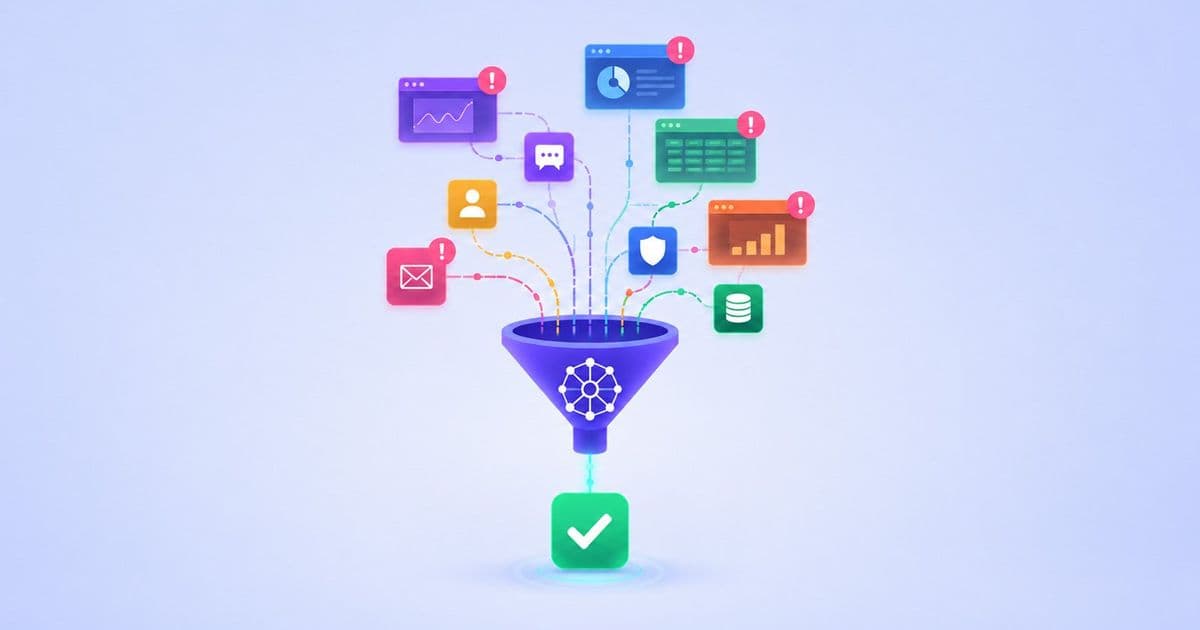
BleepingComputer’s June 2 2026 webinar with Tines’ Edgar Ortiz will dissect why juggling dozens of monitoring and ticketing tools hampers rapid incident handling, and how AI‑driven automation can stitch fragmented workflows into a single, coordinated response.
Too Many Tools Are Slowing Network Incident Response
Network incidents still cost enterprises an average of $4.2 million per breach according to the 2025 Ponemon Report. Yet many organizations unintentionally add to that cost by forcing responders to hop between a maze of dashboards, ticketing systems, identity providers, and chat apps. On June 2, 2026, BleepingComputer will host a live webinar – From alert to resolution: Fixing the gaps in network incident response – featuring Edgar Ortiz, Solutions Engineering Leader and Computer Scientist at Tines.
Why the tool sprawl matters
“When you have to open five separate consoles just to correlate a single alert, you’re buying time for the attacker,” says Dr. Maya Patel, senior analyst at Gartner. “The real problem isn’t the number of tools; it’s the lack of a shared data model that lets those tools talk to each other in real time.”
In practice, responders spend up to 45 % of their shift manually copying log snippets, pasting ticket IDs, and ping‑ponging messages across Slack, ServiceNow, and proprietary monitoring platforms. Each handoff introduces latency, increases the chance of human error, and makes post‑mortems harder to audit.
What the webinar will cover
| Segment | Key takeaways |
|---|---|
| Incident evolution | Map the typical journey from raw sensor alert to service impact, highlighting where data loss occurs. |
| Breakdown points | Identify the exact steps where triage, enrichment, and routing stall in real‑world networks. |
| Automated enrichment | Demonstrate how to pull network flow data, identity context, and threat intel into a single alert payload using Tines’ Automation Studio. |
| Prioritization at scale | Show rule‑based and ML‑assisted scoring models that auto‑assign severity and ownership without manual clicks. |
| Coordinated resolution | Walk through a unified response playbook that closes the loop across monitoring, ticketing, and communication tools. |
Practical advice you can apply today
- Consolidate alert data at the source – Use a lightweight collector (e.g., Vector) to forward raw events to a central enrichment service rather than scattering them across multiple SIEMs.
- Standardize on a schema – Adopt the OpenTelemetry or STIX 2.1 formats for all incident‑related metadata. This makes it trivial for automation platforms to parse and route information.
- Introduce AI‑assisted triage – Start with a simple confidence‑scoring model that weighs factors like asset criticality, recent change history, and known threat signatures. Tools such as OpenAI’s ChatGPT API can generate concise summaries for tickets automatically.
- Close the feedback loop – Ensure that once an incident is resolved, the outcome (root cause, mitigation steps, timeline) is fed back into the enrichment pipeline to improve future prioritization.
Expert perspective on automation’s role
“Automation isn’t about replacing analysts; it’s about giving them the context they need before they start digging,” explains Edgar Ortiz during the webinar. “A well‑designed workflow can pull a user’s Active Directory profile, recent VPN logins, and the latest threat feed, then present a single, actionable card to the responder.”
Ortiz also highlights a recent case study where a Fortune 500 retailer cut its mean time to acknowledge (MTTA) from 12 minutes to under 2 minutes after deploying a Tines‑driven workflow that auto‑enriched alerts with NetFlow data and auto‑assigned tickets based on asset criticality.
How to join
The session will be streamed live on BleepingComputer’s portal. Registration is free but limited to 200 participants on a first‑come, first‑served basis.
- Date: June 2, 2026
- Time: 10:00 AM – 11:30 AM PT
- Speaker: Edgar Ortiz, Solutions Engineering Leader, Tines
- Register: Secure your spot now
Takeaway
If your organization’s incident response still feels like a relay race with too many handoffs, the upcoming webinar will show you how to replace manual shuffling with AI‑assisted, end‑to‑end workflows. By unifying data, automating enrichment, and routing tickets intelligently, you can shave minutes—or even hours—off the time it takes to move from alert to resolution.
Comments
Please log in or register to join the discussion