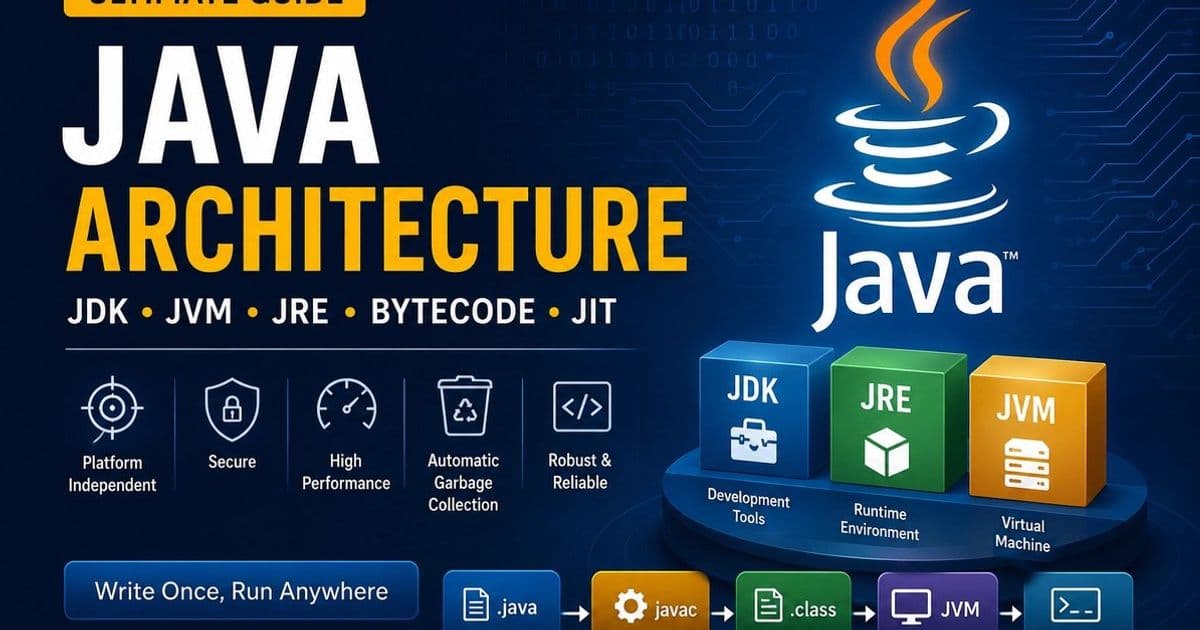
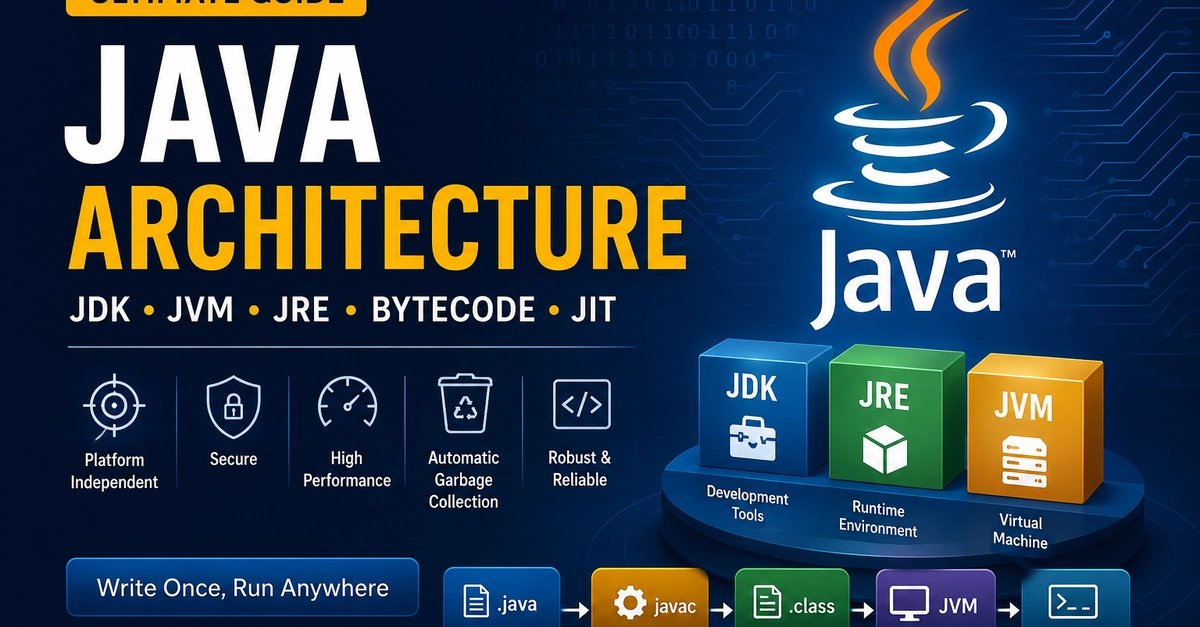
Java’s runtime stack – JDK, JRE, JVM, bytecode, and JIT – forms a predictable execution model that lets developers build horizontally scalable services, choose consistency guarantees, and expose clean API patterns without sacrificing portability.
Java Is More Than a Language – It’s a Scalable Ecosystem
The problem: portability hides operational complexity
When a junior developer runs java Main on Windows, Linux, or macOS and sees the same output, the success feels magical. The illusion of “write once, run anywhere” often masks the fact that production‑grade Java services must still deal with distributed state, network partitions, and evolving API contracts. Teams that treat Java as a simple compiler miss the hidden costs of scaling a monolith into a set of micro‑services.
Solution approach: treat the Java stack as a set of composable layers
| Layer | Primary responsibility | Scaling implication |
|---|---|---|
| JDK | Tooling – compiler, debugger, build plugins | Enables reproducible builds; supports incremental compilation that reduces CI latency |
| JRE | Runtime – JVM + core libraries | Guarantees a uniform execution environment across hosts; isolates GC and thread pools per process |
| JVM | Bytecode verifier, classloader, memory manager | Provides tunable heap, GC algorithms, and native‑code generation that can be adjusted per workload |
| Bytecode | Platform‑neutral intermediate representation | Allows the same artifact to be deployed on any cloud VM, container, or edge device |
| JIT | Adaptive native compilation | Turns hot methods into machine code; reduces CPU cycles per request as traffic grows |
By viewing each piece as a contract, architects can reason about where to apply horizontal scaling, how to enforce consistency, and which API style fits the service’s lifecycle.
Consistency models built on the JVM
Java’s memory model defines happens‑before relationships for threads, but distributed consistency is a separate concern. Two common patterns emerge:
- Strong consistency with transactional frameworks – Libraries such as Spring Transaction or Jakarta EE JTA coordinate database commits across multiple resources. The JVM guarantees that a thread sees the latest committed state after a transaction completes, but network latency still limits throughput. Use this model when business rules require immediate visibility (e.g., financial ledgers).
- Eventual consistency with messaging – Systems built on Apache Kafka, RabbitMQ, or Pulsar publish domain events from the JVM. Consumers apply those events asynchronously, accepting temporary divergence. The Java ecosystem offers idempotent consumer APIs (
@KafkaListener,@RabbitListener) that simplify replay and deduplication. This pattern scales horizontally because each consumer instance can process a partition independently.
Choosing between the two is a trade‑off between latency and availability. The JVM does not enforce either; it merely provides the primitives (threads, locks, atomic variables) that frameworks use to implement the desired guarantees.
API patterns that survive scaling
When a service grows from a single instance to dozens, the shape of its public interface matters. Java’s strong typing and annotation processing make several patterns especially robust:
- RESTful resources with JAX‑RS – Annotations like
@Pathand@GETmap directly to HTTP verbs. Because the contract is expressed in Java interfaces, tools such as OpenAPI Generator can produce client stubs that stay in sync with the server implementation. - gRPC with protobuf – The
grpc-javalibrary compiles.protofiles into Java classes, guaranteeing binary compatibility across language boundaries. Streaming RPCs let a single JVM thread handle thousands of concurrent connections with minimal context‑switch overhead. - GraphQL with graphql‑java – Schema‑first development forces a single source of truth for queries and mutations. Resolver functions are ordinary Java methods, so existing DI containers (Spring, Micronaut) can inject services without additional boilerplate.
All three patterns benefit from contract‑first tooling: the API definition lives outside the implementation, enabling independent versioning and safe rollout strategies (blue‑green, canary). The JVM’s classloader isolation also allows multiple API versions to coexist in the same process, reducing deployment friction.
Trade‑offs you’ll encounter
| Decision | Benefit | Cost |
|---|---|---|
| Enable G1 GC (default in modern JDKs) | Predictable pause times for latency‑sensitive services | Slightly higher heap overhead compared to Serial GC |
| Run on GraalVM native image | Faster startup, lower memory footprint – ideal for serverless | Longer build times, limited reflection support; requires careful testing of third‑party libraries |
| Adopt reactive frameworks (Spring WebFlux, Vert.x) | Non‑blocking I/O lets a single JVM handle many more connections | Steeper learning curve; debugging asynchronous flows can be harder |
| Persist state in a distributed cache (Hazelcast, Apache Ignite) | Reduces database load, provides near‑real‑time reads | Cache invalidation complexity; added operational surface |
Understanding where the JVM’s strengths intersect with your consistency requirements and API design choices lets you scale without hitting the classic “it works on my machine” wall.
A pragmatic roadmap for teams
- Lock down the JDK version – Use a version manager (e.g.,
sdkman) and enforce it in CI. Consistent bytecode eliminates subtle runtime mismatches. - Instrument the JVM – Enable JMX or use Micrometer to export GC, thread, and JIT metrics. Observability data guides heap‑size tuning and GC algorithm selection.
- Choose a consistency baseline – Start with eventual consistency via event streams; add transactional boundaries only where business logic demands it.
- Expose APIs through a contract‑first toolchain – Generate OpenAPI or protobuf definitions from source, then version them in a repository.
- Iterate on deployment models – Containerize the JRE, test GraalVM native images, and evaluate serverless runtimes (AWS Lambda Java) as traffic patterns evolve.
Closing thoughts
Java’s ecosystem is deliberately layered: the JDK builds, the JRE runs, the JVM executes, bytecode travels, and the JIT accelerates. Each layer offers knobs you can turn to meet scalability goals, enforce the right consistency model, and keep APIs stable across releases. Treating Java as a collection of interchangeable components, rather than a monolithic language, turns the “write once, run anywhere” promise into a concrete strategy for building distributed systems that grow predictably.
Further reading
- Official JDK documentation: https://openjdk.org/
- Spring Transaction guide: https://spring.io/guides/gs/managing-transactions/
- gRPC Java quick start: https://grpc.io/docs/languages/java/quickstart/
- Micrometer metrics library: https://micrometer.io/
Comments
Please log in or register to join the discussion