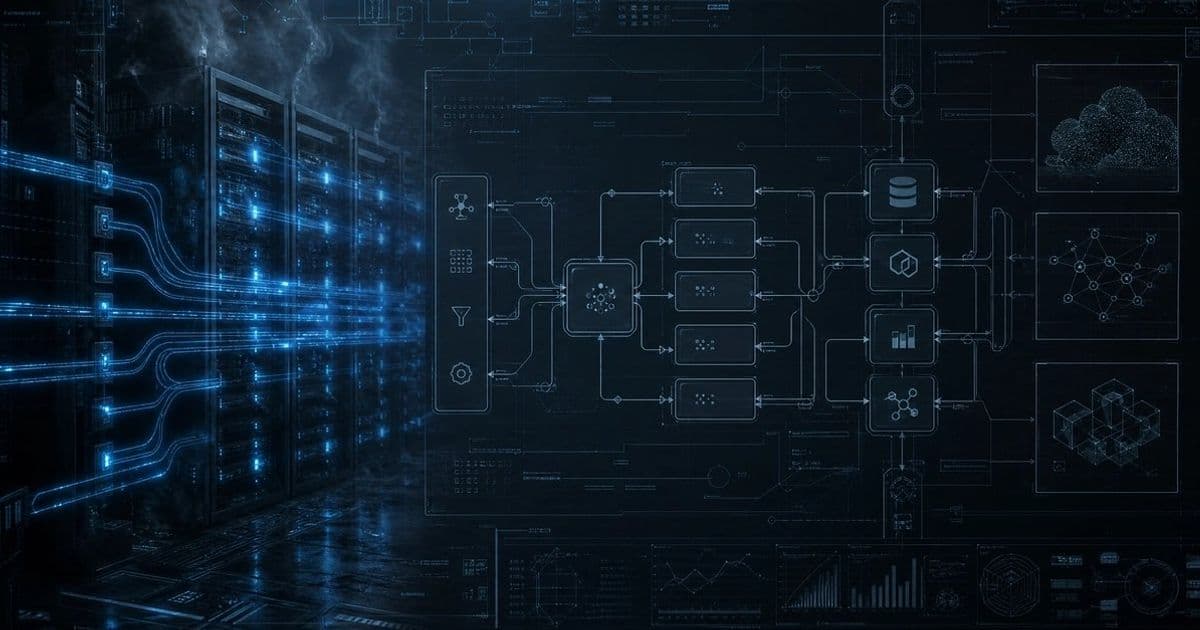
Moving a Retrieval-Augmented Generation (RAG) system from a 15-line Python demo to a production environment reveals critical failures in data ingestion, retrieval precision, and system latency. This analysis breaks down the structural fault lines of naive RAG and provides a blueprint for resilient, production-grade AI infrastructure.
The gap between a RAG demo and a production system is not a matter of scale, but a matter of architecture. In a tutorial, you work with three pristine markdown files and a toy dataset that fits in a developer's mental model. In production, you face six million scanned PDFs, legacy SharePoint dumps, and broken OCR text.
When the "happy path" ends, the pipeline typically breaks across five distinct structural fault lines. Building a reliable system requires shifting the focus from prompt engineering to systems engineering.
Failure #1: Semantic Fragmentation via Naive Chunking
Most naive implementations use fixed token lengths or character counts, such as splitting every 500 characters with a small overlap. This is the fastest way to destroy retrieval quality. If a user asks for a specific metric, the vector embedding for one chunk might contain the context while the next contains the value. Because the semantic meaning is fragmented across an arbitrary boundary, the vector search score drops, and the correct information is missed.
The Invisible Data Corruptors
- The Unicode Trap: Slicing text by raw byte arrays without evaluating Unicode characters can slice through multi-byte emojis or special characters. This creates corrupted byte sequences that break embedding models, leading to silent generation failures.
- Table Destruction: Character-based splitters chop through markdown or CSV tables, stripping row metrics from their headers and turning financial data into meaningless numbers.
The Solution: Hierarchical Parent-Child Retrieval
Production systems decouple the unit of retrieval from the unit of generation. Instead of indexing the exact text block passed to the LLM, use a parent-child structure.
- Child Chunks: Break documents into granular pieces (100–200 tokens) to generate crisp, focused vector embeddings.
- Parent Context: When a child chunk matches a query, the system pulls the pre-linked parent context (e.g., the surrounding 1,500 tokens or the entire section).
This ensures the vector search targets exact semantic matches without starving the LLM of the necessary background context.
Failure #2: Over-Reliance on Pure Vector Similarity
Dense vector embeddings are not a replacement for traditional search engines. While they excel at conceptual similarity, they are notoriously poor at exact keyword matching, serial numbers, or alphanumeric identifiers. If a technician searches for a specific error code like ERR_9402_SYS, a pure vector search often returns general "system error handling" documents rather than the specific manual containing that exact string.
The Connection Pool Collapse
High-dimensional vector index scans, such as HNSW, are computationally heavy on RAM and CPU. Without strict timeout configurations and separate read replicas, complex vector lookups can exhaust database connection pools, causing core backend services to drop incoming requests during traffic spikes.
The Solution: Hybrid Retrieval and Reranking
Production-grade RAG requires a hybrid architecture that runs two parallel tracks:
- Dense Retrieval: For conceptual and conversational queries.
- Sparse Retrieval (BM25): For exact strings and unique IDs.
These results are combined using Reciprocal Rank Fusion (RRF) to normalize scores. The top candidates are then passed through a specialized Cross-Encoder Reranker (such as those provided by Cohere). Unlike vector embeddings, a cross-encoder evaluates the query and the chunk together, filtering out the semantic drift that plagues raw vector outputs.
Failure #3: The "Black Box" Debugging Problem
Traditional applications fail with a stack trace. RAG pipelines fail silently. The system might return a confident, beautifully articulated hallucination, or claim it cannot find an answer that exists in the database. Without observability, debugging becomes a guessing game.
The Security Risk: Tenant Isolation Leaks
In multi-tenant enterprise systems, missing observability is a security liability. Without explicit logging and validation of namespace metadata filters at the retrieval layer, one tenant's query can accidentally pull chunks belonging to another organization.
The Solution: Semantic Tracing and the RAG Triad
Standard logs are insufficient. You need distributed semantic tracing using tools like OpenTelemetry or Langfuse to track the execution graph: from query transformation and hybrid retrieval to reranking and final generation.
To optimize the system, you must measure the "RAG Triad":
- Faithfulness: Is the answer derived only from the retrieved context?
- Answer Relevance: Does the response actually address the user's question?
- Context Precision: Did the system prioritize the exact chunks required?
Failure #4: Context Pollution and the "Lost in the Middle" Phenomenon
There is a temptation to dump the top 50 retrieved chunks into a massive context window (e.g., 128k tokens) and let the model sort it out. This leads to a documented behavioral trait where LLMs prioritize information at the very beginning or end of the input, ignoring critical data buried in the middle.
Packing the prompt with redundant or tangential chunks creates context pollution, increasing the probability of semantic drift and compromising the accuracy of the final payload.
Failure #5: Latency and Architecture Explosion
Feeding 8,000 tokens into an LLM per request creates a linear increase in time-to-first-token (TTFT) and an exponential increase in token costs. If a system takes seven seconds to respond because it is processing redundant context blocks synchronously, users will abandon it.
The Solution: Asynchronous Pipelines and Semantic Caching
To maintain performance, treat RAG as a decoupled backend pipeline:
- Semantic Caching: Implement a caching layer using Redis before the retrieval step. If a new query is semantically identical to a previous one, serve the cached response to drop latency to milliseconds.
- Asynchronous Processing: Ingestion, OCR parsing, and embedding generation must be handled out-of-band using message queues. Never block the primary application thread while a 50-page PDF is being vectorized.
Summary: Systems Engineering Over Prompt Engineering
When a RAG pipeline fails in production, it is rarely because the LLM was not "smart" enough. It fails because the pipeline was treated as a trivial software layer rather than a complex data-routing problem.
Building a resilient architecture requires returning to foundational computer science: deterministic data cleaning, decoupled infrastructure, and hybrid index configurations. RAG is not a prompt engineering problem. It is a systems engineering problem.
Comments
Please log in or register to join the discussion