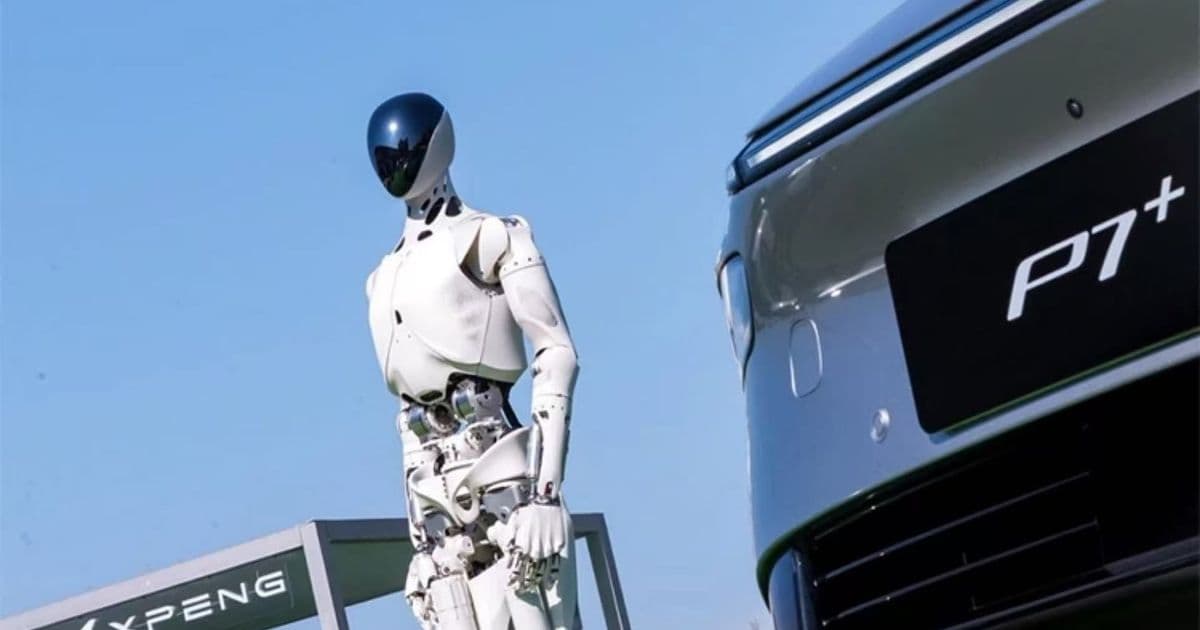
XPeng has announced the mass production of its IRON humanoid robot, with plans for thousands of units monthly by late 2026 and deployment in retail stores by early 2027. The company is taking a pragmatic approach by focusing on structured commercial environments rather than attempting more complex applications at this stage.
XPeng's recent announcement about the mass production of its IRON humanoid robot represents a significant milestone for the Chinese automaker's robotics ambitions. The company is targeting production capacity in the thousands of units per month by the end of 2026, with deployment in its own retail stores as early as Q1 2027. This timeline positions XPeng among the first Chinese automakers to transition humanoid robots from prototype to commercial deployment at meaningful scale.
The IRON robot was first unveiled at a previous product launch event, where its human-like gait drew significant attention—including speculation that it might actually be a human in costume. This initial reception suggests XPeng has made substantial progress in bipedal locomotion, one of the most challenging aspects of humanoid robotics. The company has since clarified that IRON is indeed a genuine humanoid robot platform, and development has progressed substantially since the initial unveiling.
From a technical perspective, IRON is equipped with several notable components:
- Three Turing AI chips for onboard processing
- The same XNGP AI Hawk Eye vision system used in XPeng's vehicles
- A 4D millimeter-wave radar array for real-time environmental perception
These specifications suggest XPeng is leveraging its automotive expertise in perception systems and AI processing, potentially creating synergies between its vehicle and robotics divisions. The production version is expected to stand under 1.7 meters tall, with an appearance very close to the pre-production prototype already shown publicly.
XPeng's commercial strategy appears pragmatic and well-considered. Rather than attempting to deploy robots in complex, unstructured environments like factory floors or homes, the company has narrowed its focus to structured commercial scenarios: customer guidance, sales floor leadership, and inspection. These environments feature repeatable tasks and relatively controlled conditions, making them more suitable for current-generation humanoid robots.
Deploying IRON in XPeng's own retail stores serves multiple purposes:
- The robot can perform specific functions like greeting customers, guiding them through showrooms, and demonstrating product features
- It serves as a visible technology showcase that enhances XPeng's brand image
- It allows the company to accumulate real-world operational data to feed back into the robot's ongoing development
This approach mirrors strategies employed by other robotics companies that have successfully transitioned from lab to commercial deployment, such as Boston Dynamics with its Spot robot in industrial settings.
XPeng Chairman He Xiaopeng has acknowledged the current limitations of humanoid robotics technology, stating that at current hardware and software capability levels, these robots are not yet viable for factory floor work or home environments. Factories demand extreme precision and adaptability, while homes present unpredictable edge cases that exceed today's robot capabilities. This realistic assessment contrasts with some more optimistic claims in the field and suggests XPeng is taking a measured approach to commercialization.
The target of thousands of units monthly production is ambitious but not unprecedented in the robotics industry. Companies like Tesla have announced similar scale targets for their Optimus robot, though actual production volumes have yet to materialize. XPeng's advantage lies in its manufacturing expertise as an established automaker, which could potentially give it an edge in scaling production compared to companies without such experience.
However, significant challenges remain:
Cost-effectiveness: Mass-producing humanoid robots at a price point that makes commercial sense will be difficult given current component costs and manufacturing complexity.
Reliability: Deploying robots in customer-facing environments requires extremely high reliability, as failures could damage brand perception and create liability issues.
Task specialization: While IRON may perform well in structured retail environments, its capabilities will likely be limited to specific, pre-programmed tasks rather than general-purpose assistance.
Economic justification: Retailers will need to see a clear return on investment, which may be challenging given current robotics capabilities and labor costs in many markets.
XPeng's approach of starting with its own retail stores rather than selling to third parties is a smart strategy that mitigates some of these challenges. By controlling the deployment environment and having direct access to customers and data, the company can refine the product and business model before attempting broader commercialization.
The humanoid robotics field is rapidly evolving, with numerous companies developing similar systems. XPeng's entry adds another significant player to what is becoming an increasingly competitive landscape. Other notable entrants include Tesla with Optimus, Figure AI with Figure 01, and Agility Robotics with Digit, among others.
In conclusion, XPeng's IRON humanoid robot represents a significant step toward commercial deployment of humanoid robotics, particularly in structured commercial environments. The company's pragmatic approach of focusing on retail applications rather than attempting more complex use cases shows a realistic assessment of current technological capabilities. While challenges remain in cost, reliability, and economic justification, XPeng's manufacturing expertise and phased deployment strategy position it well for potential success in this emerging market. The coming years will be critical in determining whether these ambitious production and deployment targets can be met and whether humanoid robots can transition from novelty to genuinely useful commercial tools.
For more information on XPeng's robotics initiatives, you can visit their official website. Technical details about the Turing AI chips and XNGP AI Hawk Eye vision system provide additional context for the robot's capabilities.
Comments
Please log in or register to join the discussion