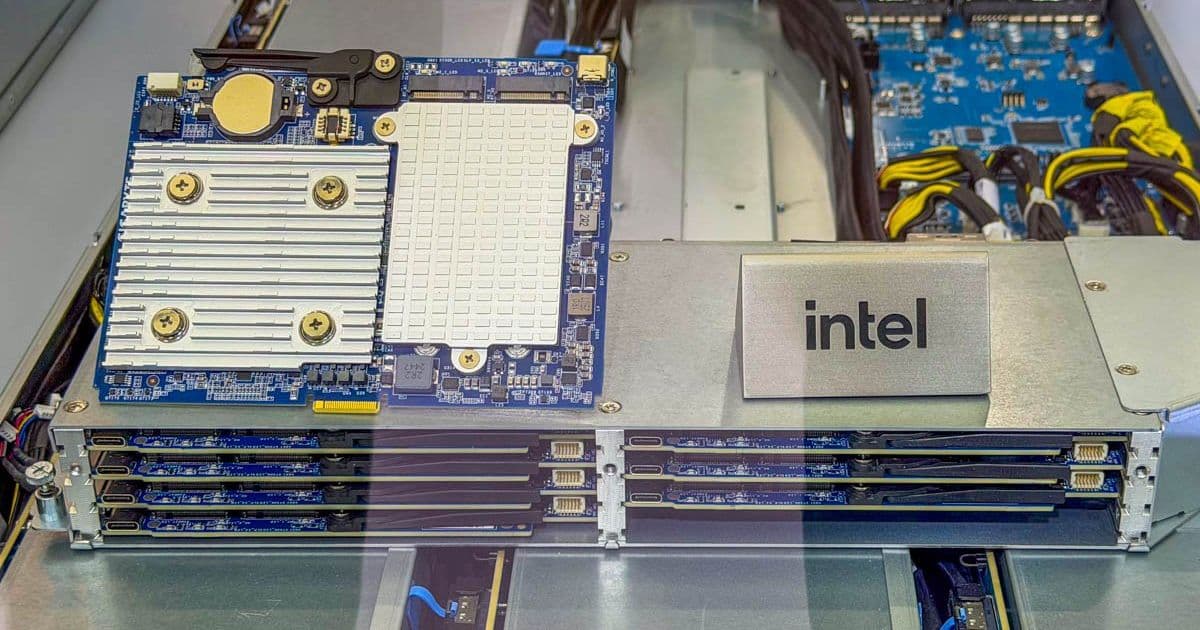
Gigabyte showcases an astonishing 40-node 1U server cluster at Computex 2026, packing 320 cores, 1.28TB of memory, and 40 integrated GPUs into a single chassis using innovative node cartridge design.
A 40-Node 1U Cluster Gigabyte R1C7-K0A-AS1
At Computex 2026, Gigabyte has unveiled a server that pushes the boundaries of density in data center hardware. The R1C7-K0A-AS1 is a 1U server that contains an incredible 40 nodes, each with its own processor, memory, and storage capabilities. This represents a significant leap in server density, offering 320 cores, 1.28TB of memory, 80 SSDs, and 40 integrated GPUs in a single rack unit.
The Cluster Architecture
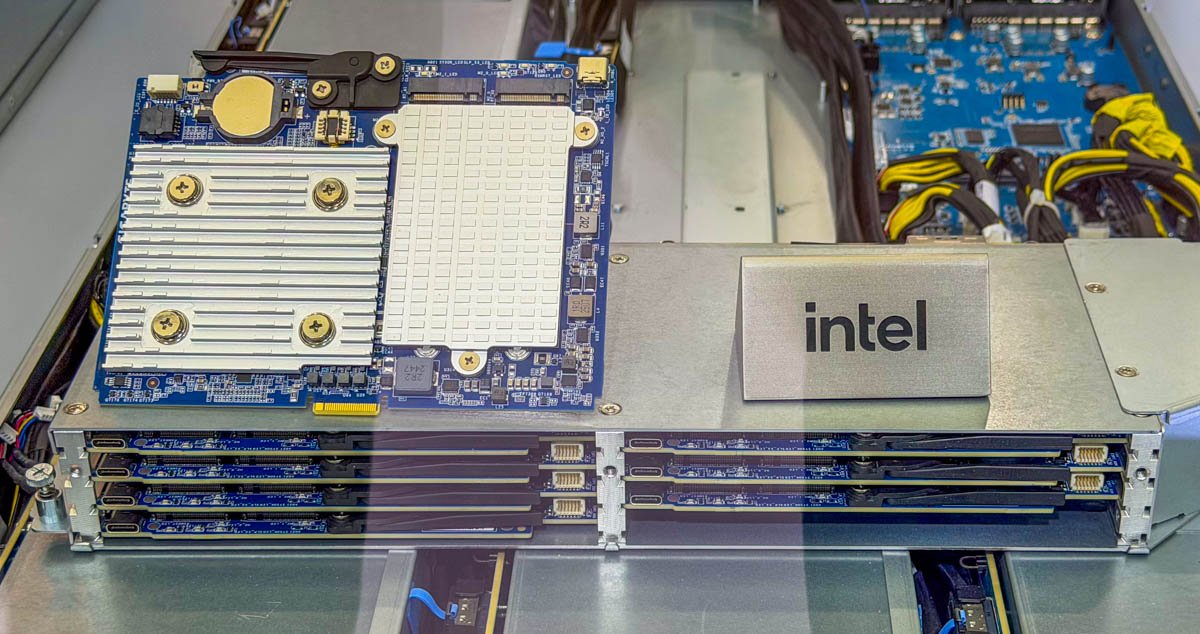
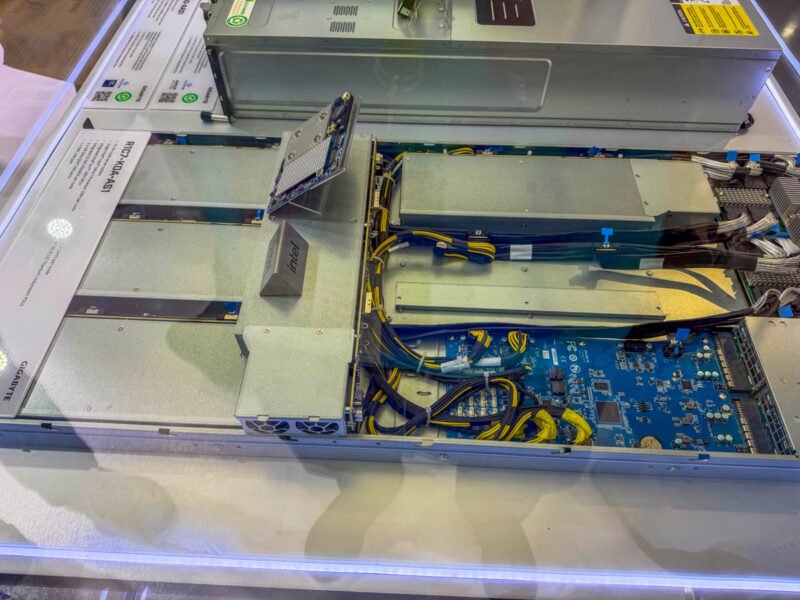
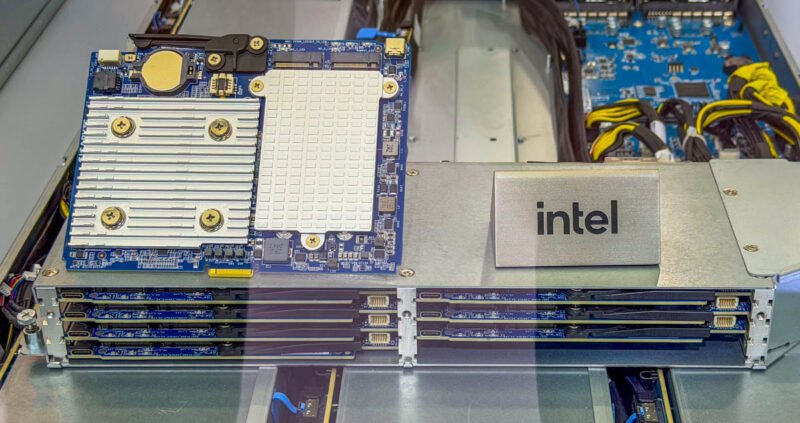
The R1C7-K0A-AS1 utilizes an innovative cartridge-based design that allows for such extreme density. Gigabyte has created five cartridges, each containing eight nodes, which are installed in the server chassis with three in the front row and two in the second row. This approach allows for efficient cooling and cable management while maximizing the usable space within the 1U form factor.
Node Specifications
Each node in the cluster is built around Intel's Core Ultra 7 258V processor, codenamed Lunar Lake. This processor features 4 Performance cores and 8 Efficiency cores, providing a balanced mix of computational power and energy efficiency. Each node is configured with 32GB of LPDDR5X memory, which offers high bandwidth and low power consumption.
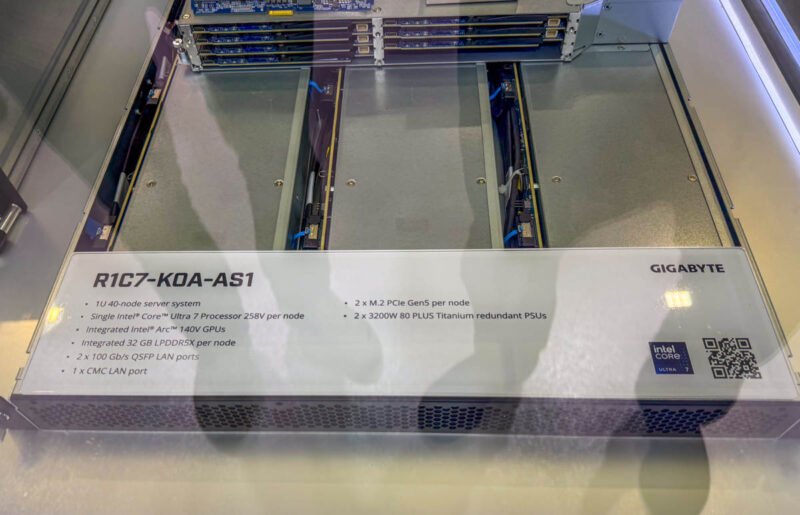
The storage configuration is equally impressive, with each node featuring two PCIe Gen5 x2 M.2 slots. This allows for high-speed local storage that can be configured based on workload requirements. The integrated GPU capability in each node adds another dimension of computational flexibility, making this system suitable for a wide range of workloads.
Technical Implementation
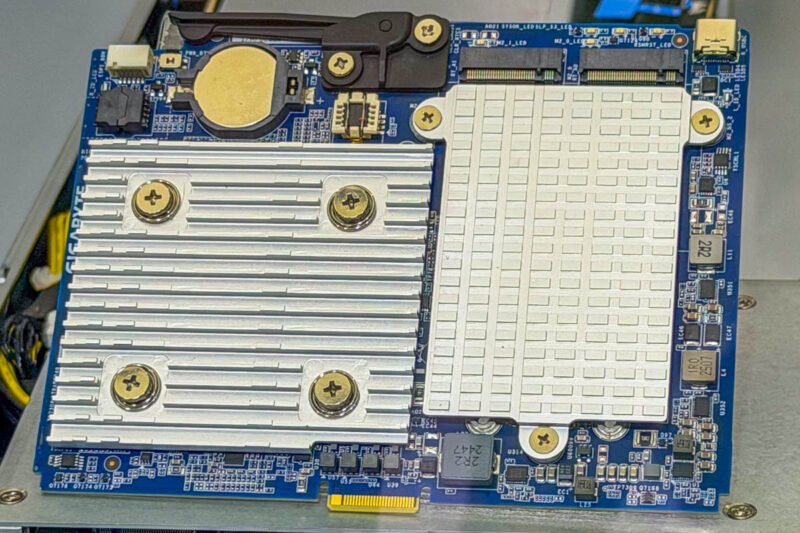
When examining one of the node cartridges, we can see that each node sits on a small board with minimal connections to the overall system. Under one heatsink resides the Lunar Lake CPU, while another heatsink covers the two M.2 slots. This compact design is key to achieving the remarkable density of the system.
The rear of the system reveals some interesting technical details. While full specifications aren't yet available, it appears that each cartridge connects via two MCIO 8i connectors. This suggests either 16 PCIe lanes per cartridge (2 per node) or an Ethernet-based interconnect. The presence of two QSFP28 ports at the rear indicates high-speed networking capabilities, though the exact internal topology remains unclear at this point.
Power and Management
The R1C7-K0A-AS1 is equipped with two 3.2kW Titanium-rated power supplies, ensuring high efficiency and reliability. A chassis management controller provides system oversight through a rear management port. This is essential for managing such a dense system efficiently.
Performance Potential
With 4 P-cores and 8 E-cores per node, the system delivers a total of 320 cores in a single 1U chassis. Extrapolating this density to a full rack (42U), this architecture could theoretically support:
- 12,800 CPU cores
- 3,200 SSDs
- 1,600 iGPUs
- 51.2TB of LPDDR5X memory
Connected via 80 power connections, 80 100GbE ports, and 40 management ports. This density exceeds many competing solutions, including upcoming Arm-based AGI CPUs.
Use Cases
This server architecture is particularly well-suited for several scenarios:
Virtual Desktop Infrastructure (VDI): Each node can function as an independent virtual desktop, with the integrated GPU providing graphics acceleration.
Media Transcoding: Intel's Quick Sync technology in the integrated GPUs excels at video transcoding, making this ideal for streaming services or content delivery networks.
High-Performance Computing (HPC): The dense core count and memory capacity make this suitable for certain HPC workloads, particularly those that can benefit from integrated graphics.
Edge Computing: The compact form factor and power efficiency make this suitable for edge deployments where space is limited.
Market Positioning
The R1C7-K0A-AS1 represents an interesting evolution in server design. As noted by industry observers, companies have used Intel iGPU nodes in clusters for years, such as the old Intel Visual Compute Accelerator. What sets this design apart is the extreme density and the integration of multiple nodes into a single 1U chassis.
The system leverages Intel Quick Sync transcoding technology, which is relatively easy to integrate into media processing pipelines. At the same time, the x86 cores provide general-purpose computing capabilities. This dual nature makes the system versatile for workloads that require both CPU and GPU resources.
Technical Challenges
Achieving such density presents several engineering challenges:
Thermal Management: With 40 processors in a 1U space, cooling is critical. The heatsink design and cartridge approach suggest Gigabyte has addressed this through efficient thermal design.
Power Delivery: Supplying adequate power to 40 nodes in a compact space requires careful power distribution and efficient components.
Interconnect Complexity: The internal connections between nodes and to the network must be carefully designed to avoid bottlenecks.
Comparison with Alternatives
Compared to traditional 1U servers with 1-2 processors, the R1C7-K0A-AS1 offers approximately 20x the density in terms of processor cores. This makes it particularly attractive for workloads that benefit from massive parallelism but don't require the highest single-thread performance.
When compared to other dense server architectures, such as blade servers or multi-node servers, the R1C7-K0A-AS1 offers a more compact solution with integrated graphics capabilities. This could make it more suitable for certain VDI and media processing workloads.
Availability and Future Prospects
As of Computex 2026, the R1C7-K0A-AS1 is not yet commercially available. However, the demonstration suggests Gigabyte is serious about bringing this innovative design to market. The use of Lunar Lake processors indicates this is a forward-looking design that may become available as Intel continues to refine its integrated graphics capabilities.
For homelab enthusiasts and small businesses, this type of extreme density server could enable powerful computing setups in minimal space. While the initial cost may be high, the performance-per-square-meter could make it attractive for certain applications.
Conclusion
The Gigabyte R1C7-K0A-AS1 represents an impressive feat of server engineering, pushing the boundaries of what's possible in a 1U form factor. By packing 40 nodes with integrated GPUs into a single chassis, Gigabyte has created a system that offers exceptional density for workloads that can benefit from massive parallelism and integrated graphics.
While the exact specifications and pricing are still forthcoming, this demonstration at Computex 2026 shows that server manufacturers continue to innovate in the quest for higher density and efficiency. For data center operators, cloud providers, and even well-equipped homelabs, this type of architecture could represent the future of compact, high-performance computing.
Comments
Please log in or register to join the discussion