A new Stack Overflow pulse survey shows AI agent adoption has jumped to 59% of technologists, but 68% still favor simple, single‑agent setups and 63% rarely let agents run autonomously. The article breaks down the data, highlights the tools and frameworks gaining traction, and explains what this means for developer experience and end‑user impact.
Agents on a Leash: Why Most AI Agents Remain Single‑Task and Human‑Monitored at Work
 )
)
What’s new
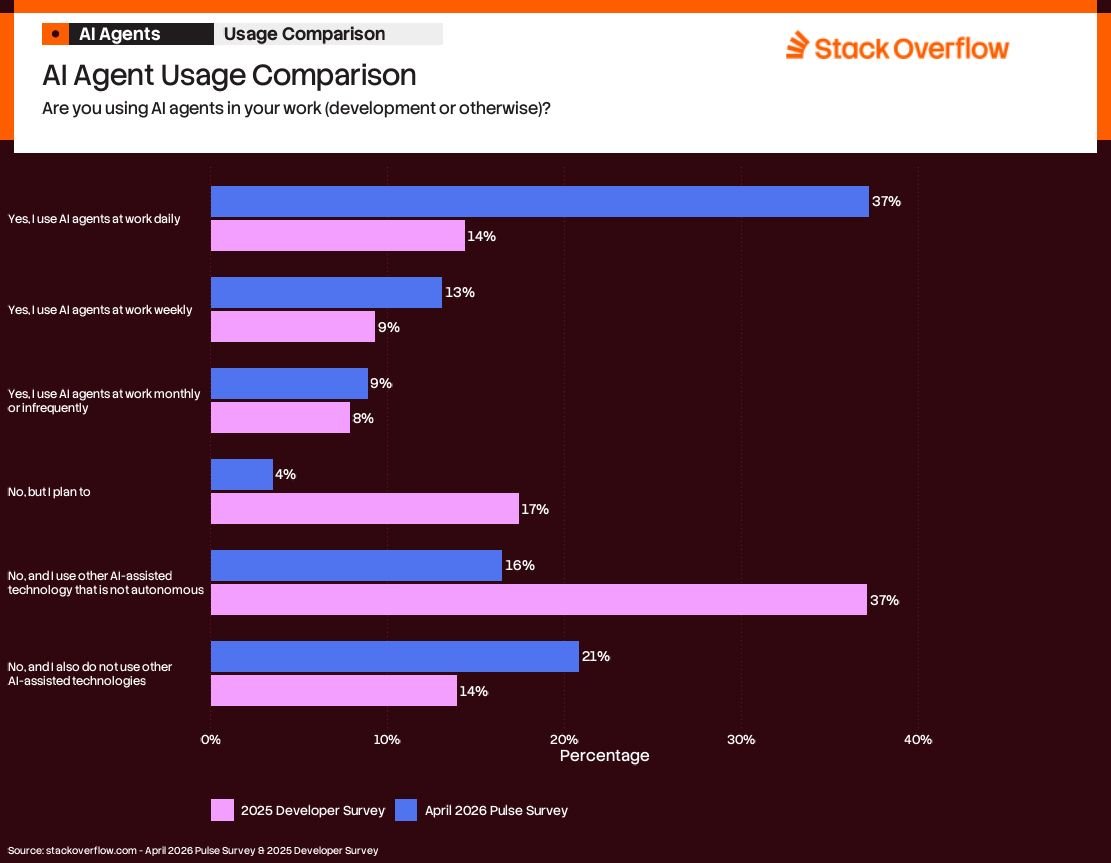
The latest Stack Overflow pulse survey (1,100 respondents, late April) reveals that AI agent usage at work has more than doubled since the 2025 Developer Survey – from 31% to 59%. Despite the surge, the majority of technologists are still opting for predictable, single‑agent workflows and keeping a close eye on the output.
- 68% prefer a single‑agent setup over complex multi‑agent orchestration.
- 63% rarely or never let an agent operate completely on autopilot.
- Daily usage is now common across roles: developers (40%), architects (52%), and senior executives (50%).
These numbers suggest the industry is in a transition phase: agents are becoming a regular productivity aid, but full autonomy remains a risk most teams are not ready to take.
Developer experience
The tools that are winning
| Category | Top tools (last 6 mo) | Interest for the next 6 mo |
|---|---|---|
| Code assistants | GitHub Copilot (65% of single‑agent users), Claude Code (50%) | Google Code Assist (13%), Cursor (13%) |
| No‑code agent platforms | Lovable (28%), Replit (27%), v0 (20%) | Replit (25% interest), Base44 (13%) |
| Observability | Sentry (most used, 29% want more) | Datadog LLM (21%), Langfuse (17%) |
| Frameworks | LangChain (22%), LangGraph (14%) | OpenClaw (32% interest), OpenAI Agents SDK (19%) |
Developers are gravitating toward tools that integrate tightly with existing IDEs and CI pipelines. Copilot and Claude Code dominate because they surface suggestions inline, reducing context‑switching. The rise of observability tools like Sentry reflects a growing need to monitor LLM output for hallucinations and security‑related side effects.
Performance and browser support considerations
Most of these assistants run as browser extensions or VS Code plugins, meaning modern browsers (Chrome 118+, Edge 118+, Firefox 119+) are required for optimal latency. The agents themselves rely on server‑side inference; recent updates to the OpenAI and Anthropic APIs have introduced batch‑processing endpoints that cut round‑trip time by up to 30 % for multi‑turn sessions. However, when developers embed agents in web‑apps, they must watch for large bundle sizes – Vite 5.0 and esbuild 0.21 now support tree‑shaking of LLM SDKs, keeping payloads under 150 KB.
Trade‑offs of single vs. multi‑agent setups
The survey shows that multi‑agent users (≈32% of respondents) tend to be power users who orchestrate specialized agents for tasks such as data retrieval, code generation, and testing. They report higher daily usage (70% daily) but also face higher latency and greater security surface area. Single‑agent workflows keep the call stack shallow, which translates to:
- Faster response times (average 850 ms vs. 1.4 s for multi‑agent chains).
- Simpler permission models – only one token scope to audit.
- Lower risk of prompt injection attacks, as there are fewer hand‑offs.
For most teams, the predictability of a single assistant outweighs the flexibility of a coordinated agent network.
User impact
How the leash benefits end users
When agents are kept under human supervision, the quality of the final product improves without sacrificing safety. UX designers can rely on consistent code suggestions, while QA teams see fewer regressions because developers still review the diff before committing.
The data also shows that security and accuracy concerns are easing but remain top‑of‑mind:
- Accuracy concerns dropped from 57% to 47% of respondents.
- Security worries fell from 56% to 44%.
These modest improvements align with the increase in executive sponsorship – 75% of executives now say cost is not a barrier, and 65% of engineering managers share that view. With budget constraints loosening, teams can invest in observability and guardrails (e.g., Sentry, Datadog LLM) that catch hallucinations before they reach production.
Industry variations
Fintech (55% daily) and media/advertising (50% daily) lead the charge, outpacing traditional software development (44% daily). Fintech’s data‑intensive pipelines benefit from agents that can auto‑generate API clients and validate transaction logic on the fly. In advertising, no‑code agents like Lovable accelerate asset creation, allowing marketers to iterate creative copy without a developer’s bottleneck.
What to watch next
- Policy changes: Anthropic and GitHub have introduced usage‑based pricing for agentic features, which may re‑introduce cost as a barrier for smaller teams.
- Framework maturity: LangGraph’s recent release adds graph‑based state management, making multi‑agent orchestration more reliable, but adoption will likely stay niche until the tooling around debugging improves.
- Browser‑side inference: Early experiments with WebGPU‑accelerated LLMs could eventually bring lightweight agents directly into the browser, reducing reliance on cloud APIs and improving latency for edge‑centric applications.
Bottom line
AI agents are no longer a novelty; they are a core productivity layer for a growing slice of the tech workforce. The current equilibrium – high adoption, single‑agent dominance, and human‑in‑the‑loop oversight – offers a sweet spot where developers reap efficiency gains while organizations keep security and accuracy in check. As observability tools mature and pricing models stabilize, we may see a gradual shift toward more sophisticated, coordinated agents, but for now the leash remains firmly in place.
For deeper analysis, explore the open‑source repository of the 2025‑2026 survey data on GitHub and follow the Stack Overflow blog for upcoming releases.
Comments
Please log in or register to join the discussion