Alibaba’s Qwen Robot Suite gives the company a place in the race to turn AI models into robot control systems.
Alibaba Group launched its first AI model suite for robots Tuesday, a move that pushes its Qwen family from chat interfaces and software tasks into machines that need to see, plan, and act in physical spaces.
The Hangzhou company introduced Qwen Robot Suite through Tongyi Lab, its AI research unit. Alibaba said selected Alibaba Cloud enterprise clients have begun pilot tests. Alibaba owns the South China Morning Post.
The suite uses three model layers. Qwen-RobotNav handles navigation through vision and language. Qwen-RobotWorld predicts how a scene may change before a robot acts. Qwen-RobotManip controls object handling through a vision-language-action model based on Qwen3.5-4B.
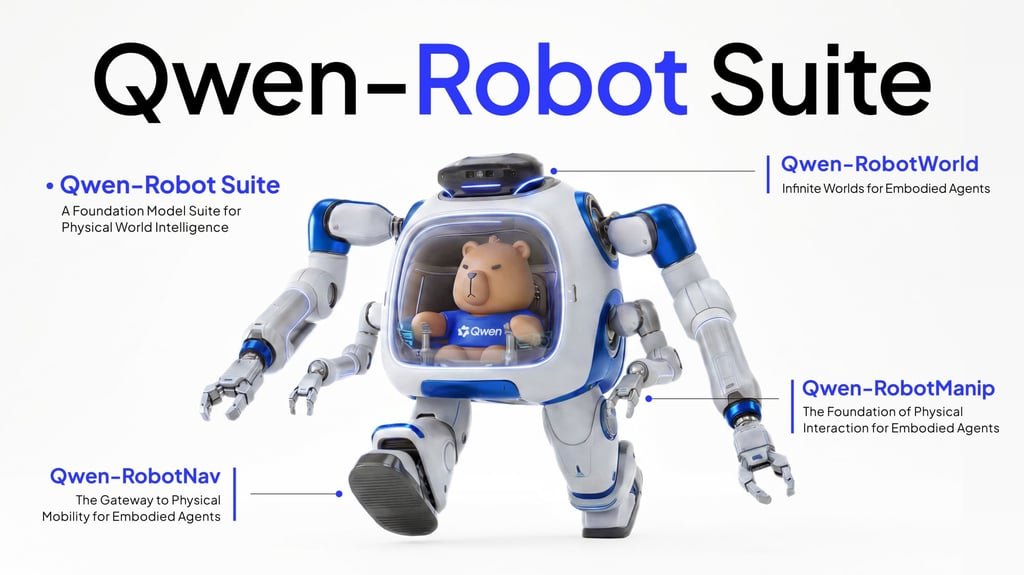
Alibaba said Qwen-RobotManip trained on more than 38,000 hours of open-source data and led the generalist track of the RoboChallenge real-robot benchmark, with a process score of 59.83 and a 45% task success rate.
The launch changes the role of Qwen inside Alibaba’s AI strategy. Developers know Qwen for language and multimodal models that compete with OpenAI, Google, DeepSeek, and ByteDance. Robots force a different test. A chatbot can recover from a poor answer. A robot that misreads a shelf, a floor, or a handoff can break goods, stop a workflow, or injure a worker.
That gap explains the industry’s focus on embodied AI. Google DeepMind has pushed Gemini Robotics as a way to connect vision, language, and action. Nvidia has built its physical AI stack around Cosmos, Isaac, and Project GR00T. Startups such as Physical Intelligence, Skild AI, and Figure AI have raised large rounds for general robot control.
China enters this race with a hardware edge. Robot makers can draw on dense supply chains, fast prototyping, and lower manufacturing costs. Companies such as Unitree, AgiBot, UBTech, Galbot, Spirit AI, and GigaAI give model labs more physical platforms to test on. Electric vehicle companies, including Xpeng and Xiaomi, bring experience from autonomous driving, cameras, sensors, and factory automation.
Alibaba’s problem sits in software. Robot models need spatial judgment, action planning, and feedback loops. A model must connect language to a physical goal, break the goal into steps, and adapt when the object slips or the room layout changes. World models help because they let a robot test a likely outcome before it moves.
Investors have started to treat robot models as a public-market theme in China. Unitree has filed for registration with regulators after clearing the Shanghai Star Market’s listing committee. Morgan Stanley industrial analyst Zhong Sheng said in a recent note that Chinese humanoid robot IPO proceeds would fund research and development, with robot models taking priority over capacity expansion.
Developers will watch two signals from Alibaba. The first signal comes from access. Qwen gained adoption in part because developers could test models, compare benchmarks, and build on open releases. Robot models need hardware, simulators, datasets, and deployment tools. Enterprise pilots help Alibaba learn, but public tools would give outside researchers a way to measure progress.
The second signal comes from real-world success rates. A 45% benchmark task success rate shows progress, but factories and warehouses need systems that can repeat tasks across shifts, lighting changes, object variation, and human interruption. Benchmarks can rank teams. Customers need robots that miss fewer picks, recover from errors, and lower labor or downtime costs.
Skeptics have a clear argument. Robotics has burned capital for years because labs can demo dexterity before customers can deploy it at scale. General robot brains still face messy environments, safety rules, maintenance costs, and hardware limits. A model that works in a lab can fail when a worker moves a box or a camera collects dust.
Supporters see a different pattern. Foundation models improved when developers combined more data, larger models, and better feedback. Robotics may follow that path as companies collect video, action traces, and simulation data. China’s manufacturing base could shorten that loop because model teams can test ideas near robot makers and customers.
Alibaba’s Qwen Robot Suite gives the company a credible entry point. The harder work now moves to pilots: measure failures, reduce retries, and show that Qwen can control machines outside staged demos.
Comments
Please log in or register to join the discussion