AMD has officially announced the pricing and availability for its new Ryzen 7 9850X3D desktop processor, positioning it as a compelling mid-point between its existing 3D V-Cache offerings. With a $499 SEP and a January 29th launch date, the 9850X3D aims to be the 'world's fastest' gaming CPU, bringing a 400MHz boost clock improvement over the 9800X3D while targeting a specific enthusiast budget bracket.
AMD has confirmed the suggested retail price and launch date for its new Ryzen 7 9850X3D desktop processor. The chip will carry a $499 USD SEP (Suggested Etail Price) and is set to become available starting January 29th, 2026. This announcement comes just weeks after the processor's reveal at CES, where AMD positioned it as a faster sibling to the existing Ryzen 7 9800X3D.
The pricing strategy places the 9850X3D in a strategic sweet spot within AMD's current Zen 5 3D V-Cache lineup. As of this writing, the Ryzen 7 9800X3D retails for approximately $469 USD, while the 12-core Ryzen 9 9900X3D sits around $569 USD. The $499 price point creates a clear mid-tier option for enthusiasts who typically budget around $500 for a processor and are seeking the absolute best gaming performance without necessarily needing the additional cores of the 9900X3D.
Performance Profile and Specifications
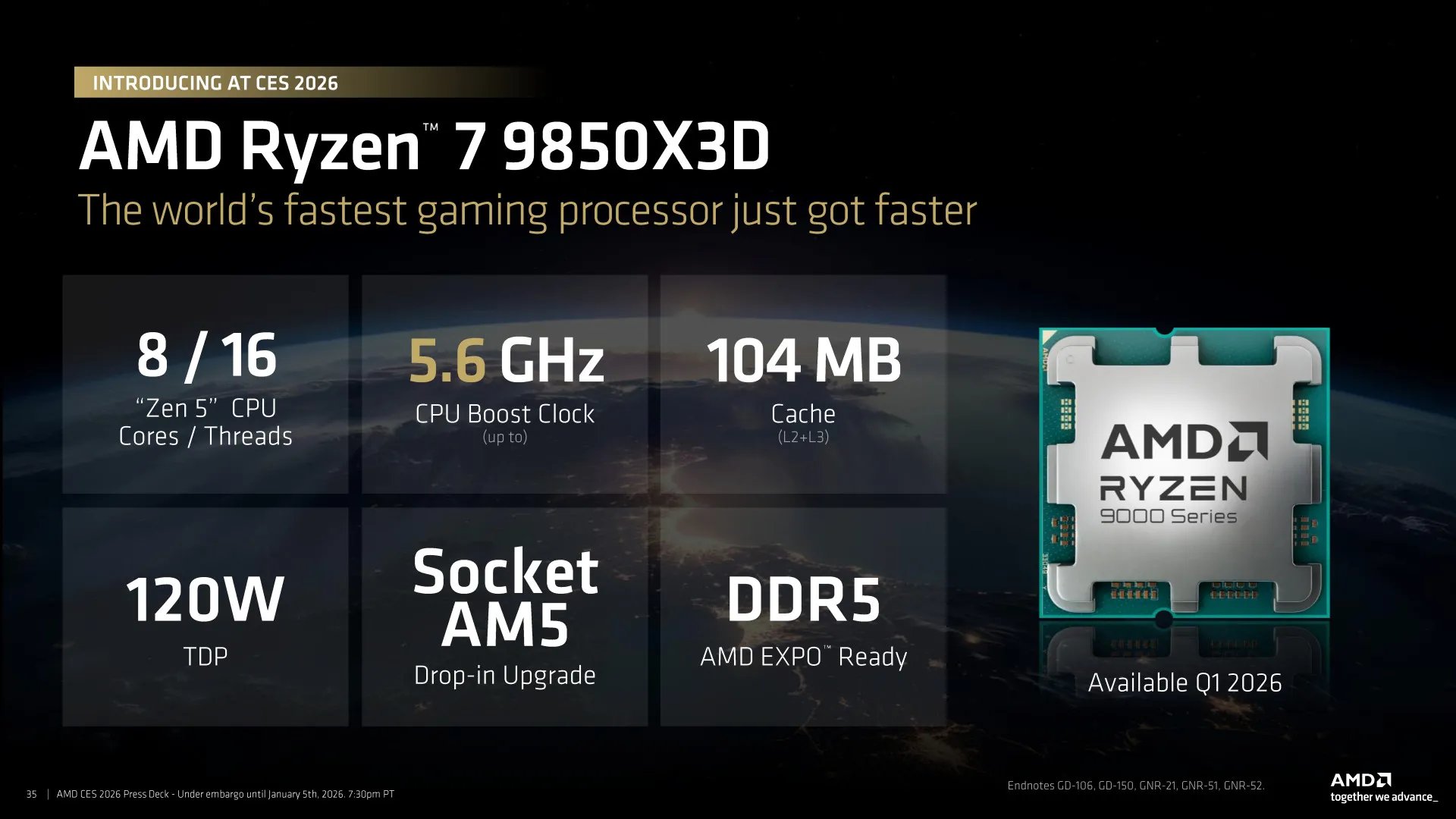
The Ryzen 7 9850X3D is an 8-core, 16-thread processor built on AMD's Zen 5 architecture. Its key differentiator is the 400MHz boost clock improvement over the 9800X3D, which AMD claims will make it the "world's fastest" gaming processor. The chip retains the massive 104MB of total cache (96MB L3 + 8MB L2) and maintains a 120W TDP, identical to its predecessor.
The 3D V-Cache technology remains AMD's primary weapon in the gaming performance war. By stacking an additional 64MB of L3 cache directly on top of the compute die, AMD reduces memory latency and increases cache hit rates, which are particularly beneficial for gaming workloads that often exhibit irregular memory access patterns. The Zen 5 architecture's improved branch prediction and wider execution units further amplify the benefits of this cache configuration.
Market Positioning and Competitive Landscape
With this pricing, AMD is directly targeting Intel's Core Ultra 9 285K from the Arrow Lake family. Early benchmarks from AMD's CES presentation showed the existing 9800X3D already outperforming Intel's flagship in gaming scenarios, and the 9850X3D's additional 400MHz should extend that lead. For Linux users and homelab builders who also game on their primary systems, this creates a compelling all-around processor that excels at both single-threaded gaming workloads and multi-threaded compilation or virtualization tasks.
The 120W TDP is particularly relevant for builders concerned with power efficiency and cooling. While Intel's Arrow Lake chips can draw significantly more power under load, the 9850X3D's power envelope makes it easier to cool in compact cases or with air coolers, which aligns well with the homelab builder mentality of measuring and optimizing every aspect of a system.
Linux and Homelab Considerations
For the Linux-focused audience, the 9850X3D presents an interesting proposition. The large cache can benefit various workloads beyond gaming, including database operations, virtual machine hosting, and compilation tasks. AMD's Zen architecture has generally had excellent Linux support, with the kernel's scheduler and power management features well-tuned for Ryzen processors.
The 8-core configuration strikes a balance between gaming performance and homelab utility. While it won't match the core count of the 9900X3D or 9950X3D for heavy virtualization or container workloads, it provides ample resources for a mixed-use system. For example, a user could run a media server, a few game servers, and their primary gaming environment simultaneously without significant contention.
Build Recommendations
For builders considering the 9850X3D, several factors warrant attention:
Memory Selection: While the 3D V-Cache reduces the performance penalty of slower RAM, DDR5-6000 CL30 remains the sweet spot for Zen 5. The Infinity Fabric clock should be kept at 1:1 with the memory controller for optimal latency.
Cooling: The 120W TDP is manageable with quality air coolers like the Noctua NH-D15 or Thermalright Phantom Spirit, but liquid cooling isn't necessary unless overclocking. For homelab builders prioritizing silence, a large air cooler provides excellent thermal performance without pump noise.
Motherboard: A mid-range B850 or X870 motherboard provides all necessary features without overspending. PCIe 5.0 support for future GPU and storage upgrades is worth considering, though current GPUs don't saturate PCIe 4.0 bandwidth.
Power Supply: A quality 750W-850W PSU provides ample headroom for the 9850X3D paired with high-end GPUs. For systems with integrated graphics or discrete cards under 300W, even 650W is sufficient.
Availability and Final Thoughts
The January 29th launch date means the Ryzen 7 9850X3D will be available through all major retailers. Given the competitive pricing and performance claims, demand is expected to be strong among gamers and enthusiasts. For homelab builders who also game, this processor represents a rare alignment of gaming performance and practical utility.
The $499 price point is particularly strategic. It's high enough to feel premium but not so expensive that it alienates the enthusiast market. Compared to the $469 9800X3D, the 400MHz boost clock improvement and the psychological appeal of the "9850" model number justify the $30 premium for many buyers.
As we approach the launch, independent Linux benchmarks will be crucial to verify AMD's performance claims. The Phoronix test suite will provide comprehensive data on gaming, compilation, virtualization, and power efficiency—exactly the metrics that matter to our audience of hardware enthusiasts and homelab builders who measure everything.
For those planning a new build in Q1 2026, the Ryzen 7 9850X3D deserves serious consideration. It combines cutting-edge gaming performance with practical power efficiency, making it a versatile choice for systems that need to excel at both work and play.
Comments
Please log in or register to join the discussion