AMD's latest 3D V-Cache processor demonstrates that its massive on-die cache architecture makes high-speed DDR5 memory largely irrelevant for gaming performance, potentially saving builders hundreds of dollars during the current RAM price surge.
AMD's Ryzen 7 9850X3D, announced at CES 2026, represents a continuation of the company's strategic advantage in gaming CPUs. While the headline performance uplift over the previous-generation Ryzen 7 9800X3D is a modest 7%, the real story lies in how AMD's 3D V-Cache technology fundamentally changes the economics of building a high-performance gaming system.
The Cache Advantage in Practice
The Ryzen 7 9850X3D leverages AMD's second-generation 3D V-Cache technology, which stacks an additional 64MB of L3 cache directly on top of the CPU die. This brings the total L3 cache to 128MB, a staggering amount compared to conventional desktop processors. This architectural choice has profound implications for memory subsystem performance.
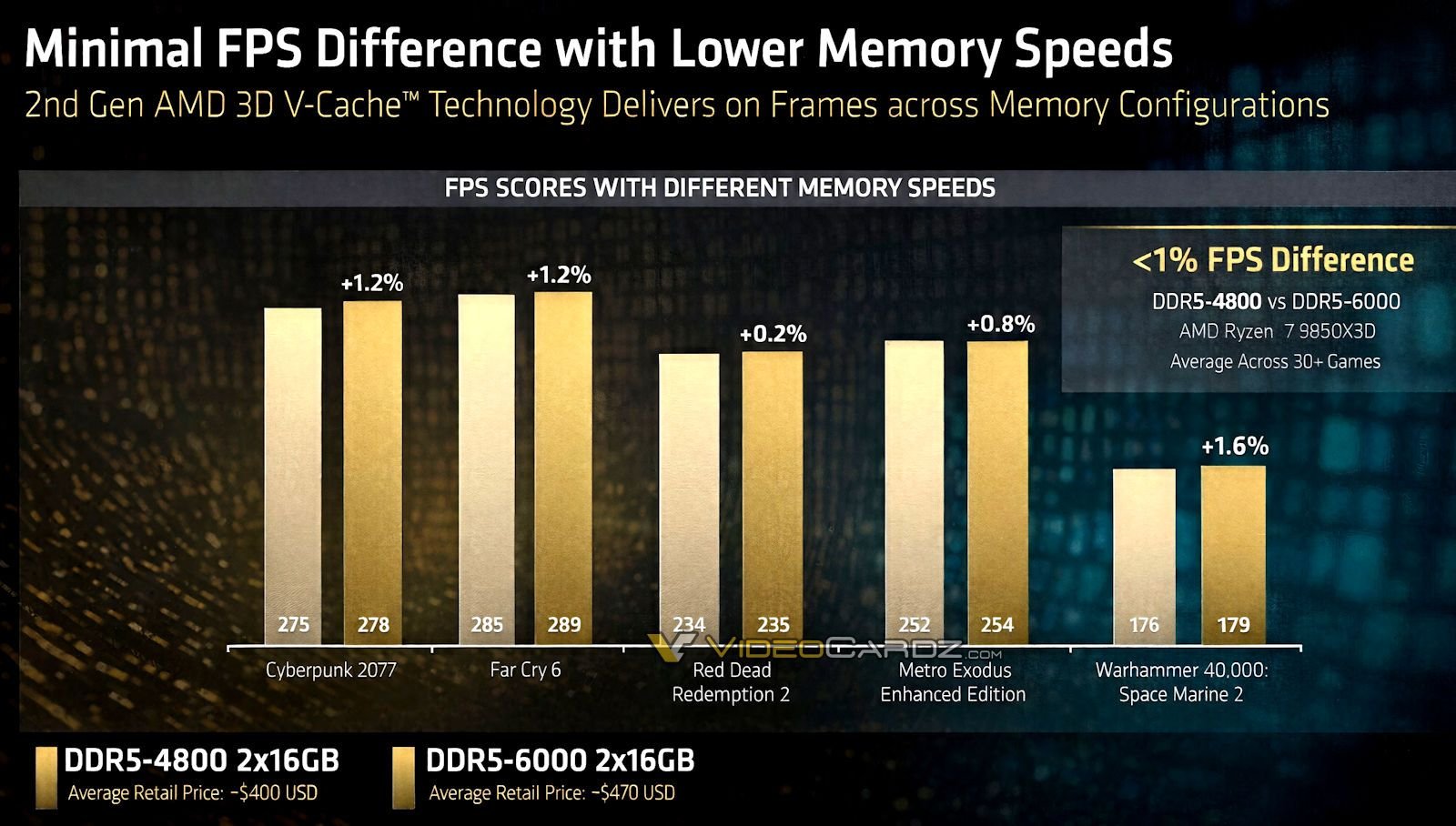
In a leaked AMD marketing slide obtained by Videocardz, the company demonstrates that the performance difference between DDR5-4800 and DDR5-5600 memory is just 1% across five gaming titles. The most significant gap appears in Warhammer 40,000: Space Marine 2 at 1.6%, while Red Dead Redemption 2 shows essentially no difference at 0.2%. On average, the delta falls below 1%.
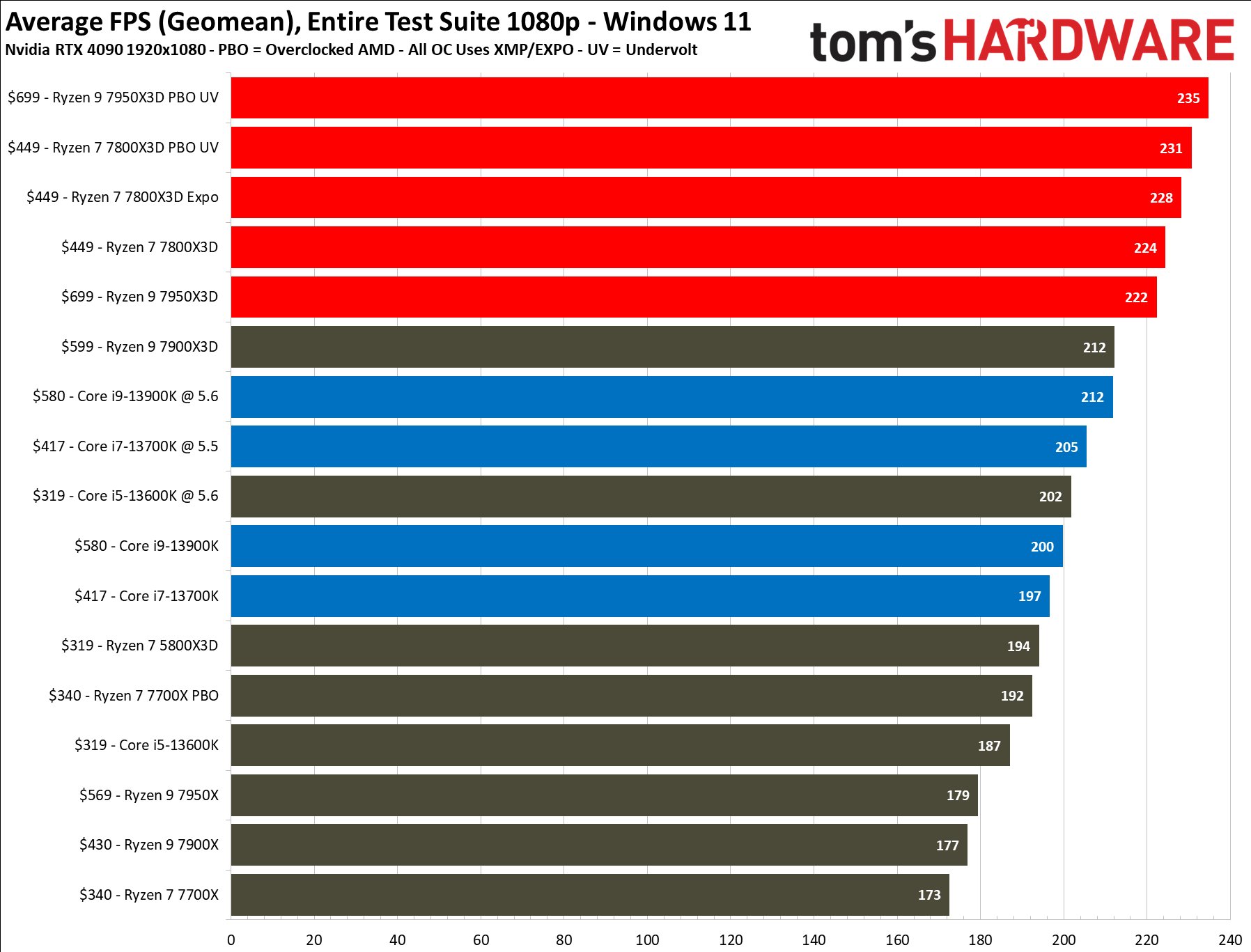
This isn't an isolated finding. The pattern has been consistent across AMD's entire X3D lineup:
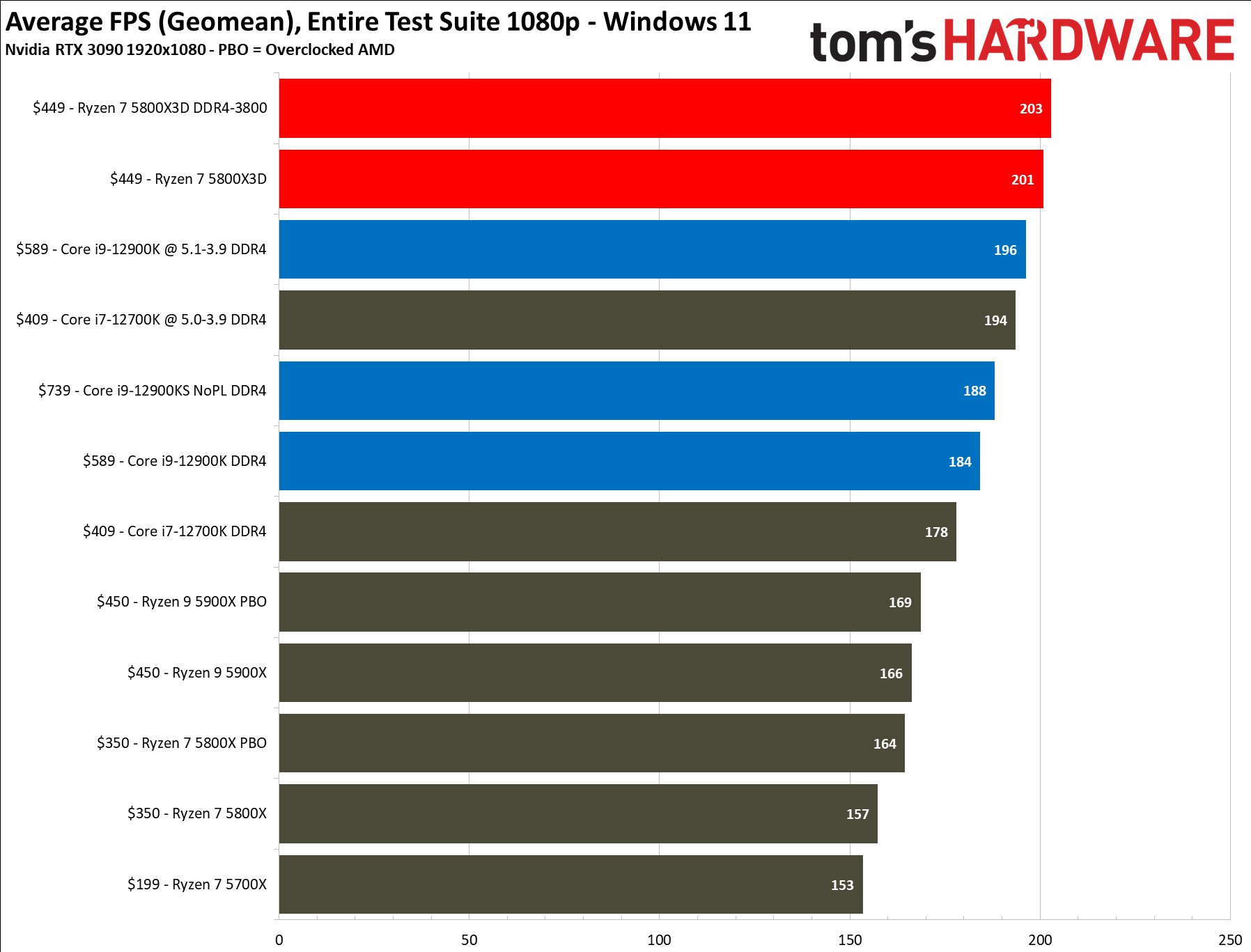
- Ryzen 7 5800X3D (Zen 3): DDR4-3200 vs DDR4-3800 showed a 1% difference
- Ryzen 7 7800X3D (Zen 4): DDR5-4800 vs DDR5-6000 demonstrated similar minimal gains
- Ryzen 7 9800X3D (Zen 5): Our review confirmed the same memory independence
- Ryzen 7 9850X3D (Zen 5): The trend continues with DDR5-4800 vs DDR5-5600
Why Cache Beats Memory Speed
The mechanism behind this phenomenon is straightforward but powerful. Modern gaming workloads are characterized by random memory access patterns with relatively small working sets. When a CPU needs to fetch data, it checks the L1 cache first (fastest, smallest), then L2, then L3, and finally system RAM (slowest, largest).
The Ryzen 7 9850X3D's 128MB of L3 cache can hold the entire working set of most games. When the CPU finds the needed data in the cache, it doesn't need to access system RAM at all. Since the cache is integrated directly on the die with ultra-low latency pathways, this is significantly faster than even the fastest DDR5 memory.
This architecture effectively decouples gaming performance from RAM speed. The bottleneck shifts from memory bandwidth to cache capacity and latency. As long as the game's working set fits within the 128MB cache, the system memory speed becomes largely irrelevant.
Market Implications and Cost Savings
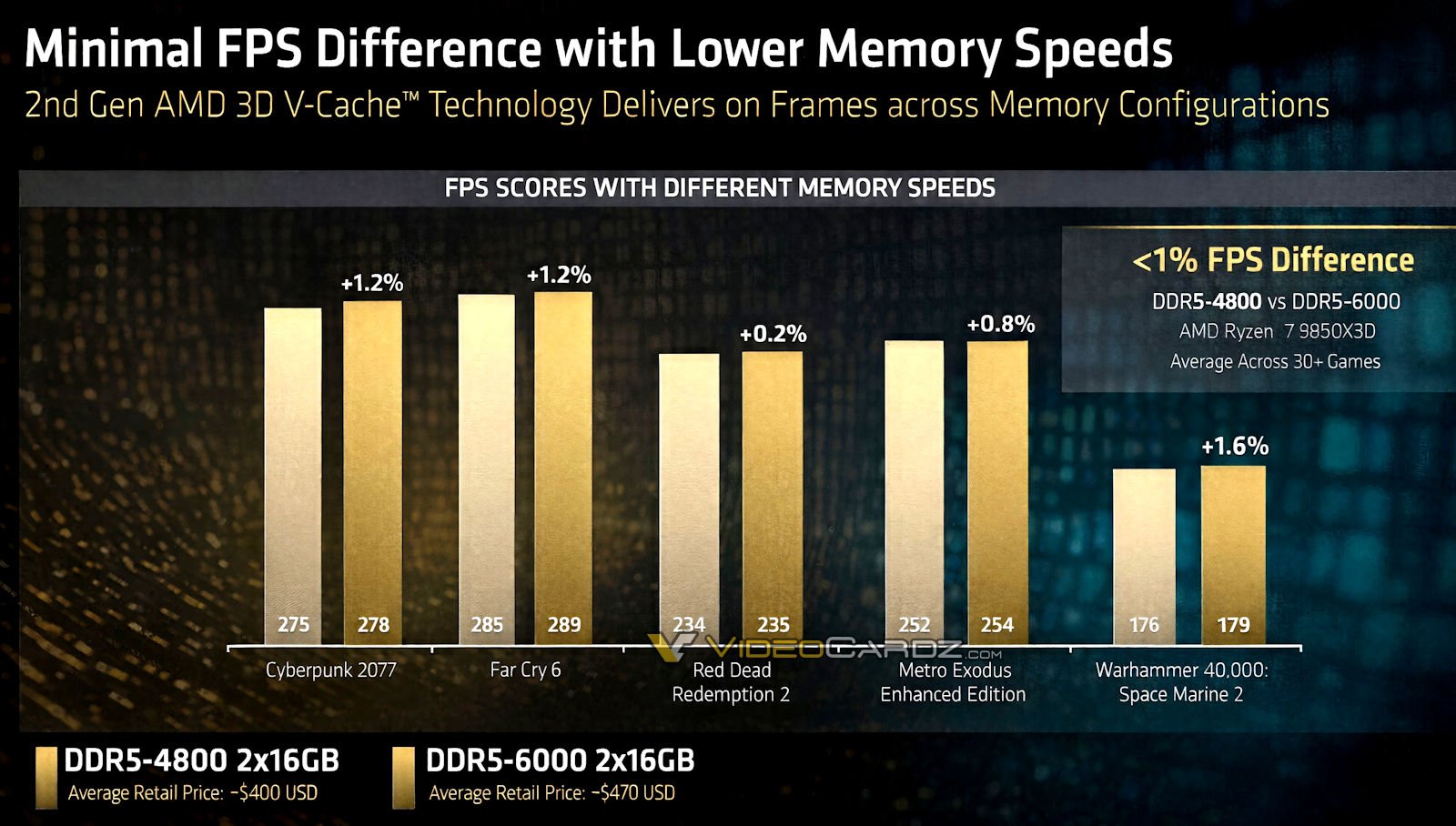
AMD's marketing slide includes current pricing estimates: a 32GB DDR5-4800 kit averages $400, while a DDR5-6000 kit can reach $470. These figures reflect the current RAM market conditions driven by the AI boom, which has consumed vast amounts of memory production capacity.
In reality, the price differential is even more pronounced. A 32GB DDR5-6000 CL36 kit is available for $325.99 on Amazon, while a CL30 variant costs $354 on Newegg. The key observation is that with the Ryzen 7 9850X3D, the performance difference between these kits is negligible for gaming.
This creates a compelling value proposition. A builder can save $70-100 on RAM without sacrificing gaming performance, redirecting those funds toward:
- A better GPU (the primary gaming performance driver)
- Higher-quality storage
- A more robust cooling solution
- A higher-wattage power supply for future upgrades
The Broader Industry Context
This memory independence represents a strategic advantage for AMD in the gaming CPU market. While Intel's competing processors benefit from higher memory bandwidth, AMD's X3D chips provide superior gaming performance through cache architecture rather than memory subsystem optimization.
The implications extend beyond individual builders. System integrators and OEMs can now specify more cost-effective memory configurations without compromising gaming performance. This could help stabilize gaming PC pricing during the current memory market volatility.
For enthusiasts who already own DDR5-4800 or DDR5-5200 memory, the Ryzen 7 9850X3D offers a clear upgrade path without requiring a complete platform overhaul. The processor effectively "future-proofs" existing memory investments.
Technical Trade-offs
It's important to note that this memory independence is primarily a gaming phenomenon. Workloads that require massive memory bandwidth—such as video encoding, scientific computing, or large dataset processing—will still benefit from faster RAM. The X3D architecture prioritizes gaming and latency-sensitive applications over bandwidth-intensive tasks.
Additionally, the 3D V-Cache implementation does introduce some thermal considerations. The stacked cache can create hotspots, requiring careful thermal management. AMD has addressed this in the 9850X3D with improved thermal interface materials and optimized heat spreader design.

The Bottom Line
The Ryzen 7 9850X3D continues AMD's successful strategy of leveraging 3D V-Cache to dominate gaming performance. By making high-speed RAM largely unnecessary for gaming, AMD not only provides better performance but also reduces the total cost of ownership for a gaming PC.
In an era where a 32GB DDR5-6000 kit can cost over $350, the ability to use slower, more affordable memory without performance penalty is a significant advantage. For builders navigating the current RAM market, the Ryzen 7 9850X3D offers a path to high-end gaming performance without the premium memory tax.
The processor is expected to launch in Q2 2026, with pricing likely to follow AMD's established X3D premium of $50-100 over the non-3D variant. When combined with the potential RAM savings, the total platform cost could be hundreds of dollars less than a comparable Intel-based system requiring high-speed memory for optimal gaming performance.
This architectural advantage may well be AMD's most compelling argument for gamers in 2026, particularly as memory prices remain elevated due to AI-driven demand. The Ryzen 7 9850X3D doesn't just offer better gaming performance—it offers better value by redefining what components actually matter for gaming.
Comments
Please log in or register to join the discussion