
Apple's 2026 Mac lineup is shaping up to be one of its most diverse in years, with a split release schedule spanning both halves of the year. The plan includes a first-half refresh of existing models with new M5 chips, followed by a second-half wave featuring a long-awaited Studio Display 2, a new low-cost MacBook, and the first major MacBook Pro redesign since 2019.
Apple's Mac roadmap for 2026 is unusually packed, according to the latest reporting from Bloomberg's Mark Gurman. The plan isn't a single event but a staggered release schedule across the year, targeting different user segments from budget-conscious students to professional creatives. This strategy reflects Apple's need to refresh its entire Mac lineup while also expanding into new price points and form factors.
First Half of 2026: Incremental Power
The year will begin with what could be described as a "spec bump" season. Rather than major design changes, Apple is expected to focus on silicon updates for its existing professional and consumer laptops.
MacBook Pro Refresh (M5 Pro/Max)
The first half of 2026 should see the debut of the M5 Pro and M5 Max chips in updated MacBook Pro models. These will likely follow the same 14-inch and 16-inch chassis designs introduced in 2021. While the external design remains unchanged, the internal upgrade is significant. The M5 series is expected to continue Apple's progression on the 3nm process node, potentially offering improved performance per watt over the M4 generation.
Alongside the new silicon, Apple is rumored to include its new N1 networking chip. This custom component is designed to handle Wi-Fi 7 and Bluetooth 5.4 connectivity more efficiently than the current discrete solutions. For professionals working with large files over wireless networks or requiring low-latency Bluetooth peripherals, this could mean more stable connections and potentially better battery life during network-intensive tasks.
MacBook Air Update
The MacBook Air will receive a similar treatment in the first half of 2026, jumping from the M3 to the M5 chip. This keeps the consumer-focused laptop in lockstep with the Pro line in terms of raw CPU and GPU performance, though it will lack the Pro's additional GPU cores and media engines. The inclusion of the N1 chip here is also likely, bringing the latest wireless standards to Apple's most popular laptop.
For MacBook Air fans hoping for a more substantial redesign, the wait continues. Current reports suggest a major overhaul, potentially including an OLED display, isn't coming until 2028. This extended timeline for the Air's design refresh aligns with Apple's typical cadence for its entry-level laptops, which tend to receive design updates less frequently than the Pro line.
Mac Studio Refresh
The Mac Studio, Apple's desktop powerhouse for creative professionals, is also due for an update in the first half of 2026. Last year's M4 Max and M3 Ultra combination was an unusual move, skipping the M4 Ultra entirely. This year, Apple is expected to correct course with an M5 Max chip, and likely an M5 Ultra chip as well.
The Mac Studio occupies a unique position in Apple's desktop lineup, sitting between the Mac mini and the Mac Pro. Its update schedule often dictates the release of Apple's highest-end silicon. If the M5 Ultra debuts in the Studio, it will set the performance ceiling for Apple's desktop chips until the Mac Pro receives its eventual update.
Second Half of 2026: New Products and Major Redesigns
The second half of the year is where Apple's roadmap gets more interesting, introducing entirely new products and the first major design change to the MacBook Pro in over five years.
Studio Display 2
Apple's display drought, which has lasted over four years since the original Studio Display launched in 2021, appears to be ending. The Studio Display 2 is expected to address many of the criticisms of its predecessor while introducing modern display technologies.

Previous reports indicate the new display will feature HDR support and a 120Hz ProMotion refresh rate. These are significant upgrades over the current Studio Display's standard dynamic range and 60Hz refresh rate. For creative professionals working with HDR video or high-frame-rate content, these features will be essential. The display is also rumored to include an A19 chip to power its integrated camera, speakers, and other smart features, potentially enabling more advanced Center Stage functionality and improved audio processing.
New Mac mini
Apple's compact desktop, the Mac mini, is also due for an update in the second half of 2026. While Gurman's report doesn't specify the chip, there's an intriguing possibility that it could feature the M6 chip. Apple's silicon typically debuts in October, and Gurman notes that the M6 might arrive "sooner than people anticipate." If the Mac mini update aligns with this earlier timeline, it could be the first product to feature Apple's next-generation chip.
This would be a strategic move for Apple. The Mac mini is often the first Mac to receive new silicon, serving as a testbed for new architectures before they roll out to laptops and higher-end desktops. An M6 Mac mini would give developers and power users an early look at Apple's next chip generation.
Low-Cost MacBook
Perhaps the most significant product in Apple's 2026 lineup is the rumored low-cost MacBook. This represents Apple's first attempt to compete directly in the sub-$1,000 laptop market since the discontinuation of the MacBook Air with Intel processors.
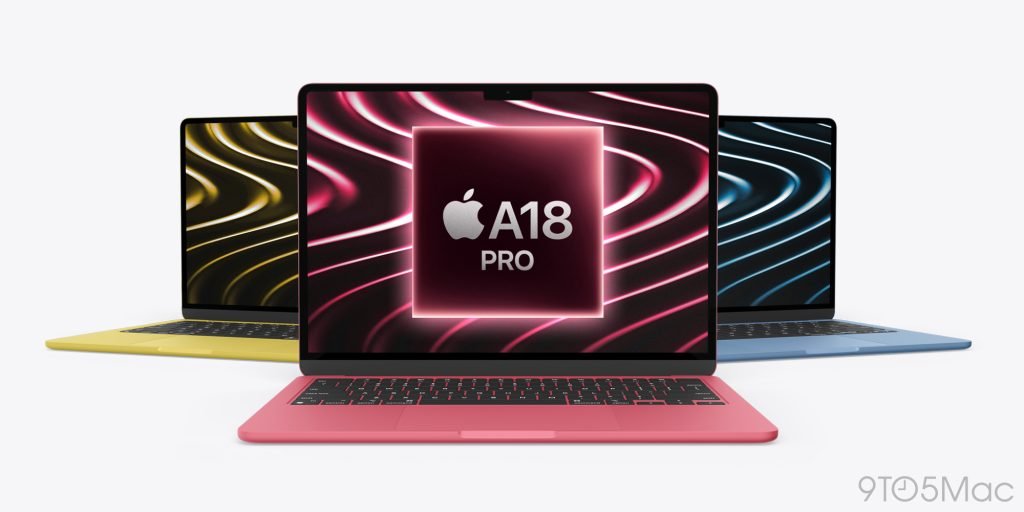
The device is expected to feature an A18 Pro chip—the same processor used in the iPhone 16 Pro. This is a strategic choice that allows Apple to leverage its existing mobile chip production while offering a compelling price point. The A18 Pro, while not as powerful as the M-series chips for sustained workloads, should provide excellent performance for everyday tasks, web browsing, and light creative work.
The display is rumored to be a 13-inch LCD panel, not OLED, which helps keep costs down. The device will also come in vibrant colors, including pink and yellow, targeting a younger demographic and students. With a potential starting price of $699, this MacBook would undercut the $999 MacBook Air by a significant margin, potentially bringing Mac ownership to entirely new markets.
MacBook Pro Overhaul
Saving the most anticipated update for last, Apple is planning a complete redesign of the MacBook Pro towards the end of 2026. This will mark the first major design change since the current chassis debuted in 2021, and the first redesign since the Touch Bar was removed in 2019.
The new MacBook Pro is expected to feature an OLED display, a thinner design, touch support, and potentially cellular connectivity. The move to OLED will provide deeper blacks, better contrast, and potentially improved battery life compared to the current mini-LED displays. The thinner design suggests Apple may be moving to a new manufacturing process or materials to reduce weight and thickness while maintaining structural integrity.
Touch support on a MacBook Pro would be a controversial but potentially powerful addition. While Apple has resisted touchscreens on laptops for years, citing ergonomics and the "clamshell" design, a touch-enabled MacBook Pro could bridge the gap between tablet and laptop workflows. This would be particularly valuable for creative professionals using apps like Procreate or Adobe Fresco.
Cellular support is another long-rumored feature that could finally arrive. Having built-in 5G would make the MacBook Pro a truly mobile workstation, eliminating the need for tethering or public Wi-Fi for professionals on the go.
Ecosystem Implications
Apple's 2026 Mac strategy reveals several key trends in the company's approach to its computer lineup:
Silicon Segmentation: The use of A-series chips in a low-cost MacBook shows Apple is willing to segment its chip architecture by price point, similar to how it uses A-series chips in the iPad line. This allows for better cost control while maintaining the Apple Silicon advantage.
Display Leadership: The Studio Display 2 represents Apple's continued commitment to the professional display market, even as competitors like Dell and LG offer compelling alternatives. The integration of an A19 chip for smart features differentiates Apple's displays from purely functional monitors.
Form Factor Innovation: The MacBook Pro redesign and potential touch support suggest Apple is willing to experiment with new interaction models, even if it contradicts previous design philosophies. This could signal a broader shift in how Apple views the laptop-tablet convergence.
Release Cadence: The split release schedule allows Apple to maintain news coverage throughout the year while ensuring each product category gets adequate attention. It also helps manage supply chain constraints by spreading component orders across different quarters.
For consumers, 2026 presents a rare opportunity to choose from a wide range of Mac products at various price points and performance levels. For professionals, the Studio Display 2 and MacBook Pro redesign address long-standing needs for better displays and more versatile laptops. For budget-conscious buyers, the low-cost MacBook could finally make the Mac ecosystem accessible without compromise.
The success of this strategy will depend on execution. Supply chain constraints, manufacturing challenges for new designs, and the performance of the A18 Pro chip in a laptop form factor will all be critical factors. But if Apple delivers on this roadmap, 2026 could be remembered as the year the Mac lineup became more diverse and accessible than ever before.
Comments
Please log in or register to join the discussion