Microsoft's ArchAngel points to the next phase of AI-assisted development, where the strategic question is not only who writes the code, but how teams preserve engineering judgment while agents accelerate delivery.
What changed
Microsoft Community Hub's ArchAngel article is less about another coding assistant and more about a structural shift in software delivery. AI tools such as GitHub Copilot, Amazon Q Developer, and Gemini Code Assist have already pushed code generation into the developer workflow. ArchAngel focuses on the next constraint: organizational learning. If junior engineers receive generated code faster than they develop judgment, senior engineers inherit a new review burden. They must validate not only syntax and tests, but architecture, team conventions, maintainability, and whether a developer understands the change.
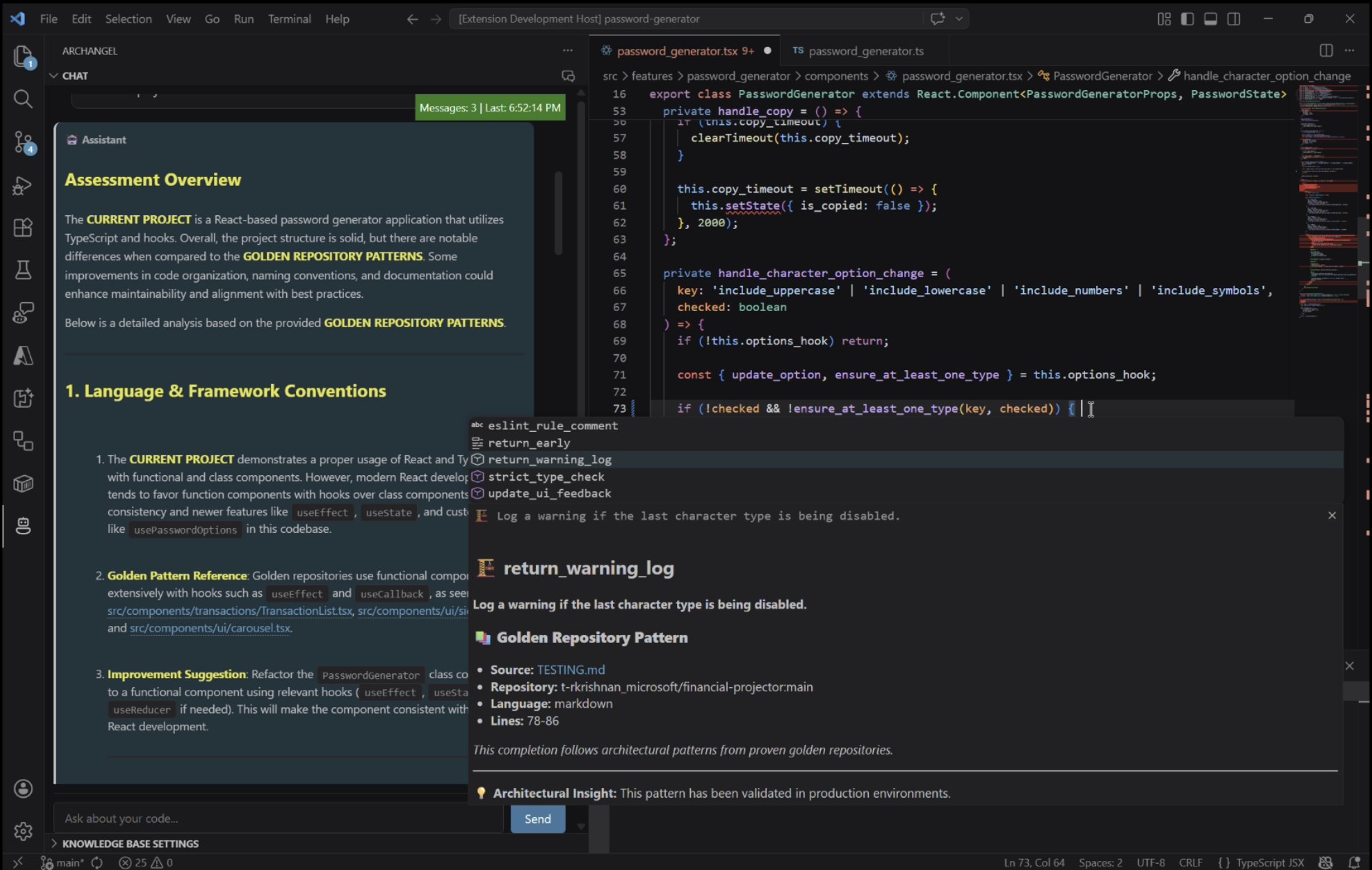
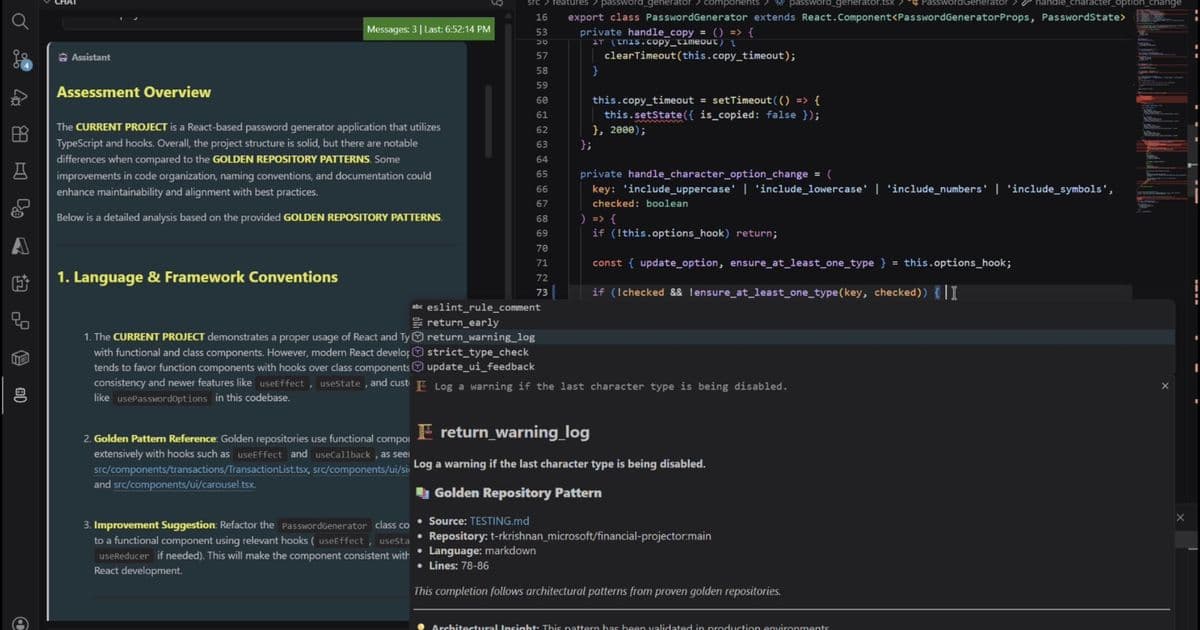
ArchAngel addresses that gap by moving standards guidance into the IDE. The project, available in the ArchAngel GitHub repository, connects to approved repositories, indexes them as a local knowledge base, and uses that context to provide educational feedback while developers code. The intent is not to replace a pull request review. It is to make the pull request arrive in better condition.
The architecture described in the Microsoft post combines Semantic Kernel, Microsoft Agent Framework, Microsoft Foundry, Language Server Protocol, SQLite, and repository configuration through files such as archangel.json. That stack matters. LSP gives ArchAngel a path across editors, Semantic Kernel and Agent Framework handle agent orchestration, Foundry supplies governed model access, and SQLite keeps local indexing practical for team-level adoption.
The strategic change is that coding assistants are moving from generic productivity tools to policy-aware development systems. Generic completion answers the question, 'what code might come next?' ArchAngel tries to answer a more operational question: 'does this code fit the way this organization builds software?'
Provider comparison
As of June 12, 2026, the provider market has split into three related categories: code assistants, agent platforms, and governance layers. ArchAngel sits mostly in the third category, although it depends on the first two.
| Provider path | Best fit | Pricing signal | Strategic consideration |
|---|---|---|---|
| Microsoft, GitHub Copilot plus Foundry plus ArchAngel | GitHub and Azure-centered engineering organizations that want agentic coding with policy, identity, and private knowledge grounding | GitHub Copilot plans list Pro at $10/user/month, Pro+ at $39/user/month, and Max at $100/user/month, while Microsoft Foundry is priced by the services consumed through Foundry pricing | Strongest when code, identity, governance, and cloud AI operations already sit inside Microsoft tooling |
| AWS, Amazon Q Developer | AWS-heavy teams that want coding help tied to AWS services, console workflows, IAM, Java upgrades, and transformation agents | Amazon Q Developer pricing includes a free tier and Pro at $19/user/month, with transformation overages at $0.003 per submitted line of code beyond included pooled allocations | Strong for AWS modernization, less focused on turning an organization's own golden repositories into live mentoring guidance |
| Google, Gemini Code Assist | Google Cloud, Firebase, Apigee, and BigQuery teams that want Gemini in IDEs and cloud development workflows | Gemini Code Assist pricing lists Standard at $22.80/user/month monthly or $19/user/month annual, and Enterprise at $54/user/month monthly or $45/user/month annual | Strong for Google Cloud development and large-context assistance, with enterprise customization and governance features tied to Google Cloud controls |
Microsoft's advantage with ArchAngel is not raw model access. All major providers can supply capable models and IDE assistance. The differentiator is the combination of GitHub-native development, Azure identity and networking, Foundry-hosted agents, API Management as an AI gateway, and the ability to ground guidance in curated repositories.
For a cloud consultant, that means ArchAngel should be evaluated as part of an engineering operating model, not as a seat-for-seat replacement for Copilot, Q Developer, or Gemini Code Assist. A team may still use Copilot for generation, Q Developer for AWS transformation work, or Gemini for Google Cloud workflows. ArchAngel's role is to capture local standards and push them earlier into the delivery cycle.
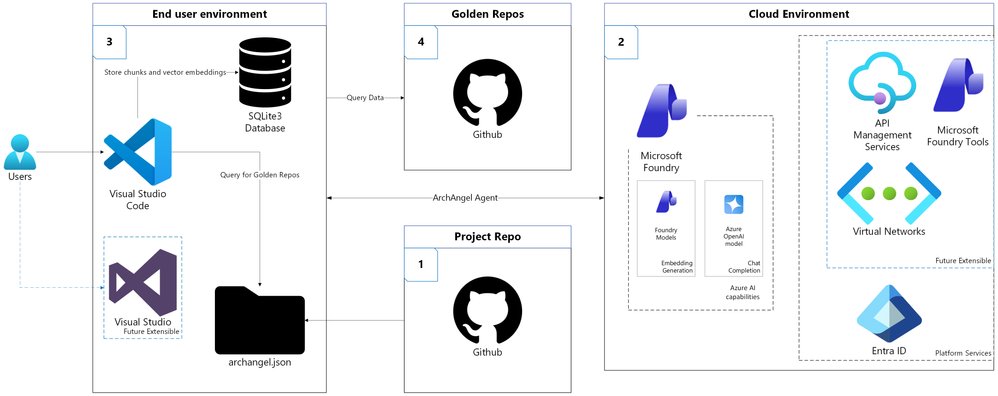
Pricing also needs to be modeled differently from standard developer tooling. A Copilot or Gemini seat is easy to count. ArchAngel-style adoption adds cloud inference, indexing, storage, API gateway, network design, observability, and administration. Microsoft Foundry is free to explore, but individual services carry their own billing models. A practical cost model should separate three buckets: developer seats, agent runtime consumption, and platform operations. Without that separation, finance teams will struggle to distinguish productivity software cost from cloud AI infrastructure cost.
Migration considerations
Teams adopting ArchAngel should start with knowledge quality, not model choice. The system can only teach from what it can see. If the golden repositories are inconsistent, outdated, or politically selected rather than technically representative, the assistant will scale confusion. The first migration task is curation: identify approved service templates, reference implementations, test patterns, deployment examples, API contracts, observability patterns, and security conventions.
The second task is boundary design. ArchAngel's article points to Azure Virtual Networks, Microsoft Foundry, API Management, and LSP extensibility. Those are not implementation details to leave until production hardening. They decide where source context moves, who can query it, which models are allowed, how prompts are logged, and whether developers can route sensitive code to third-party systems. For regulated teams, this is where architecture review belongs.
The third task is workflow placement. ArchAngel gives feedback before commit, but it should not become an invisible gate that frustrates developers. The best pattern is advisory feedback in the IDE, policy checks in CI, and human review for design intent. Junior developers should see why a pattern is preferred, senior engineers should see fewer repeated review comments, and platform teams should see standards adoption through metrics rather than anecdote.
Migration should also account for multi-cloud reality. Many organizations build on Azure, deploy some services on AWS, analyze data in Google Cloud, and run shared platform tooling across all three. In that environment, ArchAngel's value is not that it makes every workload Azure-native. Its value is that a team can document cloud-specific standards once and then surface them consistently. A repository can teach when to use Azure API Management, when an AWS service should use IAM Identity Center patterns, and when a Google Cloud service should follow Apigee or Firebase conventions.
A sensible rollout has four phases. First, index a small set of approved repositories and generate code style and wiki documents. Second, pilot IDE feedback with one product team and one senior engineer responsible for calibrating the advice. Third, add governance controls through Foundry, network isolation, and API gateway policies. Fourth, measure whether pull requests require fewer repeated comments, onboarding time drops, and junior engineers can explain the patterns they apply.
Business impact
ArchAngel is a signal that AI coding strategy is maturing. Early adoption was measured by speed: more completions, faster scaffolding, fewer repetitive tasks. The next phase is measured by retained understanding. If the team ships faster but senior engineers spend more time correcting architectural drift, the productivity gain is partly borrowed from future maintenance budgets.
For CIOs and engineering leaders, the business case should be framed around three outcomes. The first is onboarding compression. New hires often need months to learn service boundaries, naming rules, test conventions, deployment patterns, and unwritten review expectations. An IDE-resident mentor can shorten that path, especially when it cites the repositories that define team practice.
The second is review quality. Senior engineers should spend their review time on system design, reliability, failure modes, cost behavior, and customer impact. They should not repeatedly explain the same folder structure, dependency pattern, logging convention, or test fixture style. ArchAngel can move those comments earlier, where they are cheaper to fix and more useful as teaching.
The third is governance without slowing delivery. Policy documents are rarely read at the moment of implementation. CI checks catch some violations, but they arrive after the developer has already formed a solution. ArchAngel-style guidance changes the timing. It brings policy into the inner loop, while the developer still has context and before a weak pattern spreads across a branch.
There are risks. Overly rigid guidance can freeze old patterns. Poorly curated reference repositories can make the assistant authoritative for the wrong reasons. Excessive agent autonomy can increase cloud AI spend or create changes that developers cannot explain. Those risks are manageable, but only if ArchAngel is treated as a governed engineering platform. It needs ownership, evaluation, feedback loops, cost controls, and a clear path for updating standards.
For multi-cloud strategy, the practical recommendation is to avoid choosing a single coding assistant as if it settles the whole problem. Use provider-native tools where they are strongest: Copilot and GitHub for repository-centered development, Amazon Q Developer for AWS modernization and service-aware assistance, Gemini Code Assist for Google Cloud and Firebase-centric teams. Add ArchAngel where the missing capability is organizational memory inside the IDE.
That is the real update. AI coding is no longer only about producing code. It is becoming a channel for transmitting engineering culture, cloud architecture standards, and migration discipline at the point where software is actually written.
Comments
Please log in or register to join the discussion