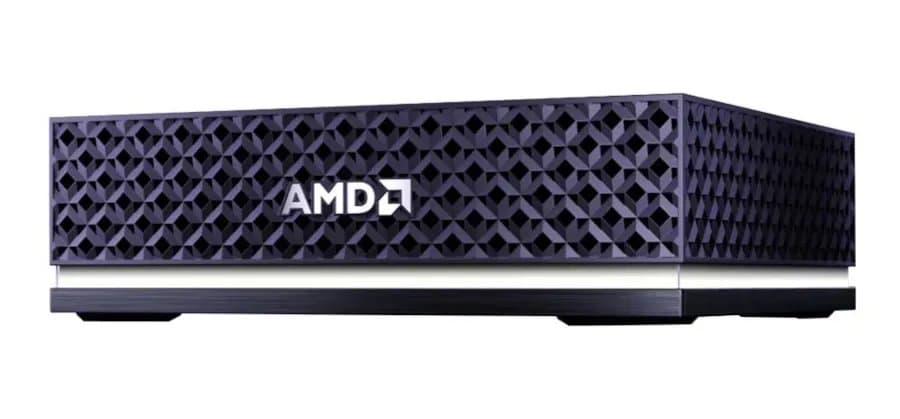
AMD is turning its 4nm Strix Halo silicon into a $3,999.99 desktop AI platform, betting that 128GB of unified memory, ROCm support, and Linux availability can win developers who want local inference without buying into a larger workstation stack.
Announcement
AMD has opened preorders for the Ryzen AI Halo Developer Platform, a compact desktop system built around the Ryzen AI Max+ 395 processor and aimed at local AI development, inference, and experimentation. The launch moves Strix Halo from high-end laptops and partner mini PCs into an AMD-branded developer box, with Micro Center listings showing both Linux OS and Windows 11 Pro configurations at $3,999.99. Both SKUs list the same core hardware: a Ryzen AI Max+ 395 running at a 3.0GHz base clock, 128GB of LPDDR5x-8000 memory, a 2TB SSD, Radeon 8060S graphics, 10GbE LAN, Wi-Fi 7, and Bluetooth 5.4.
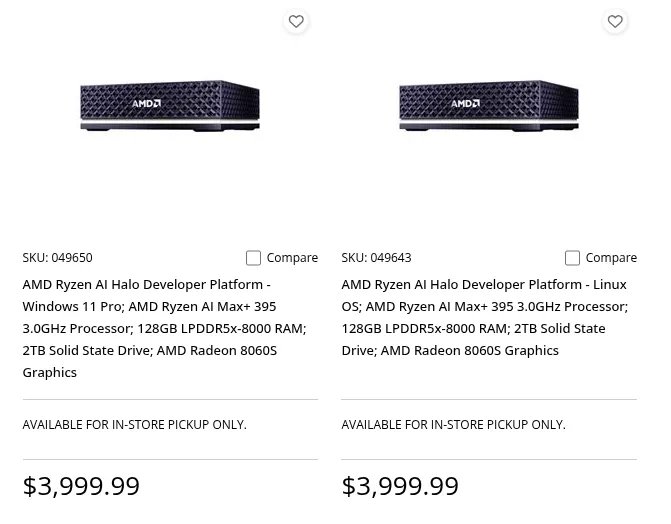
The Linux option is the more strategically interesting SKU. AMD has been positioning Ryzen AI Halo as a developer platform rather than a general-purpose small-form-factor desktop, and official Linux availability puts the box closer to the workflows used for PyTorch, vLLM, Ollama, QLoRA, ComfyUI, and local model serving. AMD also says the system ships with full ROCm software support, which matters because the hardware story only works if developers can run models without spending days on driver, kernel, framework, and library alignment.
Technical specs
At the center is the Ryzen AI Max+ 395, a Strix Halo part manufactured on TSMC 4nm FinFET process technology for both CPU cores and I/O die. AMD lists 16 Zen 5 CPU cores, 32 threads, a 3.0GHz base clock, boost clocks up to 5.1GHz, 16MB of L2 cache, 64MB of L3 cache, and a configurable TDP range from 45W to 120W. That 120W ceiling is a key distinction from thin notebooks: Halo is still an integrated SoC, but the desktop enclosure should let AMD run closer to the top of the power envelope for sustained inference and GPU-heavy creative workloads.
{{IMAGE:2}}
The graphics block is Radeon 8060S, with 40 RDNA 3.5 graphics cores and a listed graphics frequency of 2.9GHz. AMD quotes 60 FP16 TFLOPS of GPU performance for the Ryzen AI Halo platform, plus a 50 TOPS NPU. Those numbers split the machine into three compute domains: Zen 5 CPU cores for orchestration, preprocessing, code workloads, and general development; RDNA 3.5 graphics for parallel tensor and media workloads through ROCm; and the XDNA-class NPU for lower-power AI tasks where framework support and model fit are appropriate.
| Metric | Ryzen AI Halo configuration |
|---|---|
| Processor | Ryzen AI Max+ 395, Strix Halo |
| Process | TSMC 4nm FinFET |
| CPU | 16 Zen 5 cores, 32 threads |
| Clock | 3.0GHz base, up to 5.1GHz boost |
| Memory | 128GB LPDDR5x-8000 unified memory |
| GPU | Radeon 8060S, 40 graphics cores |
| GPU performance | 60 FP16 TFLOPS claimed by AMD |
| NPU | 50 TOPS |
| Storage | 2TB SSD in Micro Center listings |
| Networking | 10GbE, Wi-Fi 7, Bluetooth 5.4 |
| OS options | Linux OS or Windows 11 Pro |
| Price | $3,999.99 at Micro Center |
The memory system is the main reason this product exists. A conventional desktop CPU plus midrange GPU may offer more socketed flexibility, but GPU memory is usually the limiting factor for local large language models. Ryzen AI Halo uses 128GB of LPDDR5x unified memory on a 256-bit interface, giving the GPU access to a much larger memory pool than typical consumer graphics cards. That does not make it equivalent to 128GB of high-bandwidth HBM, but it changes which models can fit locally. AMD says the platform supports models up to 200B parameters, a claim that depends heavily on quantization, context length, batch size, and runtime.
AMD is also using performance comparisons to frame the box against two different competitors. Against Apple systems, AMD claims large gains in PyTorch-based ComfyUI workloads, including up to 3.3x faster Ace Step 1.5, up to 7.3x faster Ace Step 1.5 XL, up to 3.8x faster Flux Schnell, up to 4.5x faster Stable Diffusion XL, and up to 4.9x faster Hunyuan 3D 2.1 versus an M4 Pro Mac mini in AMD testing. Against NVIDIA DGX Spark, AMD claims higher Linux tokens per second in selected models: +14% on GLM 4.7 Flash-30B-A3B, +7% on GPT-OSS 120B, +12% on Qwen 3.5-122B-A10B, and +4% on Qwen 3.6-35B-A3B. Those are vendor benchmarks on preproduction hardware, but the model selection shows AMD is aiming at real local inference workloads rather than only synthetic TOPS figures.
The Linux support story is not only about the OS image. Strix Halo has already appeared in systems such as Framework Desktop-class designs and mobile workstations, and much of the enabling work has been flowing through standard Linux graphics, compute, and platform support paths. One remaining small but visible item is the RGB LED light bar driver, which has been under Linux development but was not described as mainline-ready in the source report. That kind of detail will not affect inference throughput, but it signals how close the platform is to acting like a first-class Linux machine instead of a Windows PC that happens to boot Linux.
Market implications
Ryzen AI Halo arrives into a market where the constraint is no longer only raw silicon. Memory supply is a pricing and availability variable across AI PCs, workstations, accelerators, and servers. A 128GB LPDDR5x configuration is attractive because it allows large local models in a compact thermal envelope, but it also ties AMD to the same premium memory supply chain pressure affecting Apple, NVIDIA, and notebook OEMs. The $3,999.99 price is not low for a mini PC, yet it is targeted below the current $4,699 class of DGX Spark systems while offering the same 128GB memory headline and a Windows option that NVIDIA does not emphasize on DGX Spark.
The comparison with DGX Spark is more nuanced than price and memory capacity. NVIDIA has the stronger AI software ecosystem, CUDA lock-in across many research and enterprise workflows, and ConnectX networking that can matter when two boxes are linked for larger local models. AMD counters with x86 compatibility, ROCm, Windows and Linux SKUs, 10GbE, and a CPU-GPU-NPU design that fits the AI PC narrative more cleanly than a small server appliance. For developers already committed to CUDA, Halo will need more than comparable token-per-second numbers. For teams building open-source local AI workflows on Linux, AMD is offering a simpler procurement path than assembling a Strix Halo system from smaller vendors.
The channel strategy also says something about supply. Micro Center preorders are in-store pickup only, and the listings show two SKUs rather than a broad stack of memory and storage options. That points to a controlled launch, likely sized around developer demand and constrained component allocation rather than mass-market desktop volume. AMD can use Halo as a reference design, a software validation target, and a demand signal for OEM partners without flooding the channel. If the platform proves stable under Linux, it becomes a template for future Strix Halo and Gorgon Halo systems.
The next supply-chain marker is the planned Ryzen AI Max+ PRO 495 variant with 192GB memory support. AMD already says that version is coming, and the jump from 128GB to 192GB would be more meaningful than a small CPU clock bump because model size and context windows are memory-bound first. In practical terms, 192GB gives developers more room for larger quantized models, multi-model agent workflows, retrieval pipelines, and local fine-tuning experiments. It also increases exposure to premium LPDDR supply, so pricing and availability will be the real test.
For AMD, the larger goal is to make ROCm feel normal on desktop-class AI hardware. The company has strong silicon, but developers judge platforms by friction: whether PyTorch installs cleanly, whether vLLM works, whether kernels are tuned, whether updates break workloads, and whether support channels produce fixes. Ryzen AI Halo packages the hardware, OS choice, Developer Center app, playbooks, and ROCm stack into one reference target. That is a more disciplined approach than asking developers to infer support from a chip spec sheet.
The market impact will depend on execution after preorders. If AMD ships Linux systems that run common LLM and image-generation stacks reliably, Halo gives the company a credible local AI workstation foothold at 128GB unified memory and under $4,000. If software gaps remain, the box becomes another capable Strix Halo mini PC in a market already populated by Framework, HP, Minisforum, and other vendors. The hardware is strong enough to matter. The supply chain is tight enough to keep volumes selective. The software experience will decide whether Ryzen AI Halo becomes a serious developer platform or a well-specified niche machine.
Comments
Please log in or register to join the discussion