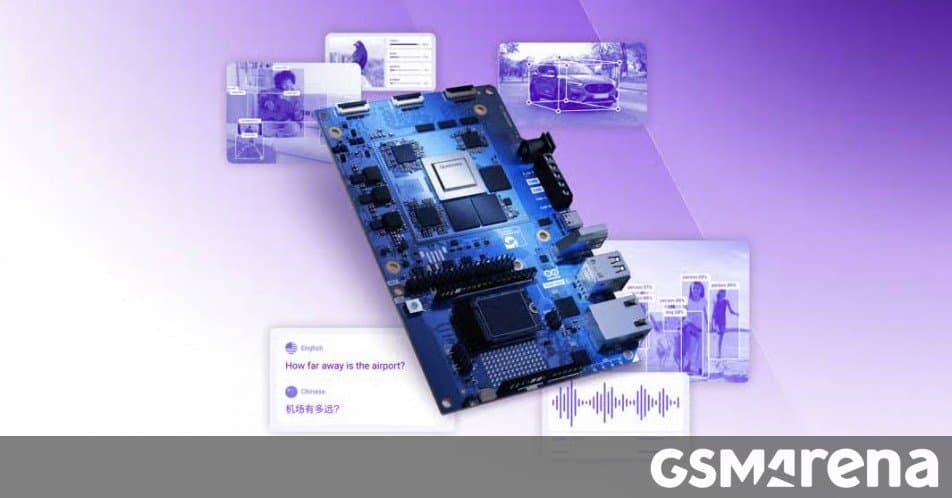
Qualcomm's Arduino division unveils the Ventuno Q, a powerful SBC with a Snapdragon-class chipset that delivers 40 TOPS of AI performance, dual-brain architecture, and extensive connectivity for robotics and edge AI applications.
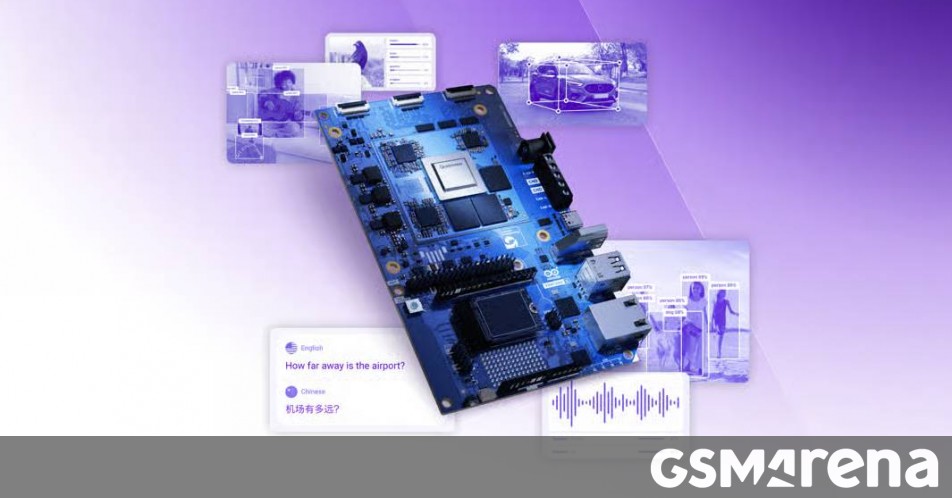
Arduino, now operating under Qualcomm's umbrella following last year's acquisition, has announced the Ventuno Q, a single board computer that represents a significant leap in capability for the maker-friendly platform. While the previous Uno Q could run Linux with modest specs, the Ventuno Q is built for serious AI workloads, robotics, and industrial applications.
The Dragonwing Chipset: Snapdragon Power in an SBC
The Ventuno Q is powered by Qualcomm's Dragonwing IQ-8275, a chipset that brings smartphone-tier performance to the single board computer form factor. The CPU features an 8-core Kryo configuration with two Gold Prime cores clocked at 2.35GHz, two additional Gold cores at 2.1GHz, and four efficiency-focused Silver cores at 1.95GHz. This heterogeneous architecture allows the board to balance performance and power consumption based on workload demands.
The Adreno 623 GPU handles graphics workloads, placing the overall performance somewhere in the Snapdragon 765G territory. That means this little board has more processing power than many smartphones from just a few years ago.
Memory and storage options are generous for the SBC market. The Ventuno Q supports up to 16GB of RAM, which is substantial for edge computing tasks, and up to 64GB of eMMC storage for the operating system and applications. For users who need more storage or faster read/write speeds, there is an M.2 NVMe Gen 4 connector that supports external SSDs.
40 TOPS of AI Performance
The standout feature is the Neural Processing Unit (NPU) delivering 40 TOPS (trillions of operations per second) of AI performance. To put this in context, that is comparable to Intel's Panther Lake processors with their 50 TOPS NPU, and represents half the AI capability of premium Snapdragon X2 Elite chips that power high-end Windows on ARM laptops.
This level of performance enables the Ventuno Q to run sophisticated AI models locally without cloud connectivity. Arduino lists several practical applications: YOLO-X models for real-time object tracking, PoseNet for pose detection, MediaPipe for gesture recognition, and local large language models like Qwen. Text-to-speech capabilities through Melo TTS and speech-to-text via Whisper are also supported.
For robotics applications, this local AI processing is valuable. A robot can process visual data, understand voice commands, and make decisions without the latency and reliability concerns of cloud-dependent systems. The 40 TOPS figure means multiple AI models can run simultaneously, enabling complex behaviors that combine computer vision with natural language processing.
Dual-Brain Architecture
One of the most interesting design decisions is the "dual-brain" approach. The Dragonwing chipset runs Linux, specifically Ubuntu or Debian, for high-level tasks and AI workloads. However, real-time interactions with hardware peripherals are handled by a separate STM32H5 microcontroller.
This separation makes practical sense. Linux is not a real-time operating system, meaning it cannot guarantee that a task will complete within a specific timeframe. For robotics and industrial applications, this matters. Motor control, sensor polling, and safety-critical operations need deterministic timing. The STM32H5 handles these time-sensitive tasks while the Dragonwing focuses on the computationally intensive work.
Robot Operating System 2 (ROS 2) is supported on the Linux side, making the Ventuno Q immediately useful for robotics development. ROS 2 has become the standard middleware for robotics research and commercial applications, so this compatibility lowers the barrier to entry for developers already familiar with the ecosystem.
Connectivity and Expansion
The Ventuno Q offers extensive connectivity options that should satisfy most project requirements. A Raspberry Pi-style 40-pin GPIO header provides access to general purpose inputs and outputs, while compatibility with Arduino Uno shields allows users to connect motor controllers, sensors, and other expansion boards from the vast Arduino ecosystem.
Solderless Qwiic connectors are included for quick prototyping without the need for soldering. This is a welcome feature for educational environments and rapid prototyping scenarios.
Vision capabilities are particularly impressive. The board supports three MIPI CSI cameras simultaneously, enabling 360-degree vision systems. This is useful for robotics navigation, security applications, and any project that needs situational awareness from multiple angles.
Display options include HDMI, a MIPI DSI port, and DisplayPort Alt Mode over USB-C. The 2.5Gb Ethernet port provides fast wired networking for data-intensive applications, while Wi-Fi 6 (802.11ax) and Bluetooth 5.3 handle wireless connections. For industrial and automotive applications, CAN-FD support is included.
Ecosystem Context and Competition
The Ventuno Q enters a competitive market dominated by the Raspberry Pi, but it takes a different approach. While the Raspberry Pi 5 offers excellent value for basic computing tasks, the Ventuno Q targets users who need serious AI performance and are willing to pay for it.
The 40 TOPS NPU is the key differentiator. The Raspberry Pi 5 relies on its CPU and GPU for AI tasks, which limits both performance and efficiency. Dedicated NPUs are significantly more power-efficient for neural network operations, and 40 TOPS is well beyond what any current Raspberry Pi can achieve.
The Arduino shield compatibility is also strategically important. By maintaining compatibility with existing Arduino hardware, Qualcomm and Arduino are leveraging an enormous ecosystem of sensors, actuators, and expansion boards. Users who have invested in Arduino shields can use them with the Ventuno Q without modification.
Availability
The Arduino Ventuno Q will be available in Q2 2026 through the Arduino Store, DigiKey, Farnell, Macfos, Mouser, and RS. Pricing has not been announced, but given the specifications, expect it to command a premium over consumer-focused SBCs. The target market appears to be professional developers, researchers, and industrial users rather than casual hobbyists.
For those who need AI performance at the edge without the size, power consumption, and cost of a full desktop system, the Ventuno Q looks like a compelling option. The combination of Snapdragon-class processing, substantial AI capabilities, and Arduino ecosystem compatibility creates a unique position in the single board computer market.
Comments
Please log in or register to join the discussion