Arm's new AGI CPU marks its transformation from IP licensor to direct CPU competitor, with surprising availability in China despite export restrictions on its core technology.
Arm's introduction of its AGI CPU last week marked a pivotal transformation for the company, shifting from its traditional role as a technology IP licensor to becoming a direct competitor in the standard CPU market. The new processor positions Arm to challenge established players like AMD, Ampere, and Intel in the high-performance computing space. However, the most intriguing aspect of this launch is Arm's announcement that it will sell these processors to customers in China, despite existing export restrictions on its Neoverse V3 core technology.
The AGI CPU: Arm's Most Ambitious Silicon Yet
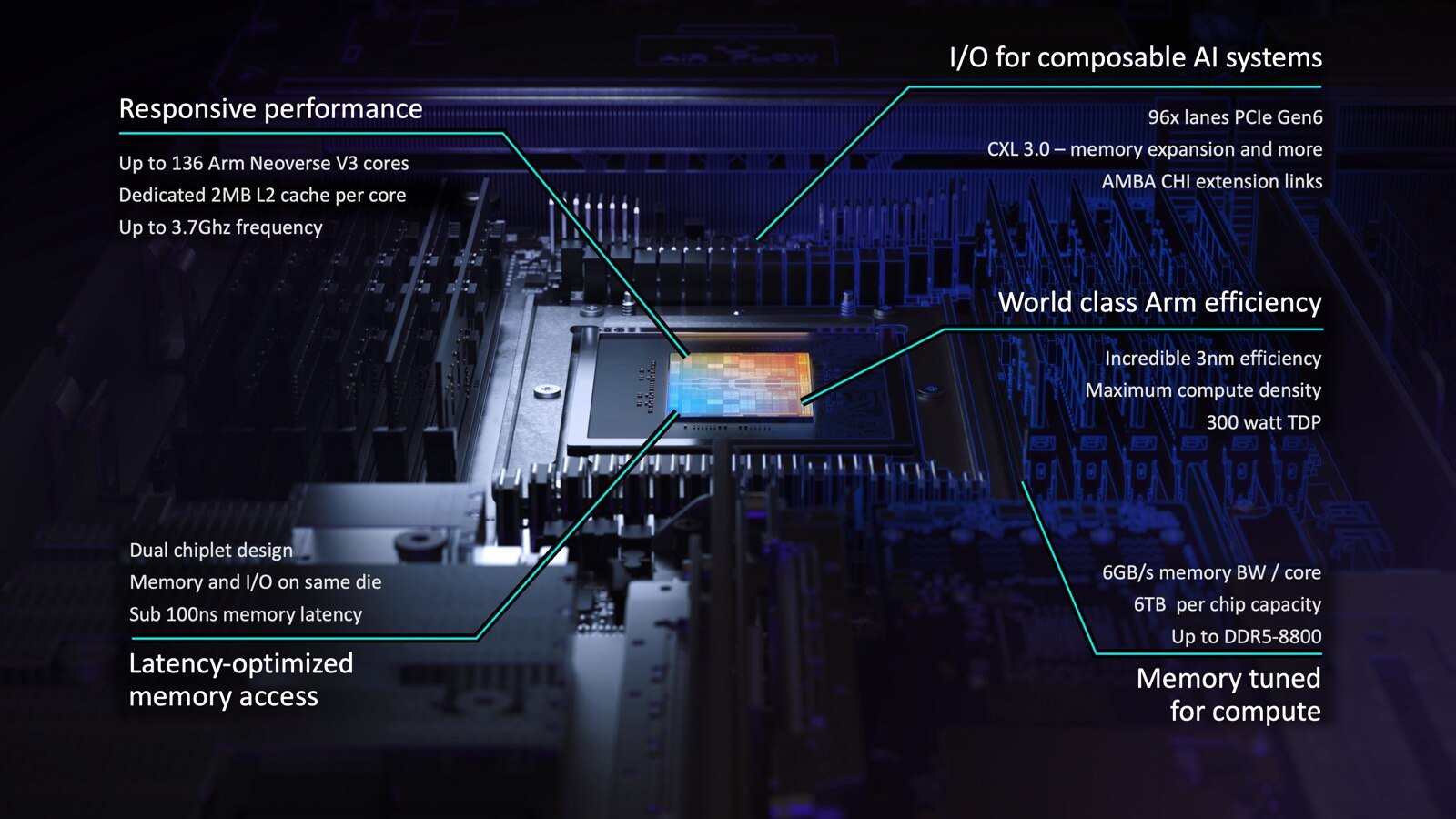
The Arm General Intelligence (AGI) processor represents the company's most ambitious silicon project to date. This dual-chiplet design packs an impressive 136 Neoverse V3 cores, each featuring 2 MB of L2 cache and running at 3.70 GHz. The processor is built on a 3nm-class process technology and has a thermal design power of approximately 300W, positioning it squarely in the high-performance computing segment.
The memory subsystem is equally impressive, featuring a 12-channel DDR5 configuration supporting memory speeds up to 8800 MT/s. On the I/O front, the AGI CPU offers 96 PCIe Gen6 lanes with CXL 3.0 support for caching and memory expansion, providing the bandwidth necessary for demanding data center workloads.
China Market Access: A Strategic Surprise
What makes this announcement particularly noteworthy is Arm's explicit statement about selling the AGI CPU in China. Rene Haas, CEO of Arm, told ChinaDaily that while the company cannot publicly discuss specific customers yet, "we would expect the demand for this product to be just as strong in China as it is in the rest of the world."
This is remarkable given that Arm cannot license its HPC-oriented Neoverse V cores to Chinese entities due to export restrictions. The U.S. and U.K. have implemented controls that prevent the transfer of advanced semiconductor design technology to the People's Republic of China, viewing such transfers as potentially providing strategic advantages to a geopolitical competitor.
Navigating Export Control Complexities
The key to understanding this apparent contradiction lies in the distinction between IP licensing and finished product sales. While Arm cannot license the Neoverse V3 core design to Chinese companies, the AGI CPU is a commercial semiconductor device—a finished product rather than intellectual property.
Export controls for finished products operate under different rules than those governing technology transfers. These regulations typically focus on performance thresholds including absolute performance metrics, compute density, and interconnect bandwidth rather than the underlying design technology. Since the AGI processor's specifications fall within current compliance thresholds, Arm can legally sell it to Chinese customers without violating export controls.
Performance Implications and Supercomputing Potential
Arm has positioned the Neoverse V3 as its fastest infrastructure and supercomputer core to date. However, unlike previous generations, the company has not disclosed specific FP32/FP64 throughput figures, leaving performance estimates to be inferred from SIMD width and pipeline count. This lack of transparency makes it difficult to definitively assess whether Chinese entities can now access high-performance HPC processors without restrictions.
What is clear is the scalability potential. Arm has developed a reference-design 2-node blade that can fully populate a standard air-cooled 36kW rack, delivering 8,160 cores. More impressively, the company has partnered with Supermicro to create a 200kW liquid-cooled system capable of accommodating 336 Arm AGI processors, providing over 45,000 CPU cores in a single deployment.
These building blocks could enable Chinese entities to construct modern supercomputers with substantial FP32 and FP64 throughput capabilities. This development is particularly significant given the challenges Chinese organizations have faced in accessing Western HPC technologies due to ongoing trade restrictions and technology export controls.
Market Implications and Industry Impact
The AGI CPU's availability in China represents a nuanced approach to navigating complex geopolitical and regulatory landscapes. By offering a finished product rather than licensing technology, Arm can maintain its presence in one of the world's largest semiconductor markets while complying with export control regulations.
This strategy could have broader implications for the semiconductor industry, potentially establishing a precedent for how companies can continue serving Chinese customers while respecting international trade restrictions. It also underscores the growing importance of China as a market for high-performance computing solutions, even amid ongoing tensions and restrictions.
For the competitive landscape, Arm's entry as a direct CPU supplier challenges the established dynamics among x86 and other architecture providers. The company's deep ecosystem, combined with its new silicon offerings, could accelerate the adoption of Arm-based solutions in data centers and high-performance computing applications globally.
As the semiconductor industry continues to evolve amid technological advancements and geopolitical complexities, Arm's AGI CPU and its China strategy exemplify the delicate balance companies must strike between innovation, market access, and regulatory compliance. The coming months will reveal how this approach shapes the competitive dynamics in both the global and Chinese markets for high-performance computing solutions.

Comments
Please log in or register to join the discussion