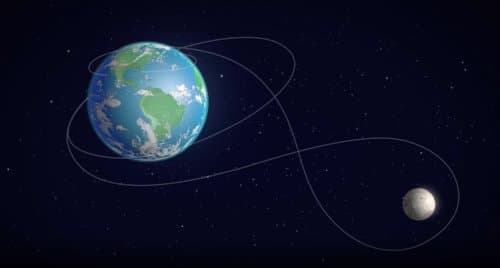
NASA's Artemis II mission draws inspiration from Apollo 8 and Apollo 13, following a free-return trajectory that will take astronauts farther from Earth than ever before.
The recent launch of Artemis II marks a significant milestone in humanity's return to lunar exploration, drawing fascinating parallels to two pivotal Apollo missions from the late 1960s and early 1970s. Much like Apollo 8's historic 1968 mission, Artemis II's primary objective is to circumnavigate the moon, serving as a crucial precursor to future lunar landing missions. However, the mission's trajectory bears an even closer resemblance to the dramatic journey of Apollo 13 in 1970.
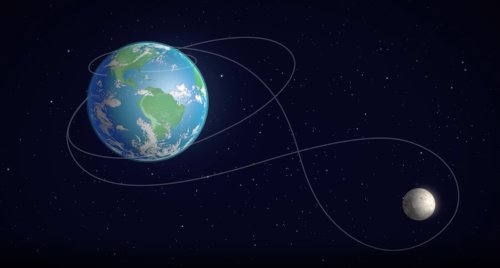
Apollo 13's mission, originally intended for lunar landing, became a story of survival when an oxygen tank explosion forced NASA to abort the landing and instead use the moon's gravity to slingshot the spacecraft back to Earth. This "free-return trajectory" has now been deliberately chosen for Artemis II, representing both a tribute to that mission's ingenuity and a practical approach to ensuring crew safety during this test flight.
The orbital mechanics of Artemis II reveal careful planning and incremental advancement over its Apollo predecessors. Where Apollo 8 spent a mere 2 hours and 44 minutes in low Earth orbit before performing trans-lunar injection (TLI), Artemis II took a more measured approach. After completing one low Earth orbit, the spacecraft ascended to high Earth orbit (HEO), where it will remain for approximately 24 hours before initiating its journey to the moon. This extended period in HEO allows for comprehensive systems checks and provides additional safety margins.
The orbital characteristics themselves demonstrate significant evolution in mission planning. Apollo 8 maintained a relatively circular low Earth orbit at approximately 100 nautical miles altitude. In contrast, Artemis II's HEO is highly eccentric, with an apogee reaching approximately 40,000 nautical miles. This dramatic difference in orbital parameters reflects both advances in spacecraft capabilities and a more cautious approach to deep space operations.
The journey to the moon also reveals interesting temporal comparisons. Apollo 8 required roughly three days to travel from TLI to lunar insertion orbit. Artemis II, while not entering lunar orbit, will spend approximately four days traveling to its closest approach to the moon (perilune). This slightly longer transit time may reflect differences in trajectory design or the spacecraft's operational parameters.
Perhaps the most striking aspect of Artemis II is its potential to break a record that has stood for over five decades. The furthest any human has ever been from Earth occurred during Apollo 13's perilune, when the spacecraft reached approximately 60 nautical miles above the far side of the moon. Artemis II is expected to surpass this milestone significantly, with perilune planned between 3,500 and 5,200 nautical miles above the lunar surface. This achievement represents not just a technical accomplishment but a symbolic passing of the torch from one generation of space exploration to the next.
The decision to follow Apollo 13's free-return trajectory is particularly noteworthy. This path ensures that in the event of a major systems failure, the spacecraft can return to Earth without requiring additional propulsion maneuvers. It's a testament to the enduring value of lessons learned from past missions and the importance of incorporating proven safety measures into new exploration initiatives.
This mission also highlights the mathematical and orbital mechanics principles that have been refined over decades of space exploration. The careful calculation of trajectories, the understanding of gravitational influences, and the precise timing of orbital insertions all demonstrate the sophisticated mathematical framework that underpins modern space travel. These principles, developed and refined through missions like Apollo, continue to guide contemporary exploration efforts.
The Artemis program represents more than just a return to the moon; it embodies the cumulative knowledge and experience gained from over half a century of human spaceflight. By deliberately following in the footsteps of both successful missions like Apollo 8 and challenging ones like Apollo 13, Artemis II bridges the past and future of lunar exploration. It honors the achievements of previous generations while pushing the boundaries of human presence in space.
As Artemis II prepares to venture farther from Earth than any humans have gone before, it carries with it the hopes and aspirations of a new era in space exploration. The mission serves as both a technical demonstration and a powerful symbol of humanity's enduring drive to explore, learn, and push beyond the boundaries of our current capabilities. In doing so, it sets the stage for the next giant leap in our journey to the stars.
{{IMAGE:1}}
Comments
Please log in or register to join the discussion