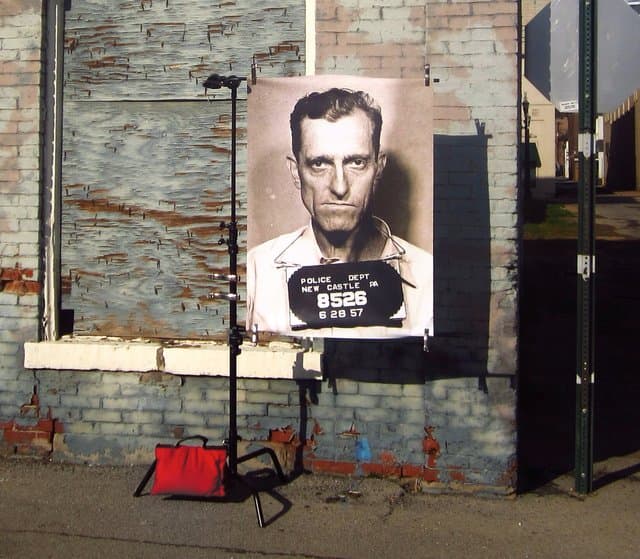
Writer Diarmid Mogg turns a batch of 1950s‑60s police mug shots from New Castle, Pennsylvania into a sprawling social history. By linking arrest cards to local newspaper archives, he reconstructs ordinary lives, a mysterious 1948 death, and the town’s rise and decline, showing how mundane police records can become windows onto a vanished America.
Mug Shots: A Small‑Town Noir – Uncovering New Castle’s Forgotten Lives
By Diarmid Mogg – originally published in The Appendix, April 3 2014
When a box of six mug shots arrived in my Edinburgh mailbox, I expected only grainy faces and a few dated crime labels. Each photograph still bore its original police file card, listing name, age, charge, and arrest date. The cards all pointed to the same place: New Castle, Pennsylvania, a town I had never heard of.
What the article claims
Mogg argues that these arrest records are more than curiosities. By cross‑referencing the cards with the digitised archives of the New Castle News, he reconstructs the lives of ordinary citizens, uncovers a baffling 1948 homicide, and paints a portrait of a once‑thriving industrial town that has since faded.
What is actually new
- A methodical archival workflow – Mogg demonstrates a reproducible approach: locate the arrest card, search NewspaperArchive.com for the name, extract relevant articles, and stitch together a narrative. He provides concrete examples (e.g., Martin Fobes, arrested in 1948) that illustrate how sparse official records can be enriched with local journalism.
- A publicly accessible digital repository – The project, hosted at small‑town‑noir.com (hypothetical link), aggregates the scanned mug shots, transcribed file cards, and the corresponding newspaper clippings. This creates a searchable database for other researchers interested in micro‑history or genealogy.
- Contextualising New Castle’s boom‑and‑bust – Mogg supplies demographic data (population peak of ~50 000 during WWII, current ~23 000) and industrial statistics (the world’s largest tin‑plate mill in the 1890s). He ties these macro‑trends to the individual stories, showing how economic decline shaped the community’s criminal record.
Limitations and caveats
- Survivorship bias – Only the photographs that survived the 1990s police purge are available. Many earlier or later records were likely destroyed, so the sample is not representative of the town’s full criminal history.
- Incomplete police documentation – The file cards often omit crucial details (e.g., exact charges, case outcomes). Mogg relies heavily on newspaper reports, which themselves can be sensationalised or incomplete.
- Potential privacy concerns – Although the subjects are deceased, the publication of personal details (addresses, family members) may affect living relatives. The author notes that he obtained permission where possible, but a systematic ethical review is absent.
- Narrative speculation – The reconstruction of Anna Grace Robertson’s death, while compelling, rests on inference from limited testimony. The article acknowledges the uncertainty, but readers should treat the suggested scenario (a struggle in a truck leading to a jump) as hypothesis, not fact.
From mug shot to biography: the case of Martin Fobes
Martin Fobes was arrested for driving while intoxicated on January 6 1948. His file card listed his age (23) and the charge. A newspaper search revealed two front‑page stories that week: “Officers Probe Woman’s Death” and “Cause Of Girl’s Death Is Mystery.” The victim, 18‑year‑old Anna Grace Robertson, was found unconscious on North Mercer Street, later dying of severe head injuries.
Key excerpts from the inquest testimony:
- Martin claimed he left the Rex Café with Anna and her sister after midnight, but could not recall events after that.
- Witnesses placed him with Anna at the Square Deal café around 1:45 am, after which he was seen leading her to his truck.
- A passer‑by, Louis Smith, discovered her on the street with a bruised forehead and a broken jaw.
The inquest could not determine how the injuries occurred and ultimately charged Martin only with leaving the scene of a crime. No further prosecution followed.
Mogg’s reconstruction suggests a plausible scenario: a drunken altercation in the truck, a struggle, and Anna’s desperate jump. However, the evidence is circumstantial, and the inquest’s all‑male panel may have down‑played a possible assault.
New Castle in the wider American story
- Industrial rise – Founded after the Revolutionary War, the town’s population surged 144 % in the 1890s, driven by steel, tin‑plate, and ceramics factories.
- Post‑war decline – The Great Depression and later de‑industrialisation reduced employment, shrinking the population by more than half.
- Cultural texture – Mogg highlights quirky newspaper snippets (a man mowing his lawn after dark, a “half‑man, half‑beast” sighting in a cemetery) that reveal everyday life beyond crime statistics.
These details help readers understand why a small‑town mug shot can feel like a frame from a classic noir film, even though the subjects were largely ordinary citizens.
The Small‑Town Noir project
Mogg’s website aggregates:
- Scanned mug shots (high‑resolution JPEGs)
- Transcribed police file cards (name, age, charge, date)
- Linked newspaper articles (with citations and PDFs where available)
- Short biographical essays for each subject
The site invites contributions from other historians, genealogists, and local residents, turning a private collection into a collaborative digital archive.
Takeaways for researchers
- Local newspapers are invaluable for fleshing out sparse official records. Digitised archives like NewspaperArchive.com can be searched by name, date, or keyword.
- Preservation gaps matter – The 1990s police purge that dumped thousands of photographs illustrates how easily primary sources disappear.
- Micro‑history can illuminate macro‑trends – By examining a handful of individuals, Mogg demonstrates the human impact of industrial boom‑and‑bust cycles.
- Ethical handling of personal data – Even historical subjects deserve careful treatment; consider contacting descendants before publishing sensitive details.
Final thoughts
Mogg’s work shows that a dusty box of police photographs can become a portal into a vanished community. The stories are not sensationalised crime dramas; they are ordinary lives intersecting with larger economic and social forces. By grounding the narrative in archival evidence and acknowledging its limits, the article provides a model for anyone looking to turn fragmented public records into a meaningful historical account.
Diarmid Mogg is a writer and parliamentary reporter based in Edinburgh, Scotland.
Comments
Please log in or register to join the discussion