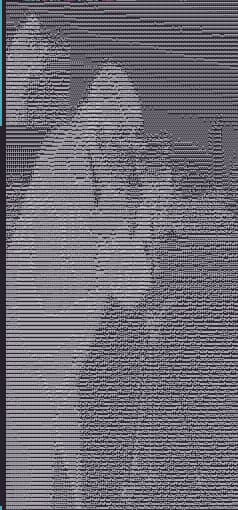
A fascinating exploration of how ASCII art can be embedded in what appears to be base64 image data, creating an optical illusion where the rendered image shows one thing while the source code reveals another entirely.
The intersection of data encoding and visual representation has long fascinated technologists and artists alike, but Jordan Matelsky's recent exploration pushes this boundary into particularly intriguing territory. By exploiting the nuanced specifications of the WHATWG URL Standard, Matelsky has developed a technique that allows ASCII art to masquerade as image data within a base64 encoded data URL, creating a visual paradox where what you see is not what you inspect.
At first glance, the concept appears deceptively straightforward. The WHATWG URL Standard permits newline characters within text representations of URLs, creating opportunities for creative data embedding. When applied to image data URLs—those base64 encoded strings that begin with "data:image/[format];base64,"—this specification allows for what Matelsky describes as a "2D-block" of data that can be visually manipulated without breaking the URL's functionality. The initial insight was simple: could an ASCII image be placed within this block such that when rendered as an image, it would display correctly, while the source code would reveal the ASCII art instead of expected base64 data?
The technical implementation, however, proved more complex than anticipated. Matelsky's initial assumption—that there would be a direct, predictable relationship between the ASCII characters and the resulting pixels—was quickly challenged. While base64 encoding and pixel data do exhibit a loose correlation, the relationship is not strictly one-to-one. A single base64 character corresponds to six bits of data, whereas a single pixel requires twenty-four bits (eight each for red, green, and blue channels). This misalignment creates a fascinating mathematical puzzle where characters and pixels exist in what Matelsky describes as a "coprime" relationship, requiring careful optimization to achieve the desired visual effect.
The solution Matelsky developed involves creating a weighted list of base64 characters sorted by their luminance—a resource that, surprisingly, did not exist in any readily accessible form. By generating individual images for each base64 character and analyzing their pixel distributions using numpy, Matelsky produced a custom luminance ranking: "N0BMW8QRDgOH96KUqGEdpbAmPSa5XZ43hkeV2woFIyCnu1JTYsftj7xLzvcil+/r". This ranking becomes the foundation for the optimization algorithm that determines which ASCII characters will best approximate the target image.
The optimization process itself represents an elegant, if computationally intensive, approach. Matelsky implemented what he describes as "the dumbest thing that could possibly work": a greedy local search over byte edits. For each position in the target ASCII block, the algorithm attempts to find the optimal base64 character by considering desired luminance rankings, evaluating nearby candidates, calculating the required byte edits, and scoring each option based on a combination of character error and pixel drift. The pixel_weight parameter allows users to control the trade-off between ASCII art quality and image fidelity, with lower values prioritizing the aesthetic quality of the ASCII art and higher values favoring visual accuracy of the rendered image.
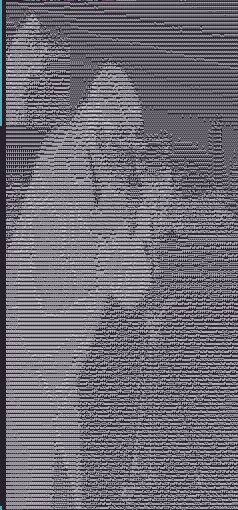
One particularly fascinating artifact of this technique is what Matelsky terms the "split down the middle" effect—a vertical seam that appears in the outputs due to the geometric relationship between BMP rows (64 pixels, or 192 bytes, which translates to 256 base64 characters) and the chosen ASCII art dimensions. When the ASCII art width is set to 128 characters, each displayed row corresponds to half an image row, creating an interleaving effect that produces the distinctive vertical division. Matelsky remains uncertain whether this represents an intentional feature of the encoding geometry or an unintended bug, highlighting the complex interplay between data structure and visual representation.
Perhaps the most counterintuitive aspect of this technique is the complete decorrelation between the ASCII art and the image data. As Matelsky discovered, there is no inherent link between the visual content of the ASCII art and the pixels it represents when rendered. This becomes evident when a thumbnail of the source image is embedded in the top-left corner of the ASCII target—despite this addition, the rendered image remains unaffected because the luminance values of base64 characters have no relationship to their alphabetical order. This decoupling opens intriguing possibilities for steganography, though Matelsky notes that the technique is less suited for text-based hidden messages, as small perturbations to readable text are immediately noticeable to human observers.
The implications of this research extend beyond mere technical novelty. In an era where digital forensics and data analysis grow increasingly sophisticated, techniques that challenge our assumptions about data representation and visual perception become particularly valuable. The method demonstrates how specifications designed for practical utility can be creatively repurposed for artistic and exploratory purposes, blurring the boundaries between functional encoding and aesthetic expression.
From a practical standpoint, the technique offers potential applications in watermarking, data obfuscation, and creative coding. The ability to encode information in a format that reveals different content depending on how it's viewed—rendered versus inspected—creates opportunities for interactive experiences that challenge users' understanding of digital media. Educational applications also present themselves, as the technique provides a compelling illustration of encoding standards, optimization algorithms, and the relationship between data and visual representation.
However, the technique is not without limitations. Matelsky himself describes the accompanying code as "unmaintained, no-promises," acknowledging both its experimental nature and the computational intensity of the optimization process. The trade-off between ASCII art quality and image fidelity, while adjustable, means perfect representation of either remains elusive. Additionally, the technique's reliance on specific browser implementations of the WHATWG URL Standard could create compatibility issues across different platforms and rendering engines.
The aesthetic dimension of this work raises intriguing questions about the relationship between code and art. By transforming binary data into human-readable ASCII while maintaining the ability to render the original image, Matelsky creates a bridge between machine and human perception that challenges conventional understandings of data visualization. The ASCII art becomes both a representation of and a distraction from the underlying data, creating a layered experience that rewards different modes of engagement.
As digital media continues to evolve, techniques like this remind us that the boundaries between data and representation remain more fluid than we often assume. The ability to hide complexity in plain sight—not through encryption, but through clever exploitation of encoding specifications—represents a fascinating frontier in the intersection of technology and creativity. Matelsky's work serves as both a technical demonstration and an artistic statement, inviting us to reconsider what we see when we look at digital images and how easily our perception can be manipulated by the very systems we design to represent reality.
The article concludes with a series of compelling examples demonstrating the technique across different types of images—from standard test images like "Cameraman" to synthetic patterns like Mandelbrot sets and SMPTE bars. Each example illustrates how the pixel_weight parameter affects the balance between ASCII art quality and image accuracy, providing a practical demonstration of the theoretical concepts discussed.
In the end, Matelsky's exploration represents more than just a clever hack; it's a meditation on the nature of digital representation, the relationship between code and perception, and the creative possibilities that emerge when we view technical specifications not as rigid constraints, but as playgrounds for innovation. As we continue to push the boundaries of what's possible with digital media, such explorations remind us that the most interesting discoveries often lie at the intersection of disciplines and the edges of specification.
Comments
Please log in or register to join the discussion