Amazon Bedrock Managed Knowledge Base gives developers a managed path from enterprise data to grounded AI answers, with built-in connectors, smart parsing, agentic retrieval and MCP access through AgentCore Gateway.
AWS launched Amazon Bedrock Managed Knowledge Base, a managed retrieval service for teams that need enterprise data inside generative AI and agentic applications without building each retrieval pipeline from scratch.
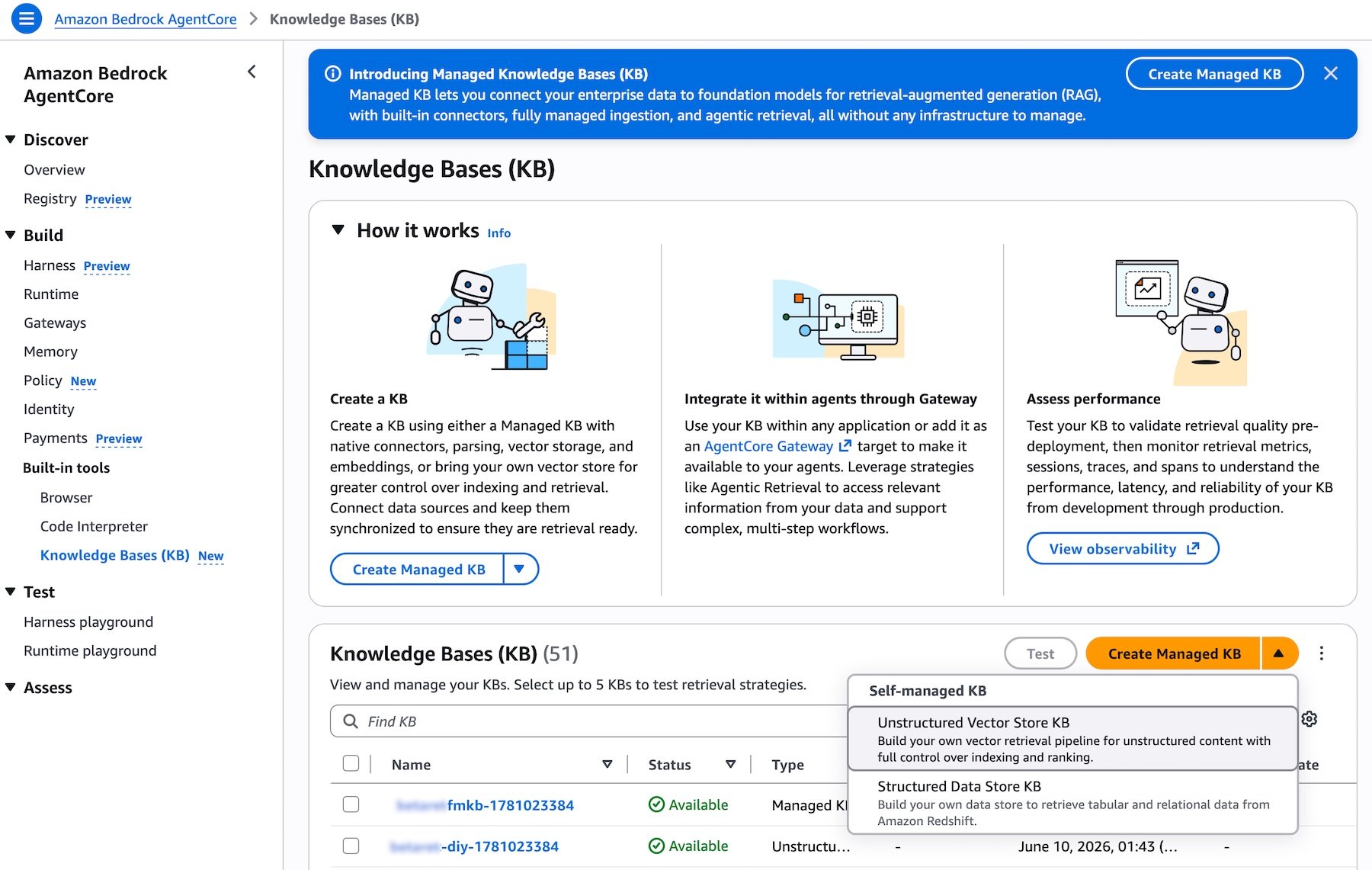
Developers can use the new service through Amazon Bedrock Knowledge Bases and Amazon Bedrock AgentCore. AWS handles storage, retrieval, embeddings, reranking and model selection as one managed service. Teams can still choose foundation models, embedding models and rerankers through Amazon Bedrock when an application needs tighter control over cost, latency or domain accuracy.
The release targets a common enterprise RAG problem. Company knowledge sits in file stores, collaboration suites, ticketing systems, web pages and document libraries. Each source brings its own permission model and format. Developers often spend weeks building connectors, parsing documents, tuning chunk sizes and testing retrieval quality before they can test the user experience.
AWS now offers six ingestion sources at launch: Amazon S3, SharePoint, Confluence, Web Crawler, Google Drive and OneDrive. Developers select a source in the console, connect data and let AWS create the required AWS Identity and Access Management roles. Teams can edit those permissions when their security model requires a narrower role.
The managed service also adds Smart Parsing. Developers point the knowledge base at a data source, and AWS chooses parsing strategies for each content type. A web page can keep HTML structure, tables and embedded media. A SharePoint library can preserve document hierarchy. Documents with mixed formats can use foundation models for extraction, captions and scene descriptions.
Smart Parsing matters because retrieval quality often fails before the model sees the prompt. A weak parser can split a contract clause from its definition, drop a table header or flatten a diagram into useless text. The model then answers from fragments. Developers can tune prompts for days and miss the ingestion flaw.

Amazon Bedrock Managed Knowledge Base gives teams a higher starting point. The service supplies defaults for parsing, chunking, embeddings, reranking and generation. Developers can then test retrieval quality against real questions and adjust the parts that affect the answer.
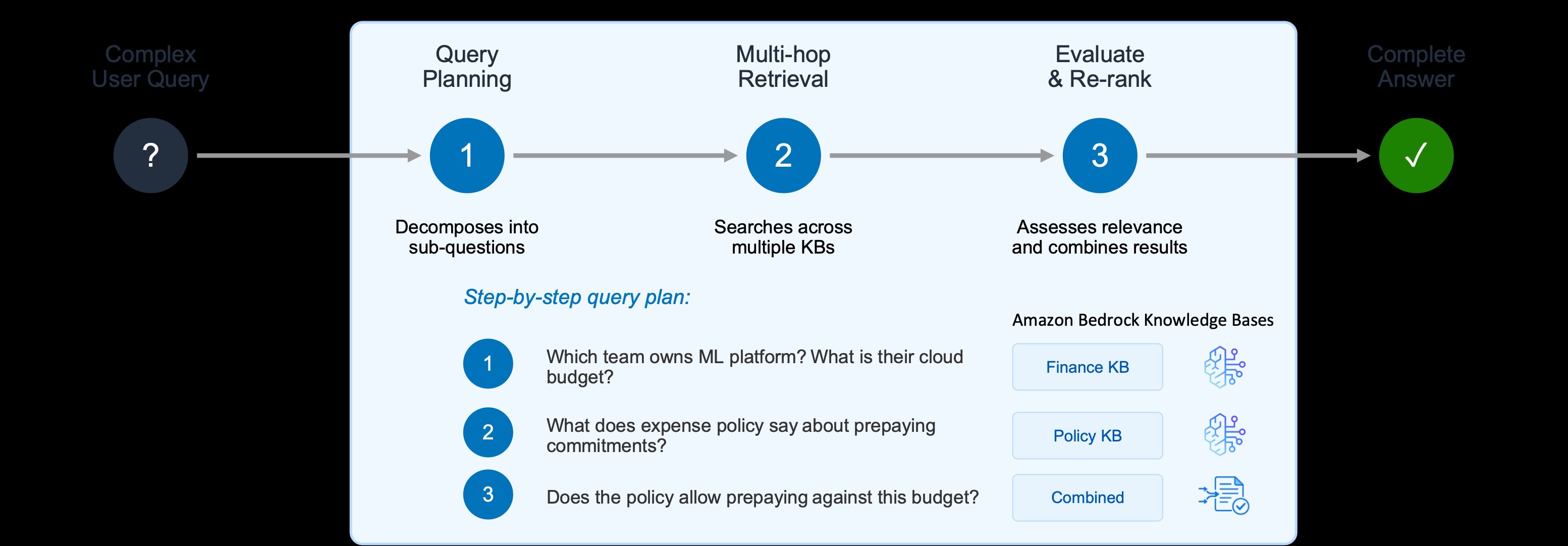
AWS also added Agentic Retriever for multistep questions. A user might ask whether a platform team can prepay annual cloud commitments from its infrastructure budget. A basic vector search may find budget documents or expense policy text, but miss the connection between the two.
Agentic Retriever plans the query, retrieves evidence across one or more knowledge bases and stops after it gathers enough context. In that budget example, the retriever can identify the team budget, inspect the prepayment rule and connect the policy to the team’s request. Developers get that behavior without wiring a planner, retriever loop and result evaluator.
The AgentCore integration gives agent builders a cleaner entry point. Developers can expose a knowledge base as a target in Amazon Bedrock AgentCore Gateway. Gateway presents the knowledge base through the Model Context Protocol, so MCP clients and agent frameworks can discover the tool. AWS named Strands Agents, LangChain, CrewAI, LlamaIndex and LangGraph as supported open source frameworks.
That pattern fits current agent architecture. A team can keep business data in governed systems, expose retrieval as a tool and let an agent call it during a workflow. The gateway layer adds observability, policy enforcement and permission handling. Developers avoid custom tool wrappers for each framework.
Pricing follows two usage dimensions: indexed data stored and on-demand retrievals. AWS said the service requires no upfront commitment. Teams can review charges on the Amazon Bedrock pricing page.
Regional support starts in US East (N. Virginia), US West (Oregon), Asia Pacific in Sydney and Tokyo, Europe in Dublin, Frankfurt and London, and AWS GovCloud (US-West). AWS directs customers to AWS Capabilities by Region for region status.
The trade-off comes from control. A managed pipeline helps teams ship faster, but some applications need strict rules for parsing, embedding choice, reranking policy or retention. Bedrock keeps model choice open, and developers can use existing Knowledge Bases APIs such as Retrieve, StartIngest, StopIngest and IngestKnowledgeBaseDocuments. Teams with custom retrieval stacks should compare Bedrock’s managed defaults against their own accuracy tests, audit needs and cost targets.
For many enterprise AI teams, the service reduces undifferentiated RAG work. Developers still need to design access controls, test answer quality and measure retrieval failures. AWS now gives them a managed base for that work, connected to enterprise data sources and agent frameworks through Bedrock and AgentCore.
Comments
Please log in or register to join the discussion