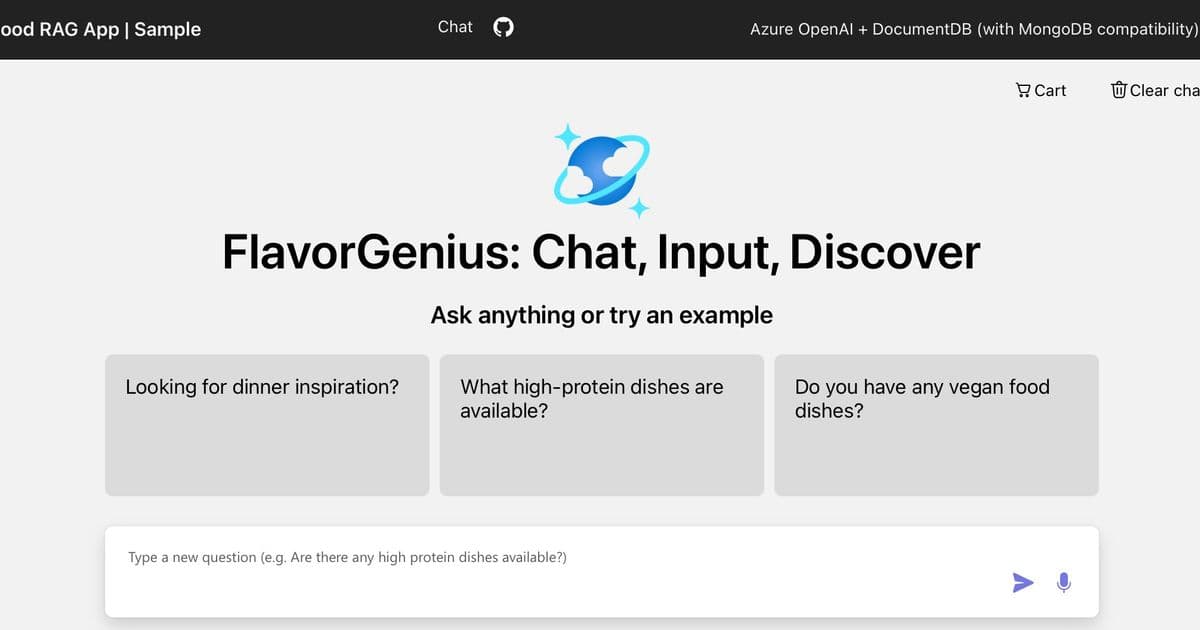
Microsoft's integration of DocumentDB with MongoDB compatibility and OpenAI services presents a compelling alternative to established cloud providers for building RAG applications, combining enterprise-grade features with developer flexibility.
Azure's DocumentDB with Vector Search: Challenging Cloud Leaders in the RAG Application Market
The race to dominate the retrieval-augmented generation (RAG) application space has intensified as cloud providers vie for developer attention and enterprise workloads. Microsoft's recent integration of Azure DocumentDB (with MongoDB compatibility) with OpenAI services creates a significant contender in this market, offering developers a streamlined path to production-ready RAG applications without the complexity of stitching multiple services together.
What Changed: Azure's Integrated RAG Approach
Azure's offering represents a strategic shift from the typical "best-of-breed" approach where developers must combine vector databases, embedding services, and LLM endpoints from multiple sources. With DocumentDB's built-in vector search capabilities and tight integration with Azure OpenAI, Microsoft provides a unified solution that reduces operational overhead while maintaining flexibility.
The key differentiator is the 99.03% MongoDB wire-protocol compatibility, which enables both portability and specialization. Developers can leverage familiar MongoDB APIs while accessing Azure's managed services and enterprise features. This approach addresses a common pain point in RAG development: the need to store both structured data and vector embeddings efficiently.
Provider Comparison: Azure vs. AWS vs. Google Cloud
When evaluating cloud platforms for RAG applications, several factors come into play: vector search capabilities, integration with LLM services, cost structure, and operational complexity.
Azure DocumentDB with MongoDB Compatibility
Strengths:
- Integrated vector search within the database layer
- MongoDB compatibility reduces learning curve
- Native Azure integration with OpenAI services
- Automatic scaling and enterprise security features
Pricing: The M25 tier with 2 vCores and 32 GiB storage provides an accessible entry point, with costs scaling predictably with usage.
Amazon Neptune with OpenSearch
AWS offers Neptune as a graph database with OpenSearch integration for vector search. While powerful for graph-based applications, the separation between graph and vector capabilities often requires additional orchestration.
Strengths:
- Mature graph database capabilities
- Tight integration with AWS ecosystem
- Serverless options for variable workloads
Considerations:
- Vector search requires separate OpenSearch configuration
- More complex setup for pure RAG applications
- Pricing can become unpredictable with serverless options
Google Cloud's Vertex AI with Firestore
Google's approach leverages Vertex AI for model deployment and Firestore for data storage, with vector search capabilities added through Firestore's new vector search features.
Strengths:
- Seamless integration with Google's AI ecosystem
- Vertex AI's unified ML platform
- Competitive pricing for Google Cloud customers
Considerations:
- Vector search is newer and less mature
- MongoDB compatibility not available
- Requires additional services for complete RAG implementation
Business Impact: Strategic Considerations for Organizations
The choice of cloud platform for RAG applications extends beyond technical capabilities to impact operational efficiency, total cost of ownership, and long-term flexibility.
Migration Considerations
Organizations with existing MongoDB deployments will find Azure's offering particularly attractive. The high compatibility percentage means minimal code changes are required to migrate existing applications while gaining vector search capabilities. This reduces the risk associated with technology transitions and allows for incremental adoption.
For enterprises already using Azure services, the integration benefits translate to reduced operational complexity. The elimination of data synchronization between separate vector databases and application databases simplifies architecture and reduces potential points of failure.
Total Cost of Ownership
Azure's approach offers predictable pricing with clear scaling paths. The M25 tier provides an accessible entry point for development and proof-of-concept projects, with clear upgrade paths as application requirements grow. The integration of vector search within the database layer eliminates the need for additional vector database services, reducing overall infrastructure costs.
Operational Efficiency
The unified approach of Azure's offering reduces the operational burden on development teams. With vector search, embeddings, and LLM access integrated within the Azure ecosystem, teams can focus on application development rather than infrastructure management. This acceleration time-to-market while maintaining enterprise-grade security and compliance features.
Technical Implementation: Building RAG Applications with Azure
The implementation guide provided by Microsoft demonstrates a practical approach to building RAG applications using Azure DocumentDB and OpenAI services. The process involves three main components:
Azure DocumentDB (with MongoDB compatibility): Stores both application data and vector embeddings in a single database, eliminating the need for separate vector databases and complex synchronization pipelines.
Azure OpenAI Service: Provides both chat and embedding models through a unified API, with enterprise features like content filtering and usage monitoring.
Azure App Service: Hosts the RAG application with continuous deployment from GitHub, enabling rapid iteration and team collaboration.
The architecture demonstrates how Azure services work together to create a streamlined development experience. The application settings configuration enables secure communication between services while maintaining separation of concerns.
Strategic Recommendations
For organizations evaluating cloud platforms for RAG applications:
Azure is particularly compelling for: Organizations with existing MongoDB investments, Azure-centric enterprises, and teams prioritizing operational simplicity.
Consider alternatives when: Your architecture heavily leverages AWS or Google Cloud services, you require specialized vector search capabilities not available in Azure's offering, or you need to maintain multi-cloud deployments with minimal code changes.
Hybrid approaches: Many organizations will benefit from a hybrid strategy, using Azure for RAG applications while maintaining other cloud providers for specialized workloads.
Microsoft's DocumentDB with vector search represents a significant step forward in making RAG development more accessible to enterprise developers. By combining MongoDB compatibility with Azure's managed services, the company has created a compelling offering that challenges established cloud providers while addressing common pain points in RAG development.
As the RAG application market continues to evolve, we can expect further innovation from all cloud providers. However, Azure's current offering sets a high standard for integration, simplicity, and enterprise readiness that will be difficult for competitors to match in the near term.
For organizations looking to implement RAG applications, Azure's approach offers a balanced solution that doesn't sacrifice flexibility for simplicity. The combination of familiar MongoDB APIs with cutting-edge AI services creates a unique value proposition that deserves serious consideration in your cloud strategy.
Learn more about Azure DocumentDB with MongoDB compatibility and Azure OpenAI Service to evaluate if this approach aligns with your organization's needs.
Comments
Please log in or register to join the discussion