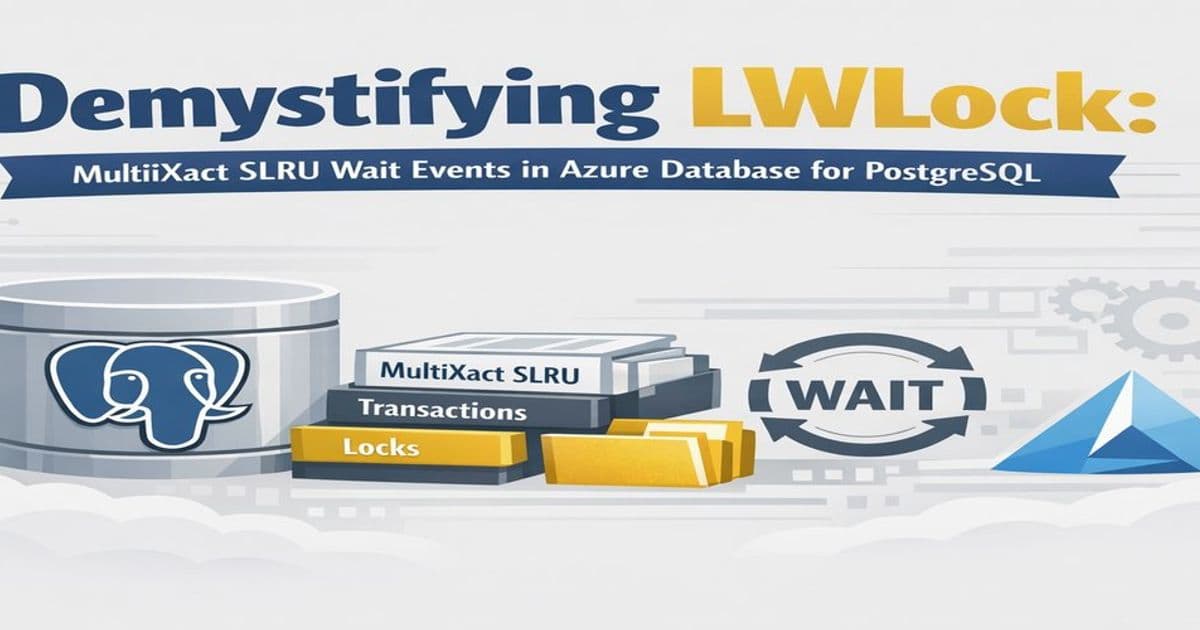
Azure Database for PostgreSQL has implemented significant optimizations to address MultiXact SLRU wait events, a common performance bottleneck in cloud database deployments. This article compares Azure's approach with offerings from AWS RDS for PostgreSQL and Google Cloud SQL for PostgreSQL, examining technical implementations, pricing implications, and migration considerations for enterprises.
What Changed: Azure's MultiXact SLRU Optimizations
Azure Database for PostgreSQL has recently implemented several enhancements to address the MultiXact SLRU wait events that have historically plagued PostgreSQL deployments in cloud environments. These optimizations represent a significant evolution in how Microsoft's managed PostgreSQL service handles the complex interplay between transaction locking, memory management, and concurrent access patterns.
The core issue lies in PostgreSQL's MultiXact subsystem, which manages concurrent row-level locks when multiple transactions need to access the same rows. When more than one transaction holds locks on a row, PostgreSQL creates a MultiXact ID (MXID) that points to a list of all involved transaction IDs. These mappings are stored in on-disk structures and cached in memory using a Simple Least Recently Used (SLRU) cache. Each buffer slot in this cache is protected by a Lightweight Lock (LWLock), and under high concurrency, these locks can become significant bottlenecks.
Azure's implementation addresses this through several key innovations:
First, Microsoft has enhanced the SLRU cache management algorithm in their PostgreSQL builds to better handle thundering herd scenarios where multiple sessions simultaneously attempt to lock the same rows. The Azure team has developed a more intelligent cache eviction strategy that prioritizes frequently accessed MultiXact pages, reducing the frequency of cache invalidation under high concurrency.
Second, Azure Database for PostgreSQL now includes automated detection and mitigation of MXID wraparound conditions. The service proactively monitors MXID age across all databases and automatically triggers VACUUM FREEZE operations before approaching the critical threshold, preventing the performance degradation that occurs when autovacuum cannot keep pace with MXID creation.
Third, Microsoft has implemented connection pool optimization specifically for MultiXact scenarios. The built-in PgBouncer configuration in Azure PostgreSQL now includes specialized parameters that better distribute connection loads and prevent thundering herd scenarios that can trigger SLRU contention.
These optimizations are particularly valuable for high-concurrency OLTP workloads common in cloud environments, where multiple application instances frequently access the same data rows.
Provider Comparison: Azure vs. AWS vs. Google Cloud
When evaluating cloud providers' PostgreSQL offerings regarding MultiXact SLRU handling, several key differences emerge in their approaches, pricing models, and operational characteristics.
Azure Database for PostgreSQL
Microsoft's approach focuses on proactive optimization and automation:
Technical Implementation:
- Enhanced SLRU cache management with intelligent page prioritization
- Automated MXID age monitoring and VACUUM FREEZE triggering
- Built-in PgBouncer with specialized MultiXact configuration
- Custom PostgreSQL builds with additional performance patches
Pricing Model:
- Offers both Provisioned and Serverless options
- Pricing based on vCores and storage, with separate compute and storage tiers
- Includes monitoring and optimization features at no additional cost
- Hybrid benefit pricing for Azure customers with existing enterprise agreements
Operational Features:
- Automated patching with maintenance windows
- Built-in high availability with automatic failover
- Performance monitoring integrated with Azure Monitor
- Point-in-time recovery with configurable retention periods
AWS RDS for PostgreSQL
Amazon's approach emphasizes flexibility and integration with the AWS ecosystem:
Technical Implementation:
- Standard PostgreSQL community version with limited customizations
- Parameter group configurations for SLRU tuning
- Enhanced monitoring through CloudWatch
- Limited automation for MXID management
Pricing Model:
- Instance-based pricing with multiple tiers (Burstable, General Purpose, Memory-optimized)
- Additional costs for backup storage, I/O operations, and data transfer
- Reserved instances and savings plans for long-term commitments
- No built-in connection pooling (requires separate ElastiCache for Redis or third-party solutions)
Operational Features:
- Manual maintenance windows required for major version upgrades
- Enhanced monitoring through CloudWatch with custom metrics
- Multi-AZ deployment options for high availability
- Point-in-time recovery with configurable retention periods
Google Cloud SQL for PostgreSQL
Google's approach centers on serverless and machine learning integration:
Technical Implementation:
- Standard PostgreSQL with limited custom optimizations
- Basic SLRU configuration options
- Integration with BigQuery for analytics
- Limited automation for performance tuning
Pricing Model:
- Serverless pricing based on usage
- Provisioned instances with per-core pricing
- Network egress costs can be significant
- Machine learning features at additional cost
Operational Features:
- Automated backups and patching
- Serverless option with automatic scaling
- Integration with Google Cloud's machine learning ecosystem
- Point-in-time recovery with configurable retention periods
Comparative Analysis
When specifically comparing MultiXact SLRU handling capabilities:
Azure Advantages:
- Purpose-built optimizations for MultiXact scenarios
- Automated MXID management without manual intervention
- Built-in connection pooling with MultiXact awareness
- Enhanced monitoring specifically for SLRU wait events
- More granular control over SLRU cache parameters
AWS Advantages:
- Greater flexibility in PostgreSQL version selection
- More extensive community and third-party tool integration
- Better integration with other AWS services
- More mature ecosystem of PostgreSQL extensions
Google Cloud Advantages:
- Serverless option eliminates capacity planning concerns
- Automatic scaling based on demand
- Strong integration with Google's analytics ecosystem
- Predictable pricing for variable workloads
For organizations specifically concerned about MultiXact SLRU wait events, Azure Database for PostgreSQL currently offers the most comprehensive solution with its purpose-built optimizations and automation features.
Business Impact: Migration Considerations and Total Cost of Ownership
The technical differences between cloud providers' PostgreSQL offerings translate into significant business implications for organizations considering migration or multi-cloud strategies.
Migration Considerations
From On-Premises to Azure: Organizations migrating from self-managed PostgreSQL to Azure Database for PostgreSQL benefit from Microsoft's MultiXact optimizations without requiring code changes. The automated MXID management and enhanced SLRU handling can provide immediate performance improvements for high-concurrency workloads that previously experienced SLRU wait events.
Migration complexity is reduced through Azure's Database Migration Service, which handles schema conversion and data migration with minimal downtime. The built-in monitoring tools make it easier to identify and address any remaining performance issues post-migration.
Between Cloud Providers: Migrating from AWS RDS or Google Cloud SQL to Azure PostgreSQL requires careful consideration of several factors:
Configuration Differences: Azure's enhanced SLRU parameters may require readjustment of application connection pooling strategies to fully benefit from the optimizations.
Pricing Models: The shift from instance-based pricing (AWS) or usage-based pricing (Google Cloud) to Azure's vCore model may result in cost changes depending on the workload profile.
Operational Changes: Organizations moving from AWS will need to adapt to Azure's monitoring tools and maintenance processes, while those coming from Google Cloud will need to adjust from a serverless-first approach.
Ecosystem Integration: The migration may require changes to dependent services and monitoring solutions, particularly for organizations deeply integrated with AWS or Google Cloud ecosystems.
Total Cost of Ownership Analysis
When evaluating the total cost of ownership (TCO) across cloud providers, several factors specific to MultiXact SLRU handling should be considered:
Direct Costs:
- Azure's vCore pricing may appear higher than AWS's instance-based pricing, but the included optimizations can reduce the required compute resources for equivalent performance.
- Google Cloud's serverless pricing can be unpredictable for workloads with frequent MultiXact SLRU contention, as performance issues may trigger increased resource consumption.
- Azure's built-in connection pooling eliminates the need for third-party solutions like PgBouncer, reducing additional licensing costs.
Indirect Costs:
- The operational overhead of manually managing MultiXact SLRU issues in AWS and Google Cloud deployments can significantly increase TCO, particularly for organizations with limited PostgreSQL expertise.
- Performance incidents related to SLRU wait events can result in application downtime, customer dissatisfaction, and lost revenue—costs that Azure's proactive optimization helps mitigate.
- The time required for performance tuning and optimization varies significantly between providers, with Azure requiring less manual intervention due to its automation features.
Multi-Cloud Considerations: For organizations pursuing multi-cloud strategies, Azure's comprehensive MultiXact SLRU optimizations can provide a performance advantage in regions where high concurrency is common. However, the operational complexity of maintaining consistent configurations across providers may offset some of these benefits.
The choice of provider should consider:
- The specific concurrency patterns of the application
- The organization's existing cloud investments and expertise
- The importance of automated performance optimization versus flexibility
- The total cost of ownership including operational overhead
Strategic Recommendations
Based on the comparative analysis, organizations should consider the following strategic recommendations:
For High-Concurrency OLTP Workloads: Azure Database for PostgreSQL offers the most comprehensive solution for addressing MultiXact SLRU wait events, with its purpose-built optimizations and automation features providing immediate performance benefits.
For Mixed Workloads: Organizations with diverse workloads may benefit from a hybrid approach, using Azure for high-concurrency OLTP workloads and another provider for analytics or batch processing workloads.
For Cost-Optimized Migration: Organizations migrating from AWS or Google Cloud should prioritize Azure's Database Migration Service and take advantage of the migration assessment tools to identify potential performance improvements and cost savings.
For Multi-Cloud Strategies: Organizations pursuing multi-cloud deployments should standardize on Azure for PostgreSQL workloads where MultiXact SLRU handling is critical, while leveraging other providers for specialized services.
For Operational Efficiency: Azure's automated monitoring and optimization features reduce the operational overhead associated with managing PostgreSQL performance, allowing organizations to focus on application development rather than database tuning.
The evolution of Azure Database for PostgreSQL's MultiXact SLRU handling capabilities represents a significant advancement in cloud database performance optimization. As organizations increasingly rely on cloud-based PostgreSQL deployments, these enhancements provide a compelling reason to consider Azure as their preferred cloud provider for database workloads, particularly those with high concurrency requirements.
In conclusion, while all major cloud providers offer managed PostgreSQL services, Azure's purpose-built optimizations for MultiXact SLRU wait events provide a clear advantage for organizations prioritizing performance and operational efficiency. The combination of technical innovation, competitive pricing, and comprehensive migration support makes Azure Database for PostgreSQL an attractive option for organizations considering cloud migration or multi-cloud strategies.
For more information on Azure Database for PostgreSQL, visit the official documentation. To explore AWS RDS for PostgreSQL, see their product page. For Google Cloud SQL for PostgreSQL, refer to their documentation.
Comments
Please log in or register to join the discussion