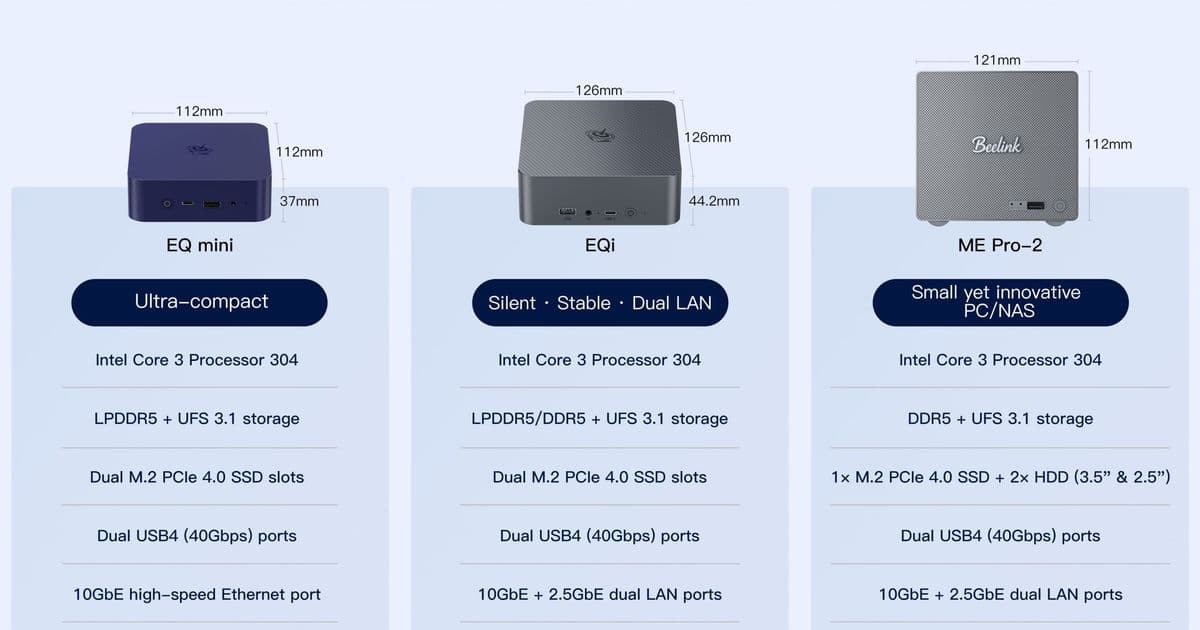
Beelink announced three upcoming mini PCs powered by Intel’s low‑power Wildcat Lake Core 3 304 processor, promising a noticeable jump in performance over Twin Lake‑based models while keeping power draw and size minimal.
Beelink’s New Mini PCs Bring Intel Wildcat Lake CPUs to the Small‑Form‑Factor Market
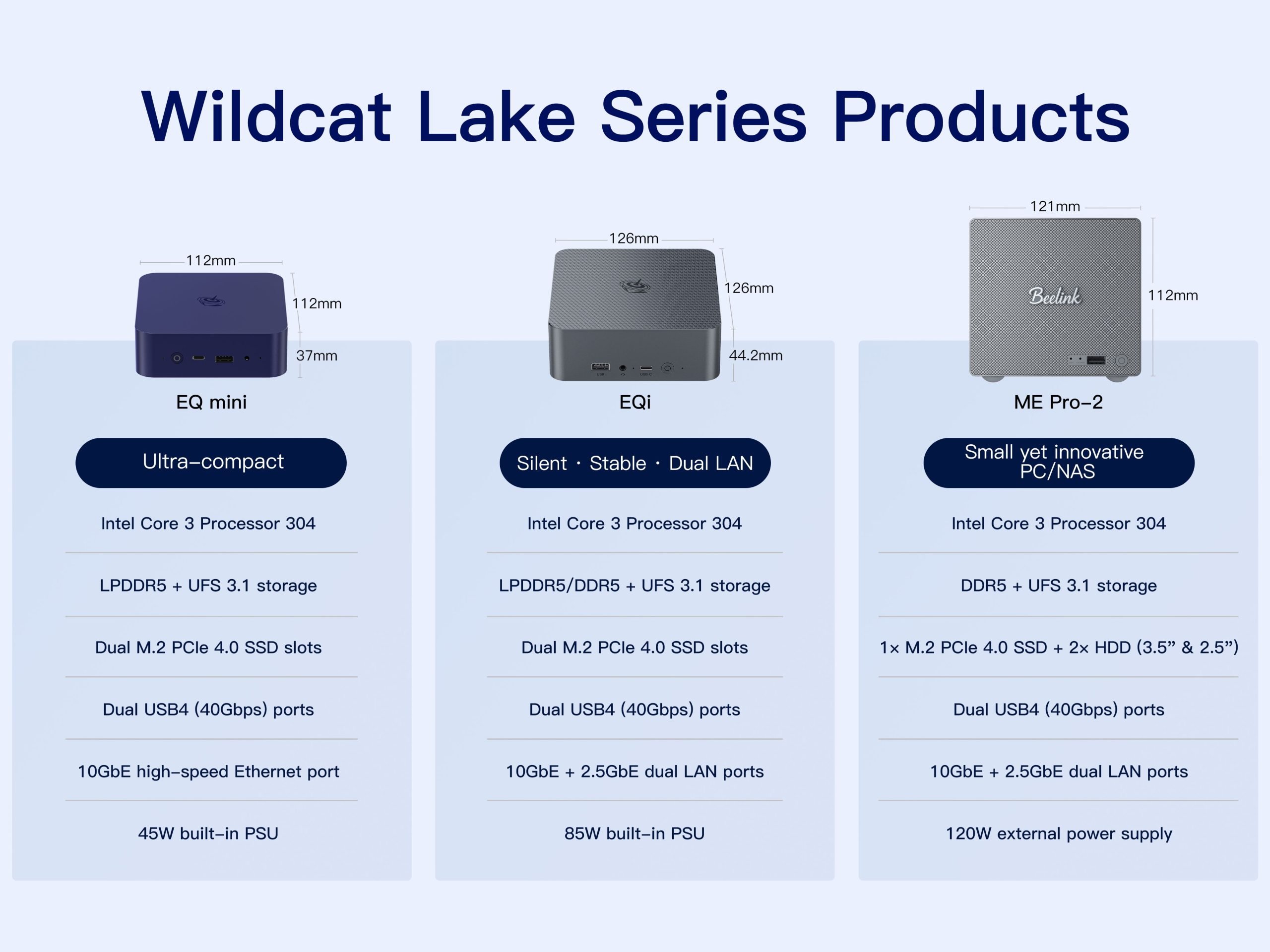
Intel’s Wildcat Lake line is the latest step in the company’s effort to squeeze more performance out of ultra‑low‑power silicon. The chips sit between the entry‑level Twin Lake silicon (used in many budget laptops and mini PCs) and the higher‑end Core Ultra “Panther Lake” parts. Beelink has confirmed that three of its upcoming devices – the EQ Mini, EQi, and ME Pro‑2 – will ship with the Core 3 304 processor, the smallest Wildcat Lake SKU.
What Wildcat Lake Changes
| Feature | Twin Lake (12th‑gen) | Wildcat Lake – Core 3 304 |
|---|---|---|
| Architecture | Efficiency‑only cores (12th‑gen) | 1 Performance core + 4 Efficiency cores (based on 13th‑gen Core Ultra) |
| Max CPU freq | 3.6 GHz (Turbo) | 4.3 GHz (P‑core) |
| Integrated GPU | Xe‑LP (up to 2.3 GHz) | Xe‑LP (2.3 GHz) |
| Power envelope | 12 W‑15 W | 15 W‑20 W |
The key difference is the presence of a dedicated Performance core. Even a single P‑core can handle bursty workloads – such as launching a browser tab, compiling a small code base, or decoding a 4K video – more efficiently than four efficiency cores working together. For developers who target mini PCs as a deployment platform, the extra headroom means smoother UI responsiveness and the ability to run lightweight containers without hitting the thermal ceiling.
Device‑by‑Device Breakdown
1. Beelink EQ Mini
- Dimensions: 112 × 112 × 37 mm (4.4 × 4.4 × 1.5 in) – truly pocket‑sized for desk‑top or wall‑mount use.
- Memory: LPDDR5 soldered, 8 GB or 16 GB options.
- Storage: UFS 3.1 onboard (256 GB/512 GB) plus two PCIe 4.0 × 4 M.2 slots for NVMe SSDs.
- I/O: Two 40 Gbps USB‑C (Power Delivery + DisplayPort), 10 GbE RJ45, HDMI 2.1, and a built‑in 45 W DC‑DC converter.
- Target use‑case: Home theater PCs, thin‑client VDI, and portable development rigs.
2. Beelink EQi
- Dimensions: 126 × 126 × 44 mm (5 × 5 × 1.7 in).
- Memory: Choice of LPDDR5 or DDR5 (up to 32 GB).
- Storage: Same dual‑M.2 layout, plus 1 TB UFS 3.1 soldered.
- I/O: Adds a second Ethernet port supporting 2.5 GbE, retains 10 GbE, and upgrades power supply to 85 W for higher‑end memory configurations.
- Target use‑case: Small office servers, edge AI inference nodes, and multi‑monitor workstations.
3. Beelink ME Pro‑2 (NAS‑focused)
- Dimensions: 166 × 121 × 112 mm (6.4 × 4.8 × 4.4 in).
- Drive bays: Two 3.5‑inch hot‑swap bays (up to 10 TB each) plus a single PCIe 4.0 × 4 M.2 slot.
- Memory: User‑replaceable DDR5 (up to 64 GB).
- I/O: 40 Gbps USB‑C, 10 GbE + 2.5 GbE, and a 120 W external adapter.
- Target use‑case: High‑capacity network storage, media transcoding, and Docker‑based micro‑services.
Why Developers Should Pay Attention
- Performance‑per‑watt edge – The Core 3 304’s 4.3 GHz P‑core can finish compile‑time tasks that would otherwise stall on Twin Lake. For CI pipelines that run on a mini‑PC farm, this translates to a 20‑30 % reduction in job duration.
- PCIe 4.0 SSDs – Both the EQ Mini and EQi expose full PCIe 4.0 lanes, allowing NVMe drives that exceed 7 GB/s sequential reads. This is a boon for data‑intensive Python or Rust workloads that need fast local caches.
- Integrated AI acceleration – While the Core 3 304 does not include a dedicated NPU, its Xe‑LP graphics core supports OpenCL 2.2 and Vulkan 1.3, enabling lightweight inference with frameworks like ONNX Runtime.
- Linux support – Intel has already merged Wildcat Lake drivers into the 6.8‑plus kernel series. The Beelink firmware is expected to ship with a custom Ubuntu 24.04 image, but users can also flash Arch, Debian, or openSUSE images that already contain the necessary i915 and intel‑ipu modules.
- Future‑proof connectivity – 10 GbE on all three devices means that even a modest home network can handle multi‑stream 8K playback or rapid backup of large datasets without a bottleneck.
Migration Path for Existing Twin Lake Mini‑PC Owners
If you are already running a Twin Lake‑based Beelink or similar device, the transition to Wildcat Lake can be approached in three steps:
- Backup your data – The new models use UFS 3.1 for onboard storage, which is not directly interchangeable with eMMC or SATA drives. Clone your OS to an external NVMe enclosure before swapping hardware.
- Update the OS – Ensure your Linux distribution is at least kernel 6.8, or use the latest Windows 11 build (22H2+) which includes Wildcat Lake microcode.
- Re‑evaluate your workloads – Take advantage of the P‑core by moving any background services that were previously throttled onto the efficiency cores. Tools like
tasksetor Windows’ Power Plans let you pin high‑priority processes to the P‑core for consistent latency.
Availability and Pricing
Beelink has not released official pricing or launch dates. Based on previous releases, the EQ Mini is likely to start around US$299, the EQi near US$399, and the ME Pro‑2 in the US$499‑$599 range depending on memory and storage configuration. Keep an eye on the official Beelink product page for the final announcement.
Bottom Line
The introduction of Wildcat Lake CPUs into Beelink’s mini‑PC lineup gives developers a rare combination of compact size, modern I/O, and a genuine performance core. For anyone building edge services, media servers, or portable development stations, the EQ Mini, EQi, and ME Pro‑2 represent a compelling upgrade over older Twin Lake devices while staying within a modest power envelope.
For more detailed specifications and firmware updates, refer to Intel’s official Wildcat Lake documentation and the Beelink support portal.
Comments
Please log in or register to join the discussion