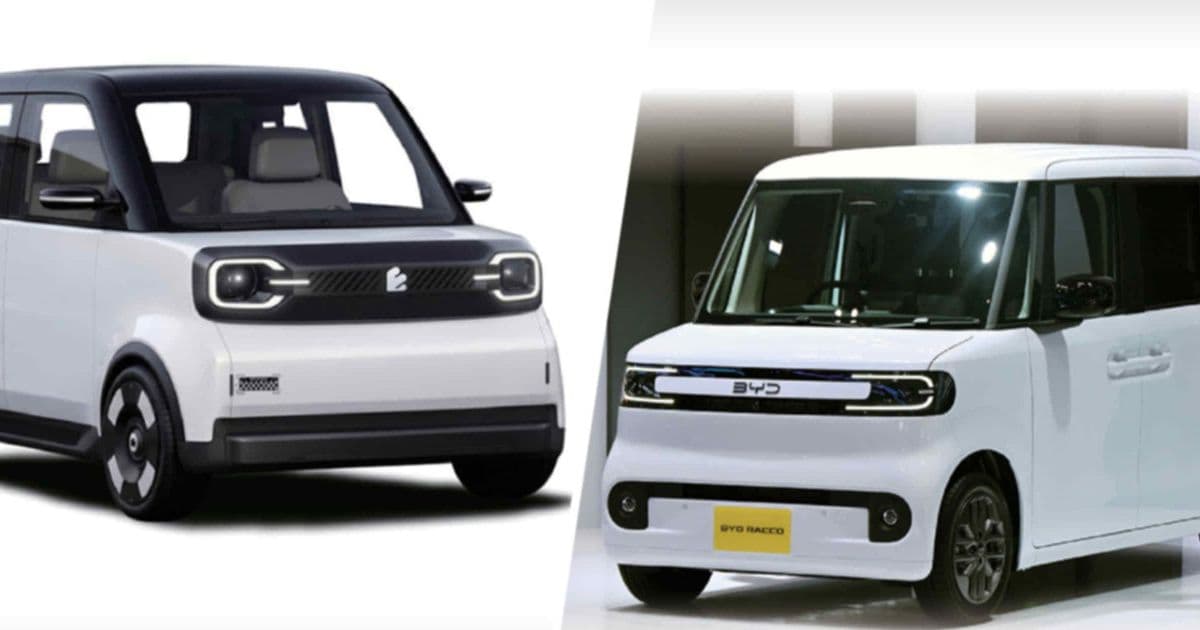
Chinese automaker Chery plans to introduce a battery‑electric kei‑class vehicle in Japan next spring, targeting price points comparable to gasoline‑powered micro‑cars. The move follows BYD’s recent launch of its Racco kei, intensifying competition in a segment where Japanese manufacturers have long dominated and where government subsidies are shaping demand.
Business news
Chinese carmaker Chery Automobile announced that it will bring an all‑electric kei‑class minicar to the Japanese market in the spring of 2027. The model will be positioned to sell at a price similar to traditional gasoline‑powered kei cars, which typically range from ¥1.2 million to ¥1.5 million (about $8,500‑$10,700). Chery’s entry comes just months after BYD unveiled its Racco kei EV, slated for a summer 2026 release in Japan.
Market context
Japan’s kei‑car segment, defined by strict size and engine‑displacement limits (maximum 660 cc and 3.4 m length), accounts for roughly 30 % of new‑vehicle registrations each year, according to the Japan Automobile Manufacturers Association (JAMA). In 2025, total kei‑car sales hit 1.1 million units, a modest decline from the 2019 peak but still a sizable market for low‑cost mobility.
The Japanese government has recently expanded its EV‑incentive scheme, offering up to ¥1 million (≈ $9,000) in subsidies for battery‑electric kei cars that meet a minimum range of 150 km. Combined with a ¥200,000 tax break for zero‑emission vehicles, the effective price floor for an EV kei could fall to ¥900,000 (≈ $7,600), making it competitive with the cheapest gasoline models.
Chinese EV makers have been eyeing this niche for two reasons:
- Volume potential – Even a 5 % market share would translate to 55,000–60,000 units annually, enough to justify dedicated production lines.
- Brand spillover – Success in Japan can improve perception of Chinese brands in other premium markets, as seen with BYD’s recent growth in Europe.
Chery’s strategy mirrors BYD’s: launch a compact, low‑cost EV that leverages existing battery‑pack technology (likely the Blade Battery platform) while localising assembly through a partnership with a Japanese contract manufacturer. Analysts at Nomura estimate that a ¥1.3 million price tag, combined with the subsidy, yields a net cost of ¥300,000 for the manufacturer, allowing a gross margin of around 15 % per unit.
What it means
Competitive pressure on domestic players: Companies such as Suzuki, Daihatsu, and Honda have traditionally dominated the kei segment with models like the Spacia, Mira, and N-Box. An influx of cheap Chinese EVs could force them to accelerate electrification or risk losing market share. Suzuki’s 2025 earnings call hinted at a ¥200 million R&D allocation to develop a next‑generation EV kei, underscoring the urgency.
Supply‑chain implications: If Chery adopts the Blade Battery, demand for lithium‑iron‑phosphate (LFP) cells in Japan could rise sharply. Current LFP capacity in the country sits at 2 GWh, enough for roughly 150,000 kei EVs. Scaling to meet combined BYD and Chery volumes may require new joint‑venture cell plants, potentially involving Toshiba or Panasonic.
Policy feedback loop: The Japanese Ministry of Economy, Trade and Industry (METI) is monitoring the impact of foreign EV entrants on domestic employment. Should Chinese EVs capture more than 10 % of kei sales, METI may adjust subsidy thresholds or introduce localisation quotas, similar to the "Made in Japan" rules applied to larger EVs.
Consumer adoption trajectory: Price parity with gasoline kei cars, combined with lower operating costs (estimated ¥8,000 annual electricity expense versus ¥15,000 for petrol), could push the total cost of ownership (TCO) advantage to a break‑even point within 3‑4 years of purchase. Early adopters—urban commuters in Tokyo, Osaka, and Nagoya—are likely to be the first wave, given the dense charging infrastructure in these metros.
Overall, Chery’s planned launch signals a maturing phase for Chinese EV makers: moving from mass‑market sedans to highly regulated, low‑margin segments where price sensitivity is paramount. The next 12‑18 months will reveal whether Japanese manufacturers can defend their home turf or whether the kei‑car segment will become a new battleground for Sino‑Japanese automotive competition.
Comments
Please log in or register to join the discussion