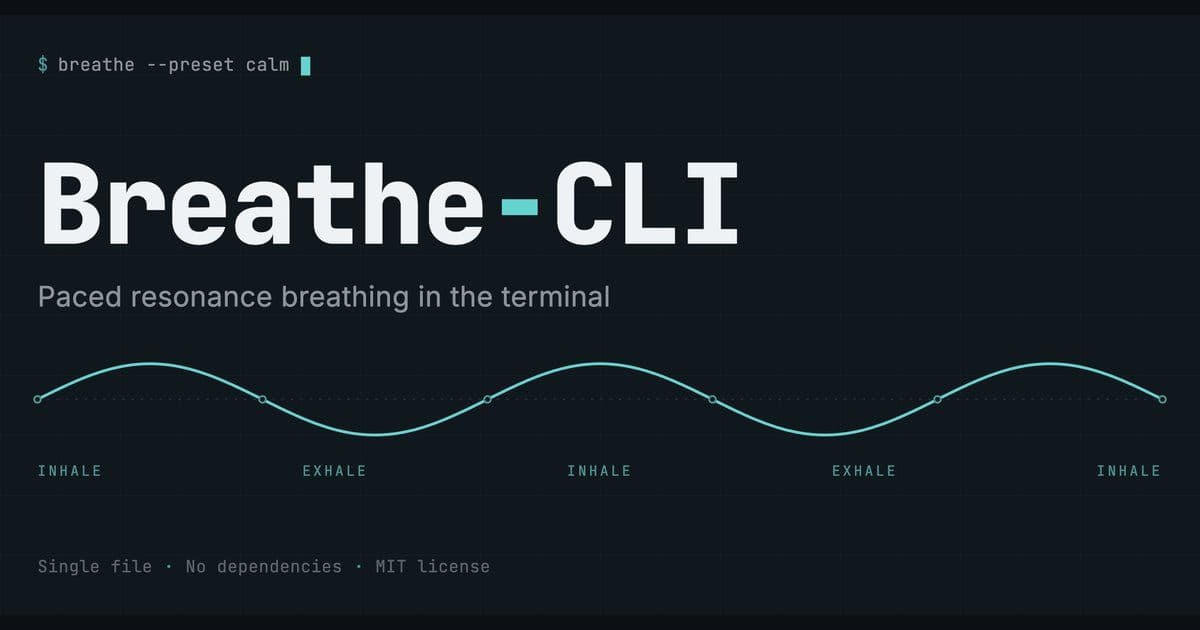
A lightweight macOS‑only Python tool lets developers practice slow, vagal‑tone‑enhancing breathing from the command line. While the app’s scientific grounding and minimal footprint attract a niche of health‑conscious coders, questions remain about its accessibility, safety assumptions, and relevance beyond a small user base.
Breathe‑CLI Brings Clinically‑Inspired Resonance Breathing to the Terminal
Why a breathing coach lives in a terminal
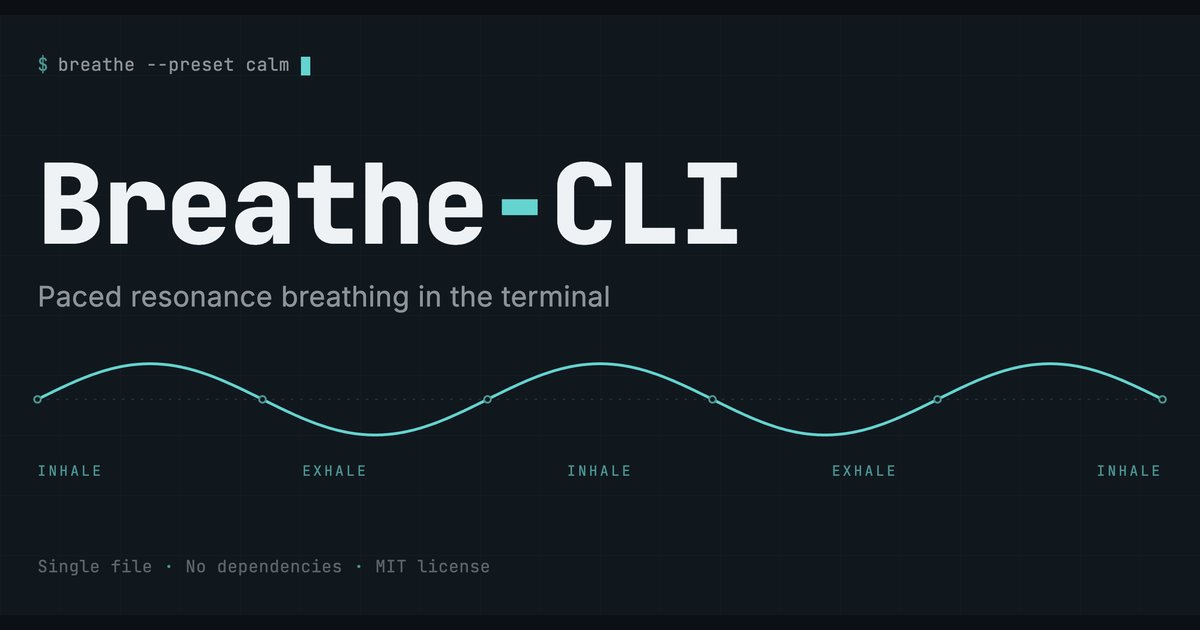
Marek Kowalczyk’s breathe‑cli is a single‑file Python script that turns a Unix shell into a paced‑breathing guide. The program displays a simple bar that fills on inhale and drains on exhale, lets you pause with the space bar, mute audio cues, and quit instantly with q. Its default cadence—six breaths per minute—mirrors the “resonance breathing” protocols used in cardiac‑failure studies from the late‑1990s.
The appeal is obvious for a certain slice of the developer community:
- Zero‑dependency – it runs on the Python that ships with macOS, needs no
pip installand leaves no lingering services. - Low friction – a single
./breathe.pyor a symlink in$PATHgets you a 10‑minute session without opening a GUI. - Evidence‑backed – the README cites Bernardi et al. (1998, 2002) and Vaschillo et al. (2006), explaining how slow breathing amplifies respiratory sinus arrhythmia (RSA) and improves baroreflex sensitivity.
These points have sparked a modest but enthusiastic chatter on Reddit’s r/quantifiedself and on the #health‑tech channel of the Python Discord. Users post screenshots of the bar, share their daily logs (~/.breathe_log.csv), and even script cron jobs to run a 5‑minute session at 9 am.
Signals of early adoption
- GitHub stars – the repository crossed the 200‑star mark within six months, an indicator that the project resonates beyond a handful of personal scripts.
- Forks for customization – several forks replace the ANSI colors, add a Pomodoro‑style timer, or adapt the script for Linux using
aplayinstead ofafplay. - Third‑party mentions – the tool appears in a few “CLI health hacks” blog posts and was highlighted in the Awesome macOS CLI list on GitHub.
- Integration attempts – a user created a Homebrew formula (
brew install breathe-cli) that automates the download and adds a shell alias, showing a desire to treat the script as a first‑class command‑line utility.
These adoption signals suggest a growing niche: developers who already track metrics (heart‑rate variability, sleep, steps) and want a quick, reproducible way to add vagal‑tone training to their routine.
Counter‑perspectives and cautionary notes
1. Platform lock‑in limits reach
The current implementation relies on macOS‑specific utilities (/usr/bin/afplay) and assumes the presence of a chest‑strap HR monitor for proper HRV feedback. Linux and Windows users must either modify the source or accept a silent mode, which reduces the perceived value of the tool. Some community members have opened issues requesting cross‑platform audio handling, but the maintainer has not yet prioritized it.
2. Safety assumptions are strong, but not universal
The README makes clear that the app is not a medical device and warns against breath‑holds or rapid patterns. However, the safety screen is only shown when the --safety flag is used; a casual user could launch the script without reading the disclaimer. Moreover, the script enforces a minimum cycle of eight seconds but does not verify that a user’s cardiovascular condition permits even the default six‑bpm cadence. A few commenters on the issue tracker have asked for an optional “medical‑screen” questionnaire before the first run.
3. Limited evidence for non‑clinical populations
While the cited studies demonstrate benefits for patients with chronic heart failure, the translation to healthy developers is less certain. Researchers such as Lehrer & Gevirtz (2014) note that RSA gains are dose‑dependent and that individual resonance frequencies can vary between 4.5 – 6.5 bpm. Breathe‑CLI offers a simple way to experiment, but without integrated HRV hardware the user cannot confirm they are hitting their personal resonance frequency. This limitation fuels a debate: is the tool a “habit‑forming cue” or a potentially misleading proxy for a therapeutic intervention?
4. Minimal UI may deter newcomers
The interface is intentionally austere—no graphical waveform, just a text bar. For users unfamiliar with breathing‑rate terminology, the preset names (balanced, calm, extended) and ratio syntax (4-6) can be opaque. Some forks have added a small ASCII‑art wave to make the inhale/exhale phases more intuitive, indicating a demand for a slightly richer visual cue.
Where the conversation is heading
The repository’s issue board shows three recurring themes:
- Cross‑platform support – Requests for Linux audio, Windows PowerShell wrappers, and even a Node.js port.
- Data export – Users want JSON or CSV streams that can be fed into personal dashboards (e.g., Grafana or Notion) to correlate breathing sessions with productivity metrics.
- Community‑driven presets – Proposals for “focus” (shorter inhale, longer exhale) and “recovery” (slightly faster cadence) presets, reflecting a desire to adapt the tool beyond the strict clinical protocol.
The maintainer has responded by adding a --list-presets flag and a --log option that prints the log file path, but the core design—single file, no dependencies—remains unchanged. This tension between simplicity and feature creep is the central narrative shaping the project's future.
Bottom line
Breathe‑CLI exemplifies a micro‑tool that bridges scientific breathing protocols and the everyday developer workflow. Its low barrier to entry, clear documentation, and evidence‑backed defaults have earned it a modest but enthusiastic following. At the same time, platform constraints, safety framing, and a lack of integrated biofeedback keep it firmly in the realm of “habit‑support” rather than a substitute for professional HRV biofeedback systems.
For developers who already use the terminal as a productivity hub and who appreciate a quick, reproducible way to practice slow breathing, the script is a useful addition. Those looking for a medically‑validated, cross‑platform solution will likely need to supplement Breathe‑CLI with dedicated hardware or a more feature‑rich app.
If you want to try it yourself, clone the repo, make the file executable, and run ./breathe.py --preset calm. For a deeper dive into the science, see the original papers by Bernardi et al. (1998, 2002) and Vaschillo et al. (2006).
Comments
Please log in or register to join the discussion