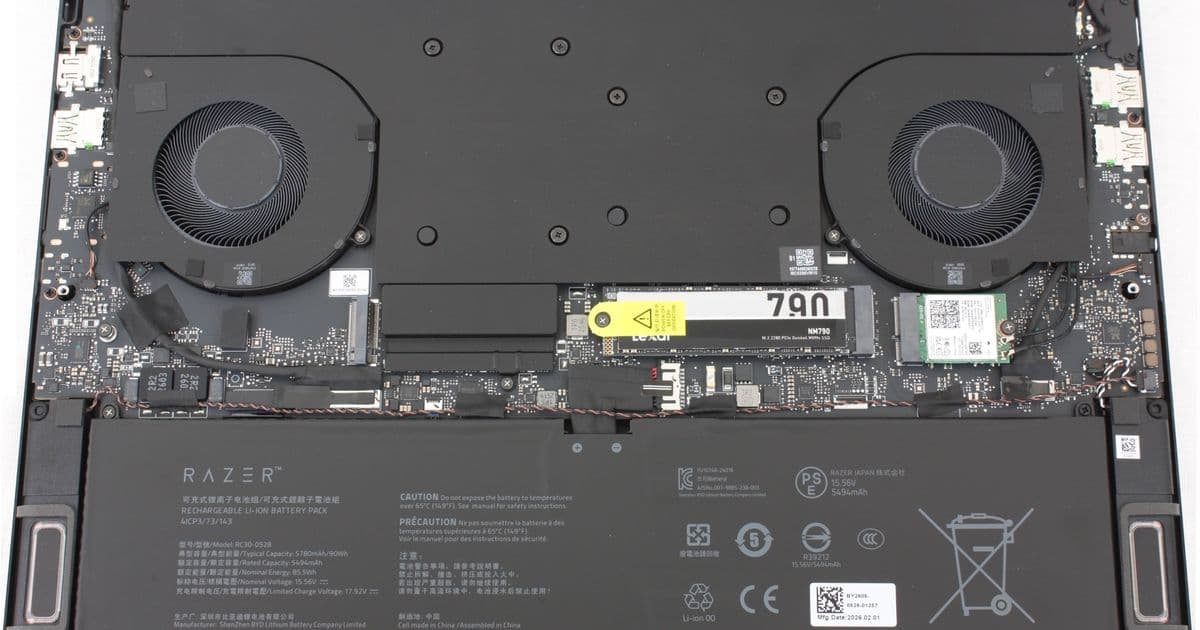
Razer's latest Blade 16 laptop makes a significant switch from AMD to Intel processors, delivering better gaming performance, Thunderbolt connectivity, and a brighter display despite slightly lower multi-threaded CPU benchmarks.
The 2026 Razer Blade 16 represents a strategic shift in the company's flagship laptop lineup, trading last year's AMD Ryzen processor for Intel's latest offering. While maintaining the same external design language that has become synonymous with Razer's premium gaming laptops, the internal changes are substantial and impact both performance and user experience.
What's New in the 2026 Blade 16
The most significant change is the complete transition from AMD to Intel, with the new model featuring the Intel Panther Lake Core Ultra 9 386H CPU replacing the AMD Ryzen AI 9 HX 370 found in the 2025 version. This processor swap brings several immediate benefits:
- Enhanced Connectivity: The USB-C ports now support both Thunderbolt 4 and Thunderbolt 5 standards, a notable improvement over the USB4-only ports on the AMD-based Blade 16. This change future-proofs the laptop for high-speed peripherals and external displays.
- Faster Memory: The 2026 model features faster onboard memory at 9600 MHz, up from 8000 MHz in the previous generation. This improvement contributes to better overall system responsiveness and data transfer speeds.
- Improved Display: The OLED panel has been upgraded from DisplayHDR500 to DisplayHDR1000, delivering significantly brighter visuals and better contrast for both gaming and content creation.
- Slightly Higher Power: The maximum Total Graphics Power (TGP) boost has increased from 160W to 165W, providing a small but consistent performance improvement in demanding gaming scenarios.
- Better Battery Life: The Intel-based Blade 16 offers extended battery longevity compared to its AMD predecessor, a welcome improvement for mobile users.
Performance Comparison: Intel vs AMD
Benchmark testing reveals a nuanced performance picture between the Intel Core Ultra 9 386H and the AMD Ryzen AI 9 HX 370. In traditional multi-threaded workloads, the AMD processor maintains a slight edge, as evidenced by the Cinebench R15 test where the Ryzen AI 9 HX 370 achieved an average score of 3489, compared to the Intel's 2941.
However, the Intel-based Blade 16 excels in gaming scenarios. Our testing across multiple titles and resolutions shows consistent advantages:
- In Assassin's Creed Shadows at 1080p Ultra settings, the Intel model averaged 67 fps versus 64 fps for the AMD version
- At 1440p Ultra, the Intel Blade 16 maintained 56 fps compared to 50 fps from the AMD model
- Most impressively, at 4K Ultra with ray tracing and DLSS enabled, the Intel system delivered 53 fps versus 47 fps from the AMD configuration
The gaming performance advantage becomes even more pronounced when enabling advanced features like Global Illumination, DLSS Quality, and Frame Generation. In Cyberpunk 2077 with these features enabled at 1440p, the Intel model achieved 90 fps compared to 87 fps from the AMD system.
Who Should Choose the 2026 Blade 16
The Intel-based Blade 16 presents a compelling case for several user groups:
- Gamers Seeking Maximum Performance: While the difference may seem modest in percentages, the consistent frame rate improvements across multiple titles and resolutions translate to a smoother, more responsive gaming experience.
- Content Creators Needing Thunderbolt Connectivity: The Thunderbolt 4/5 support provides significant advantages for video editors, 3D artists, and photographers who work with high-speed external storage and multiple monitors.
- Mobile Professionals Valuing Battery Life: The improved battery performance makes this version more suitable for work on the go without constantly searching for an outlet.
- Display Enthusiasts: The jump to DisplayHDR1000 makes this Blade 16 the best option for users who prioritize vibrant colors, deep blacks, and high brightness in their visual experience.
The Trade-Offs
Switching to Intel isn't without compromises. The AMD Ryzen AI 9 HX 370 still holds an advantage in multi-threaded CPU workloads, making it potentially better suited for certain content creation tasks like video rendering, 3D modeling, and scientific computing. The 15% performance gap in Cinebench R15 tests indicates that AMD's architecture still has an edge in pure multi-threaded scenarios.
Additionally, while the Intel model offers better gaming performance, the difference may not be significant enough to justify upgrading for existing AMD Blade 16 owners unless they specifically need the Thunderbolt connectivity or display improvements.
Final Thoughts
The 2026 Razer Blade 16 represents a thoughtful evolution of the product line, with Intel's processor bringing tangible benefits in gaming performance, connectivity, and display quality. While AMD maintains an advantage in multi-threaded CPU tasks, the overall package improvements make the Intel-based Blade 16 a compelling option for its target audience.
For potential buyers, the decision comes down to specific needs. Gamers and mobile professionals will appreciate the Intel model's strengths, while those heavily invested in multi-threaded CPU workloads might still consider the AMD version or wait for future processor generations that may close the performance gap.
The Blade 16 continues to establish itself as a premium option in the high-end gaming laptop market, with this Intel iteration offering a refined experience that builds on the strengths of previous generations while addressing key user feedback.
For more detailed specifications and purchasing options, visit Razer's official Blade 16 page.
Comments
Please log in or register to join the discussion