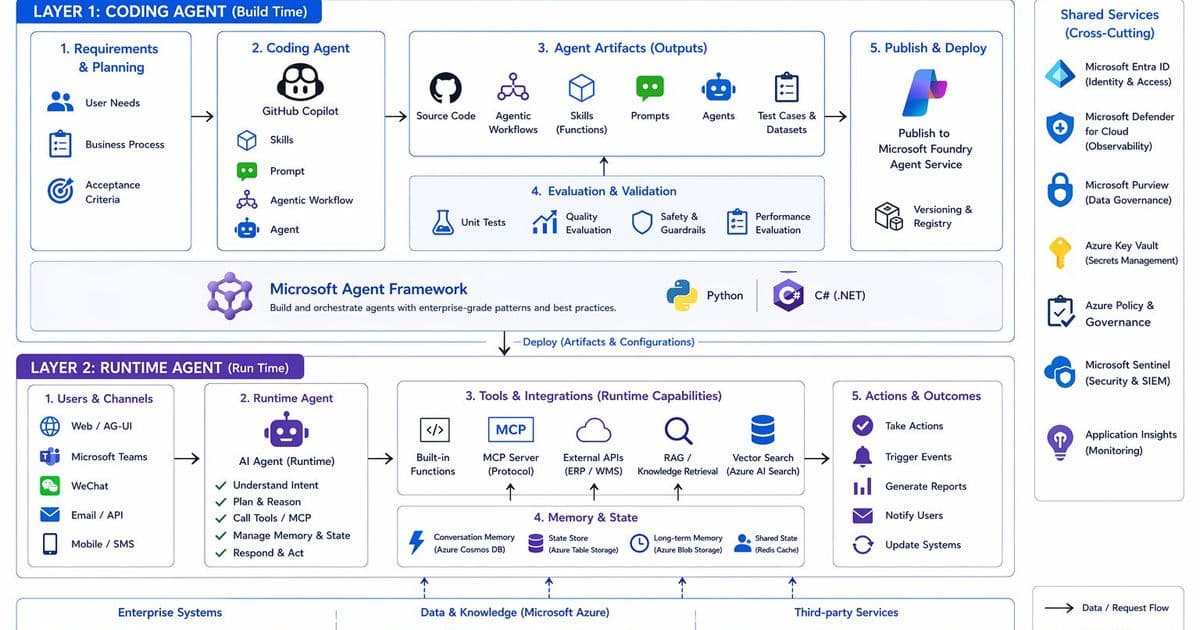
Microsoft introduces a revolutionary two-layer architecture for AI agent development, separating the build-time coding process from runtime operations, with the SKILL framework as the key differentiator for domain-specific agent development.
The single insight that transforms AI agent development from a chaotic process into a structured discipline is the separation of two fundamentally different jobs: building an agent versus running an agent. Most organizations collapse these responsibilities into a tangled mess, resulting in generic solutions that fail to address specific business needs. Microsoft's approach with the Agent Framework and Foundry platform introduces a clean two-layer architecture that fundamentally changes how enterprises develop and deploy AI agents.
What Changed: The Two-Layer Architecture
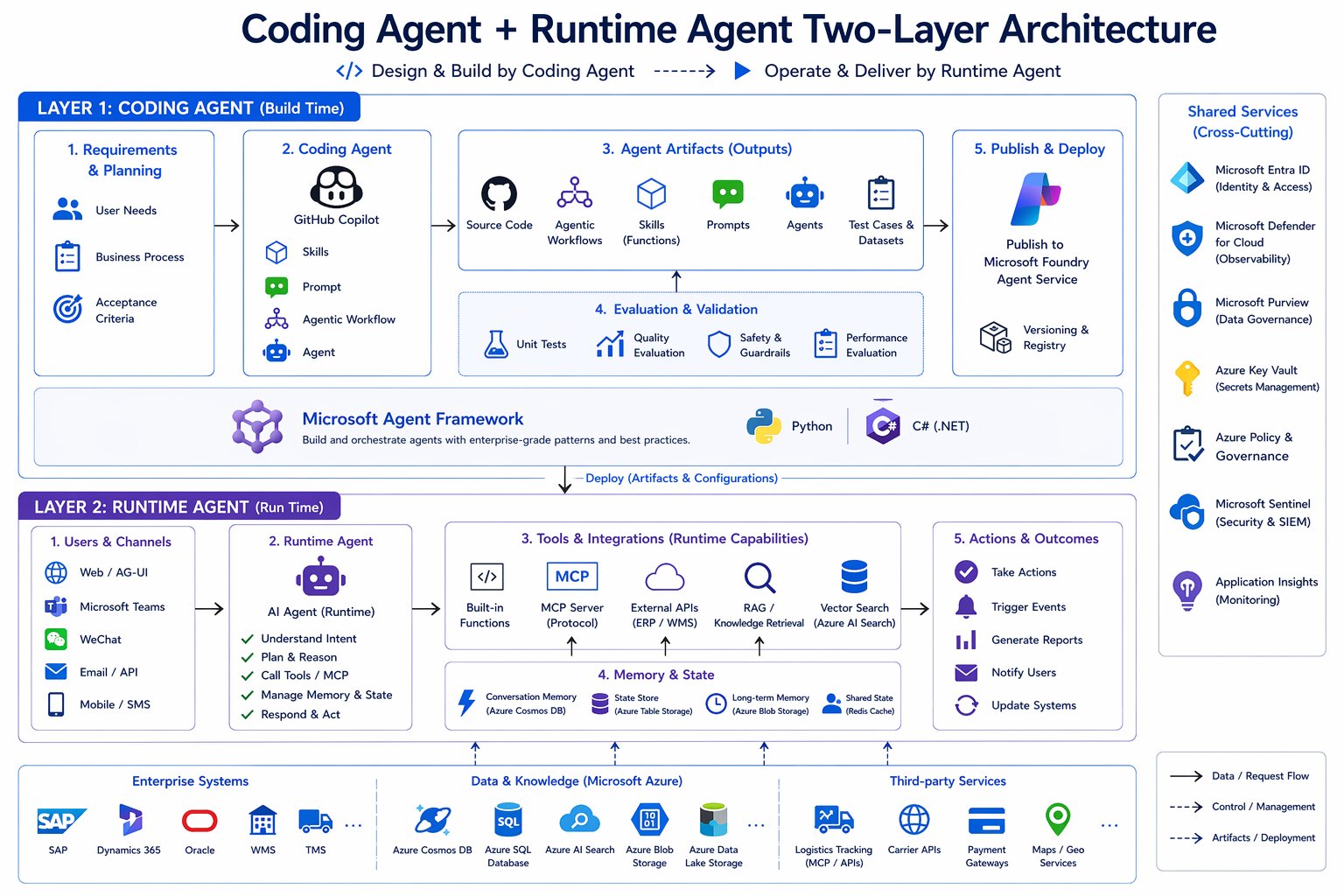
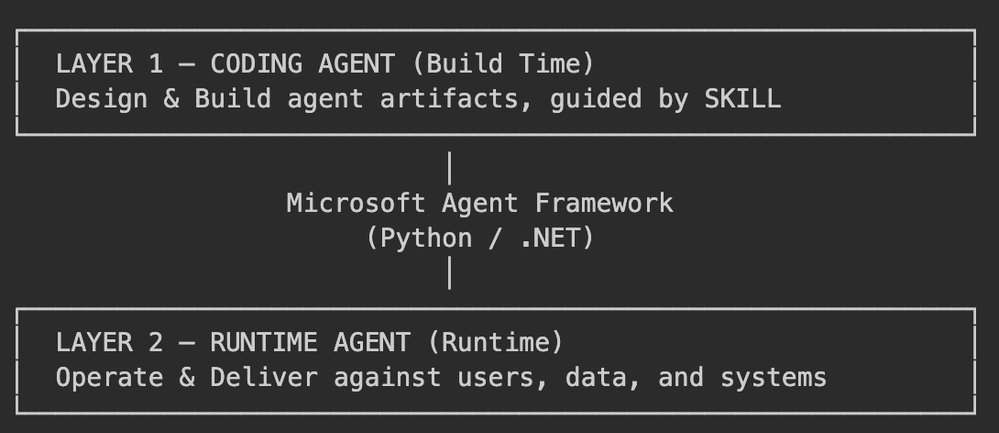
Traditional AI agent development treats the entire process as a single activity, mixing code generation with runtime concerns. Microsoft's approach recognizes these as distinct architectural layers:
- Layer 1: Coding Agent (Build Time) - The agent that constructs the runtime agent
- Layer 2: Runtime Agent (Runtime) - The agent your business operates and interacts with
This separation enables a more professional, scalable approach to agent development. The Microsoft Agent Framework serves as the SDK that ties these layers together, while Microsoft Foundry provides the platform for both layers to publish to and run on.
The Secret Ingredient: SKILL
The key differentiator that transforms a generic Copilot into a domain-aware engineer is the SKILL framework. A SKILL is a structured contract that teaches the Coding Agent how to write code within your specific framework, following your conventions, and addressing your domain requirements.
A well-structured SKILL contains:
- Scope & when to use: Clear guidance on the appropriate use cases
- Framework idioms: Exact patterns for constructing key components
- Code patterns: Reference snippets the Coding Agent can imitate
- Fixture/data contract: How to load and interact with test data
- Anti-patterns: Explicit guidance on what not to do
- Acceptance heuristics: How to map requirements to validation checks
The ZavaShop workshop demonstrates six SKILLs covering three orthogonal capability surfaces for both Python and .NET:
- Single agent development on Foundry
- Multi-agent workflows
- AG-UI server and client implementation
Provider Comparison: Microsoft's Approach vs. Traditional Methods
Traditional AI agent development approaches typically:
- Treat the entire process as a single activity
- Lack structured guidance for domain-specific development
- Produce inconsistent code patterns across projects
- Separate validation from development
- Focus on single-agent solutions without multi-agent orchestration
Microsoft's approach addresses these limitations through:
Structured Build Process
The Coding Agent follows a six-movement process that ensures professional-grade output:
- Requirements & Planning: Establishing business pain points, acceptance criteria, and fixtures
- SKILL Integration: Using domain-specific guidance before writing code
- Code Generation: Translating requirements into properly structured artifacts
- Artifact Production: Generating a complete bundle of deployable components
- Validation: Testing, linting, evaluation, and red-teaming before deployment
- Publish & Deploy: Flowing validated artifacts to Foundry and Azure
This process ensures that what gets built matches the business requirements and follows established patterns.
Runtime Capabilities
The Runtime Agent layer addresses five critical concerns:
- Users & Channels: Deploying through existing channels like Teams, Outlook, or custom interfaces
- Agent Core: The reasoning loop that plans, calls tools, and manages memory
- Tools & Integrations: Four capability types (function tools, MCP tools, Toolbox tools, Agent Skills)
- Memory & State: Thread-level and persistent memory management
- Actions & Outcomes: Taking real actions that change system state
Business Impact and Migration Considerations
Benefits of the Two-Layer Approach
- Consistency Across Projects: SKILLs enforce consistent patterns and conventions
- Domain Specialization: Agents become domain-aware rather than generic
- Validation at Build Time: Catching issues before deployment, not after
- Multi-Agent Orchestration: Building complex workflows that coordinate multiple agents
- Enterprise-Ready Infrastructure: Built on Azure services for security, governance, and observability
Migration Considerations
Organizations looking to adopt this architecture should consider:
Skill Investment: Developing comprehensive SKILLs requires upfront investment but pays dividends across all subsequent agents
Team Structure: Separating build-time and runtime responsibilities may require organizational changes
Tooling Requirements: Teams need access to Visual Studio Code with Agent Mode, Foundry projects, and Azure AI services
Learning Curve: The two-layer approach represents a significant shift from traditional development patterns
Language Choice: Both Python and .NET are first-class citizens, allowing organizations to leverage existing expertise
Practical Implementation
The ZavaShop workshop provides a comprehensive example of implementing this architecture for a fictional global e-commerce company with multiple fulfillment centers, suppliers, and complex operational needs. The workshop demonstrates:
- Inventory management agents
- Procurement agents with approval workflows
- Customer service agents with memory
- Multi-agent fulfillment workflows
- Executive control towers
Getting started involves cloning the ZavaShop workshop repository, setting up the environment, and using the Coding Agent with the mantra: "Read the SKILL first."
Strategic Implications
Microsoft's two-layer architecture represents a maturation of AI agent development from experimental to enterprise-grade. By separating the creation process from runtime operations and providing structured guidance through SKILLs, organizations can build agents that are both technically sound and business-aligned.
The approach addresses the fundamental challenge of scaling AI agent development across an enterprise: how to maintain consistency while allowing for domain specialization. The SKILL framework serves as the bridge between generic AI capabilities and domain-specific solutions, enabling organizations to build agents that their technical leads would have written themselves.
For organizations considering AI agent adoption, this architecture provides a clear path from concept to production, with built-in validation, observability, and governance. The separation of concerns makes it possible to professionalize what has traditionally been an ad-hoc development process, reducing risk while increasing the likelihood of delivering solutions that actually solve business problems.
As AI agents become increasingly critical to business operations, architectures like Microsoft's two-layer approach will likely become the standard for enterprise-grade development. The key insight—that building and running agents are fundamentally different jobs—may seem obvious in retrospect, but it represents a significant shift in how organizations approach AI development.
Comments
Please log in or register to join the discussion